

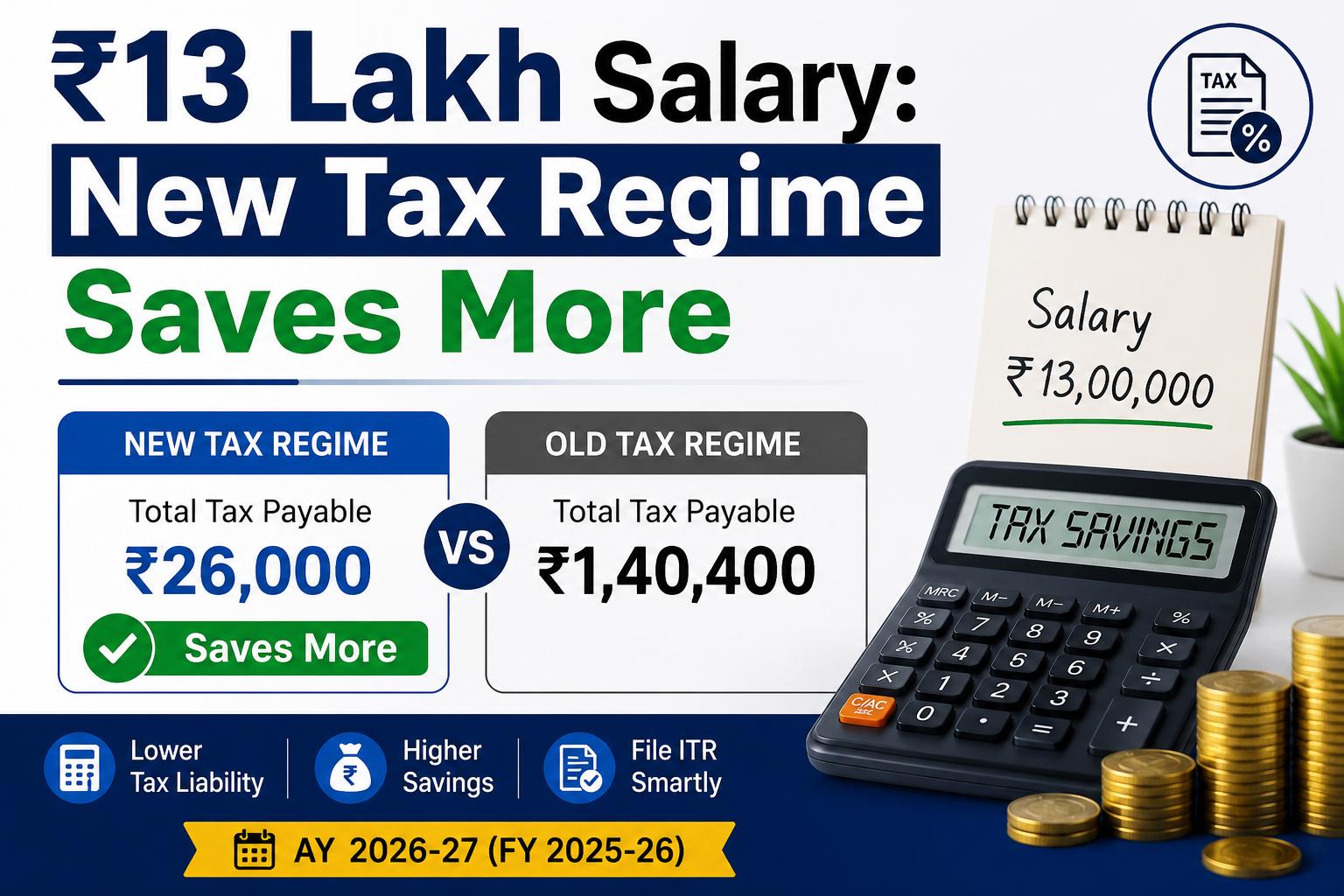
New vs Old Tax Regime for ₹13 Lakh Salary Explained
A salaried person earning ₹13 lakh in FY 2025-26 may pay substantially less tax under the new regime. A corrected comparison for AY 2026-27 shows how the ₹75,000 standard deduction and Section 87A marginal relief change the final liability and regime choice.₹13 Lakh Salary Tax in 2026: Which Regime Is More Beneficial?
A salaried taxpayer earning ₹13 lakh annually may find the new tax regime considerably more beneficial while filing an income tax return for Assessment Year 2026–27. However, the correct comparison must include the different standard deductions available under each regime and the marginal relief provided under Section 87A.
Why the New Regime Wins in This Example
The new tax regime is the default system and offers lower slab rates with limited deductions. For AY 2026–27, income up to ₹4 lakh is taxed at nil, followed by rates of 5%, 10%, and 15% across the next slabs. Salaried taxpayers choosing this regime are entitled to a standard deduction of ₹75,000.
The following example assumes that the taxpayer is a resident individual, has only normal salary income, and does not have capital gains or other income taxed at special rates.
New Tax Regime Calculation
Gross annual salary: ₹13,00,000
Standard deduction: ₹75,000
Taxable income: ₹12,25,000
Tax before marginal relief:
- Up to ₹4,00,000: Nil
- ₹4,00,001 to ₹8,00,000 at 5%: ₹20,000
- ₹8,00,001 to ₹12,00,000 at 10%: ₹40,000
- Remaining ₹25,000 at 15%: ₹3,750
The slab-based tax is therefore ₹63,750.
However, Section 87A provides marginal relief when taxable income exceeds ₹12 lakh by a relatively small amount. Since the taxable income is only ₹25,000 above the ₹12 lakh rebate threshold, the income tax after marginal relief is restricted to ₹25,000.
After adding the 4% health and education cess of ₹1,000, the estimated final tax liability becomes:
Net tax payable under the new regime: ₹26,000
The marginal-relief provision applies to normal slab-rate income. The rebate and related relief may not apply in the same way to capital gains and other income taxed at special rates.
Old Tax Regime Calculation
The old regime permits deductions and exemptions such as Section 80C investments, Section 80D medical insurance, eligible HRA, LTA, and home-loan interest. However, its standard deduction for AY 2026–27 remains ₹50,000, not ₹75,000.
Assume the taxpayer claims:
Gross annual salary: ₹13,00,000
Standard deduction: ₹50,000
Section 80C deduction: ₹1,50,000
Section 80D deduction: ₹25,000
Taxable income: ₹10,75,000
Tax calculation for an individual below 60:
- Up to ₹2,50,000: Nil
- ₹2,50,001 to ₹5,00,000 at 5%: ₹12,500
- ₹5,00,001 to ₹10,00,000 at 20%: ₹1,00,000
- Remaining ₹75,000 at 30%: ₹22,500
Total income tax is ₹1,35,000. After adding 4% cess of ₹5,400, the final amount becomes:
Net tax payable under the old regime: ₹1,40,400
New Regime Saves About ₹1.14 Lakh
Under these assumptions, the new tax regime produces an estimated tax liability of ₹26,000, compared with ₹1,40,400 under the old regime.
The resulting estimated saving is:
₹1,40,400 − ₹26,000 = ₹1,14,400
The old regime may still benefit employees with much larger HRA exemptions, home-loan interest, NPS contributions, and other eligible deductions. Taxpayers should calculate their liability under both systems instead of selecting a regime only on the basis of their salary.
Salaried taxpayers without business or professional income can generally choose between the regimes each year while filing their return. Different switching rules apply to taxpayers earning business or professional income.
Income Tax Day is observed on July 24 to commemorate the introduction of income tax in India by Sir James Wilson in 1860. The occasion also serves as a reminder for taxpayers to verify deductions, report all income correctly, and choose the regime that provides the most lawful tax benefit.