

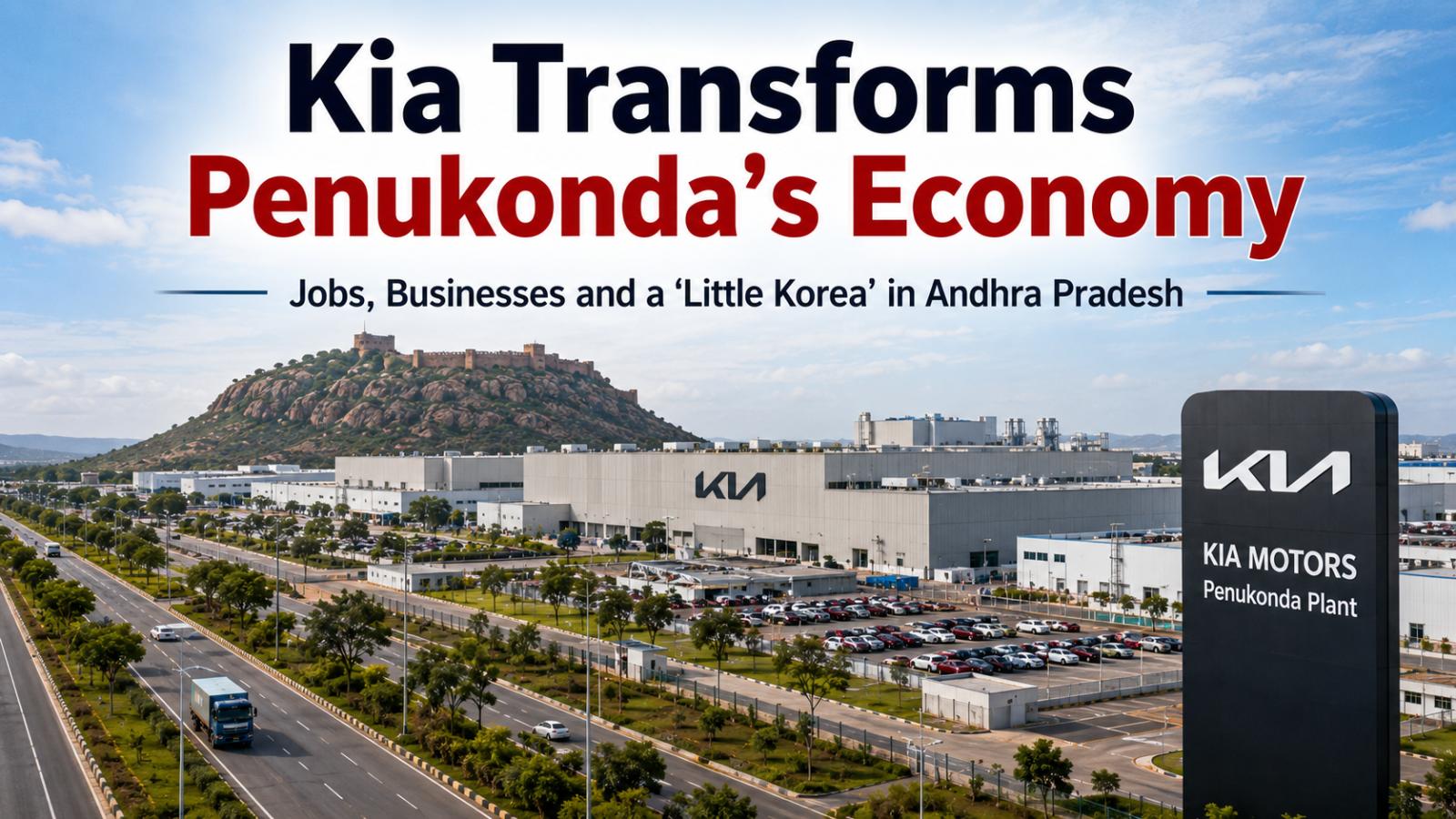
From Historic Fort Town to Automobile and Cultural Hub
Kia’s manufacturing ecosystem has reshaped Penukonda from a historic fort town into a fast-growing industrial and cultural hub. New jobs, supplier units, rental housing, Korean stores, and language training are creating a distinctive ‘Little Korea’ in Andhra Pradesh.
Kia Penukonda Local Economy: How ‘Little Korea’ Took Shape
Penukonda, Andhra Pradesh: The Kia Penukonda local economy has grown into one of Andhra Pradesh’s most distinctive industrial success stories. Once known primarily for its Vijayanagara-era fort and rocky landscape, the historic town is now surrounded by automobile factories, supplier units, worker housing, and businesses serving both Indian and Korean communities.
Kia began mass production at its Andhra Pradesh plant in August 2019. The company lists an annual production capacity of approximately 300,000 vehicles and says the plant and its affiliates support more than 15,000 employees. enukonda Local Economy Expands Around Automobile Cluster
Kia’s arrival attracted a network of specialised component manufacturers producing vehicle interiors, climate-control systems, structural parts, and other automotive equipment. These supplier factories have turned the surrounding industrial park into a major automobile cluster.
A recent ground report estimates that Kia and the wider supplier ecosystem support nearly 20,000 on-site workers. The report also describes more than 800 vehicles leaving the plant on a typical production day for markets across India and overseas. strial expansion has generated demand for transport, warehouses, maintenance services, catering, household supplies, and accommodation. Residents who previously depended on farming, quarry work, or small shops are increasingly becoming vendors, contractors, and rental-property owners.
Housing Demand Creates New Income for Local Families
Housing has emerged as one of the biggest beneficiaries of Penukonda’s industrial growth. Homes and apartment buildings in nearby villages are being converted into accommodation for factory workers, managers and expatriate families.
Some property owners have moved to nearby towns while renting their Penukonda buildings at higher rates. Contractors and developers have also established specialised housing with property managers and Korean-speaking facilitators.
A dedicated Korean residential area, modern apartment complexes and new commercial establishments have gradually changed land use along the highway. Rental housing, restaurants, supermarkets, and transport services now provide a steady income to hundreds of local families.
Telugu and Korean Cultures Meet in Penukonda
The economic transformation has also created a visible cultural shift. Telugu and Korean signs appear together outside shops and residential buildings, while Korean groceries, cosmetics, stationery, and food products have become increasingly available.
Restaurants and food trucks serve both Rayalaseema dishes and Korean meals. Korean supermarkets and beauty stores attract local customers as well as employees connected to the automobile cluster.
This mixture of industrial development and cultural exchange has earned Penukonda the informal description of Andhra Pradesh’s “Little Korea.” The phrase reflects how deeply the South Korean business community has become connected with everyday life in the region.
Language and Technical Skills Open New Careers
Local workers initially needed training in factory discipline, technical communication, and automobile-production standards. Industrial employers, training institutes, and government agencies responded with programmes designed for young people from Penukonda and surrounding areas.
Korean-language certificate courses have also gained popularity among workers seeking better opportunities in supplier companies. Employees who can understand Hangul, technical manuals, or workplace instructions may communicate more effectively with Korean engineers and managers.
These language and technical skills are helping local workers move from entry-level positions into quality control, supervision and specialised manufacturing roles.
Penukonda Could Become a Model for Industrial Townships
Penukonda’s location near National Highway 44 and its access to Bengaluru, Chennai, and other major markets make it suitable for further industrial investment. Government plans for better roads, water facilities, and transport infrastructure could generate additional demand for housing and hospitality.
The transformation demonstrates how a large manufacturing investment can influence employment, skills, property markets, and local culture. However, sustainable growth will depend on reliable water supplies, planned housing, worker welfare, and infrastructure that keeps pace with industrial expansion.
Nearly five centuries after serving as an important Vijayanagara centre, Penukonda is again becoming a meeting point for different languages, industries and communities—this time through automobiles, technology, and growing India–South Korea ties.