

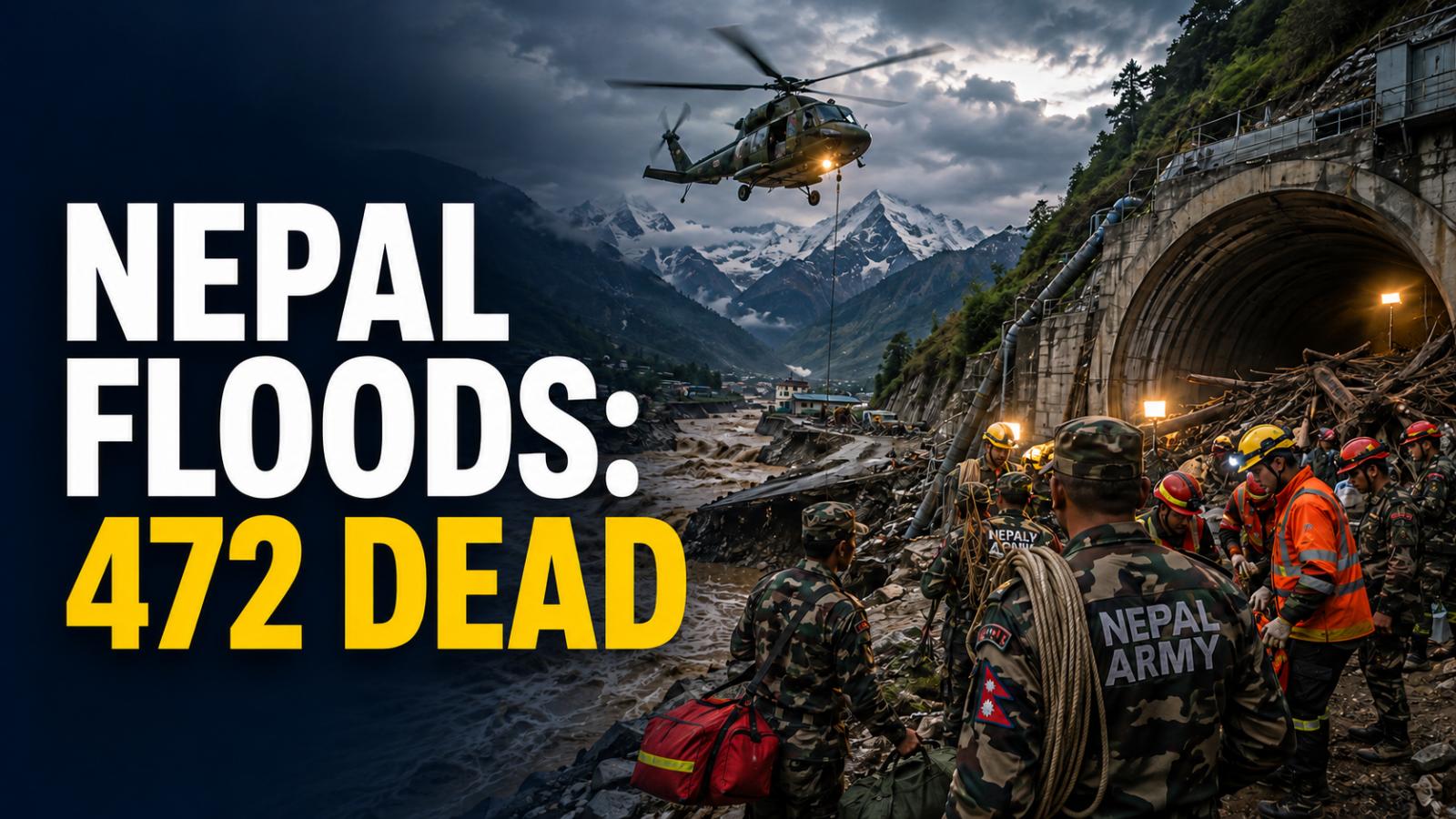
At least 472 people have died across Nepal and Tibet, while an operation is underway to rescue 100 people trapped in a hydropower tunnel.
Death toll rises as search expands downstream
The death toll from the catastrophic Himalayan flash floods has reached at least 472 across Nepal and China’s Tibet region, with 469 deaths confirmed in Nepal and three in Tibet.
Nepalese authorities reported that 977 people remained missing in the country. China separately reported hundreds unaccounted for in Tibet, meaning the combined number of missing people across the border region was significantly higher.
Among those missing in Nepal were members of the Nepal Police, Nepal Army, Armed Police Force and Customs Department. The list also included foreign tourists, pilgrims and Nepali citizens living abroad.
Bodies swept away by the Bhote Koshi and Trishuli rivers have been recovered far downstream from the original disaster zone. Recovery operations have extended from Rasuwa and Nuwakot to Chitwan, Tanahun, Gorkha and other districts.
Seven bodies believed to have been carried across the border were also recovered from rivers in Uttar Pradesh, India. Authorities were working to establish their identities, and those recoveries had not initially been added to the reported toll.
The scale of the recovery operation has placed pressure on hospitals and morgues. Temporary facilities are being prepared to preserve unidentified bodies while officials collect photographs, fingerprints, post-mortem information and DNA samples.
Tunnel rescue targets 100 trapped people
The Nepal Army has launched an operation to reach approximately 100 people trapped inside a tunnel at the Trishuli 3A hydropower project.
Army helicopters have been deployed, but thick mud, damaged access routes and unstable terrain have made it difficult for teams to locate and reach the tunnel entrance.
Nepal Army spokesperson Raja Ram Basnet said the immediate priority was to find and rescue those still trapped. Approximately 350 workers and local residents had already been evacuated from the affected hydropower area.
The condition of those remaining inside the tunnel was not immediately clear. Rescue teams must determine whether the tunnel has safe air pockets, accessible exits or sections blocked by flood debris.
Hydropower facilities along the river corridor suffered extensive damage when the flood carried rock, ice, mud and water through the valleys. Roads and bridges linking project sites to nearby towns were also destroyed or buried.
The operation remains highly dangerous because river levels can rise rapidly and unstable debris barriers upstream could release another surge without much warning.
Rescue force grows amid foreign-national searches
Nepal has mobilised 13,295 personnel from the Nepal Police, Nepal Army and Armed Police Force for search, rescue and relief work.
Fifteen helicopters were operating across affected areas, while nearly 2,000 people had been airlifted from locations cut off by destroyed roads and bridges. An Emergency Control Room was established to coordinate information and assistance for foreign nationals.
Prime Minister Balen Shah said the government was using its full capacity to locate missing people, treat the injured and deliver relief to survivors.
India’s Ministry of External Affairs said 84 Indian nationals had been rescued, including 63 workers from the Trishuli-I project and 21 Tamil Nadu residents returning from the Kailash Mansarovar Yatra.
The Indian Embassy in Kathmandu also issued emergency telephone and WhatsApp numbers for citizens seeking assistance. Hundreds of foreign nationals, including pilgrims and tourists from India, the United States, Britain, Australia and Canada, remained unaccounted for.
Nepal declined offers of foreign search-and-rescue teams at this stage, saying its security agencies could manage field operations. However, Kathmandu continued to accept financial, material and logistical assistance from international partners.
Flood warnings disrupt ongoing operations
Fresh flood warnings have complicated rescue efforts after a barrier lake formed by landslide and glacial debris began overflowing near the Nepal-Tibet border.
Residents, security personnel and rescue workers in vulnerable locations were told to move to higher ground. Nepal temporarily suspended some operations as officials monitored rising water levels.
China also withdrew rescuers and vehicles from threatened areas in Tibet. Engineering teams used aerial surveys and three-dimensional modelling to assess the expanding lake and the possibility of a sudden breach.
The original disaster was triggered when a glacier-linked collapse sent a huge mass of rock, ice, mud and water into Himalayan river systems on Wednesday. Entire communities, border facilities, roads, bridges and power projects were devastated.
Continued rainfall, unstable slopes and debris-blocked rivers mean affected areas face the danger of secondary floods, landslides and avalanches. Rescue operations will continue only when authorities determine that teams can safely return to riverbanks and low-lying zones.