
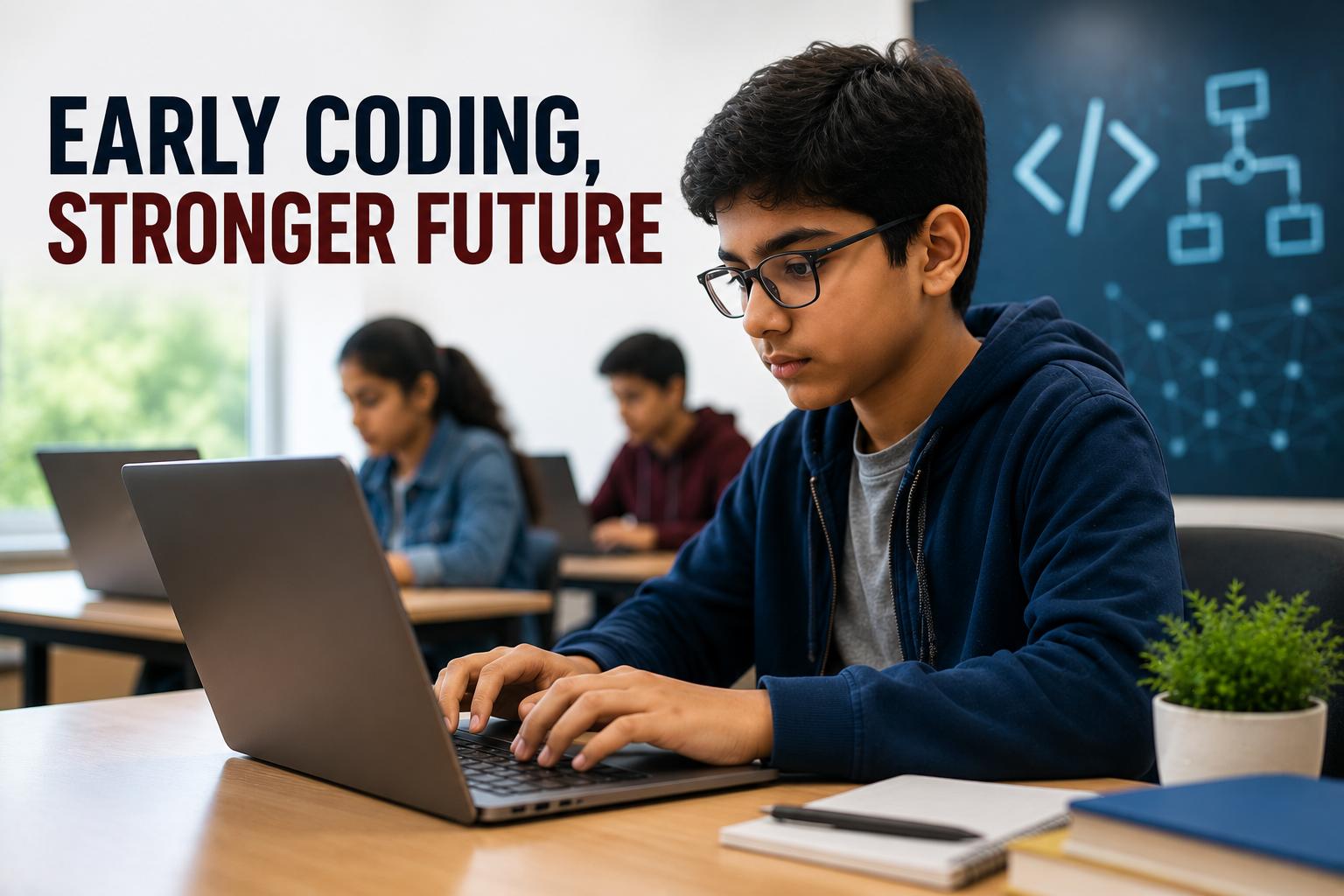
Introducing competitive programming earlier in Indian education could help students develop stronger logical reasoning, computational thinking and algorithmic problem-solving skills instead of encountering structured programming challenges only at college level.
Building Problem-Solving Skills from School
Competitive programming asks students to solve mathematical and logical problems by designing efficient algorithms and implementing them through code. Unlike simply learning the syntax of a programming language, it encourages learners to analyse a problem, break it into smaller parts, select an appropriate approach and test whether their solution works efficiently. These activities can strengthen logical thinking, accuracy and persistence. Competitive programming commonly involves areas such as algorithms, data structures, combinatorics, graphs and number theory, making it a structured way to develop computational reasoning.
Why an Early Start Matters for Indian Students
A major challenge in India is that many students discover competitive programming only after entering engineering colleges, sometimes when they begin preparing for internships or placements. Starting at that stage leaves comparatively less time to build deep algorithmic skills through regular practice. Introducing age-appropriate programming challenges during school could instead allow students to progress gradually from basic logic and coding to more sophisticated algorithms. Earlier exposure can also make programming a problem-solving activity rather than something students associate only with examinations or employment.
Programming Competitions Can Create a Stronger Learning Culture
International competitions already demonstrate that competitive programming is relevant well before university. The International Olympiad in Informatics is designed for secondary-school students and tests their ability to solve challenging algorithmic problems through programming. India has also seen initiatives aimed at encouraging school students to participate in coding contests and develop problem-analysis, algorithm-design and testing abilities. A stronger school-level ecosystem involving teachers, coding clubs, contests and structured practice could give interested students a clearer pathway to such competitions.
Competitive Programming Should Complement Broader Computer Education
The aim, however, should not be to turn every child into a competitive coder. Programming contests primarily develop algorithmic reasoning and fast problem-solving, while professional software development also requires skills such as collaboration, software design, documentation, testing and building large real-world systems. Therefore, competitive programming can work best as one component of a broader computer science curriculum. Introduced gradually and without excessive pressure, it could help Indian students become more confident problem-solvers while creating a stronger foundation for advanced computing, engineering and technology education.