

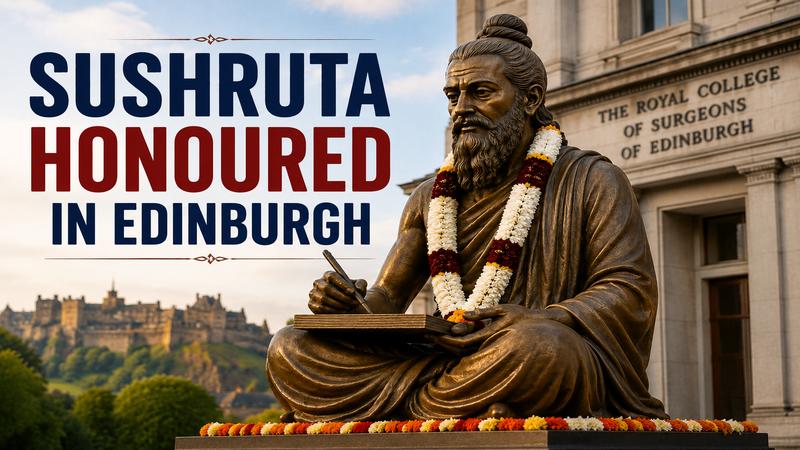
Sushruta Statue Unveiled In Edinburgh Honours Ancient Indian Surgeon
Date: June 23, 2026
The Royal College of Surgeons of Edinburgh in Scotland has unveiled a bronze statue of Sushruta on June 23, 2026, honouring the ancient Indian physician widely remembered for his pioneering role in surgery and medical learning.
The honour also highlights how ancient Indian medical knowledge continues to find recognition in global academic and scientific institutions. The development has renewed attention on the Sushruta Samhita, one of the most important medical texts from ancient India.
Ancient Indian Medical Legacy Gets Global Recognition
Sushruta is widely associated with the early development of plastic surgery and surgical practice. His work is considered significant because it recorded medical knowledge in a structured and detailed manner at a time when formal medical systems were still evolving in many parts of the world.
The statue in Edinburgh reflects the growing international recognition of Sushruta’s contribution to the history of surgery. Earlier, the Royal Australasian College of Surgeons in Melbourne had also honoured him with a statue, showing that his medical legacy continues to be acknowledged beyond India.
Why The Sushruta Samhita Remains Important
The Sushruta Samhita is known for documenting a wide range of medical knowledge, including illnesses, medicines, surgical procedures, instruments, and treatment methods. The text also discusses areas such as medicine, paediatrics, toxicology, eye and ear-related conditions, and care for elderly patients.
One of the most important aspects of the text is its focus on surgical training. It suggests that ancient Indian medical education included both theoretical knowledge and practical learning, making it an important reference point for historians and medical researchers.
Sushruta’s Contribution To Surgery
Sushruta’s work described several surgical methods, including incision, excision, puncturing, extraction, drainage, and suturing. These classifications show that surgery was studied in an organised manner in ancient India.
The text also discussed health conditions linked to lifestyle, including symptoms resembling diabetes, obesity, and heart-related disorders. Sushruta’s emphasis on physical activity and disciplined living continues to attract interest among researchers studying traditional knowledge systems.
Recognition Beyond India
The unveiling of Sushruta’s statue in Edinburgh is more than a symbolic tribute. It shows how India’s ancient knowledge systems are being revisited and studied in a wider global context.
At a time when several Indian institutions are examining traditional knowledge through modern research methods, the recognition of Sushruta offers a timely reminder of India’s long history in medical thought and surgical practice.
The statue does not settle every debate around ancient medical history, science, or tradition. However, it clearly signals that Sushruta’s contribution to early surgical knowledge continues to be recognised far beyond India’s borders.