Plot
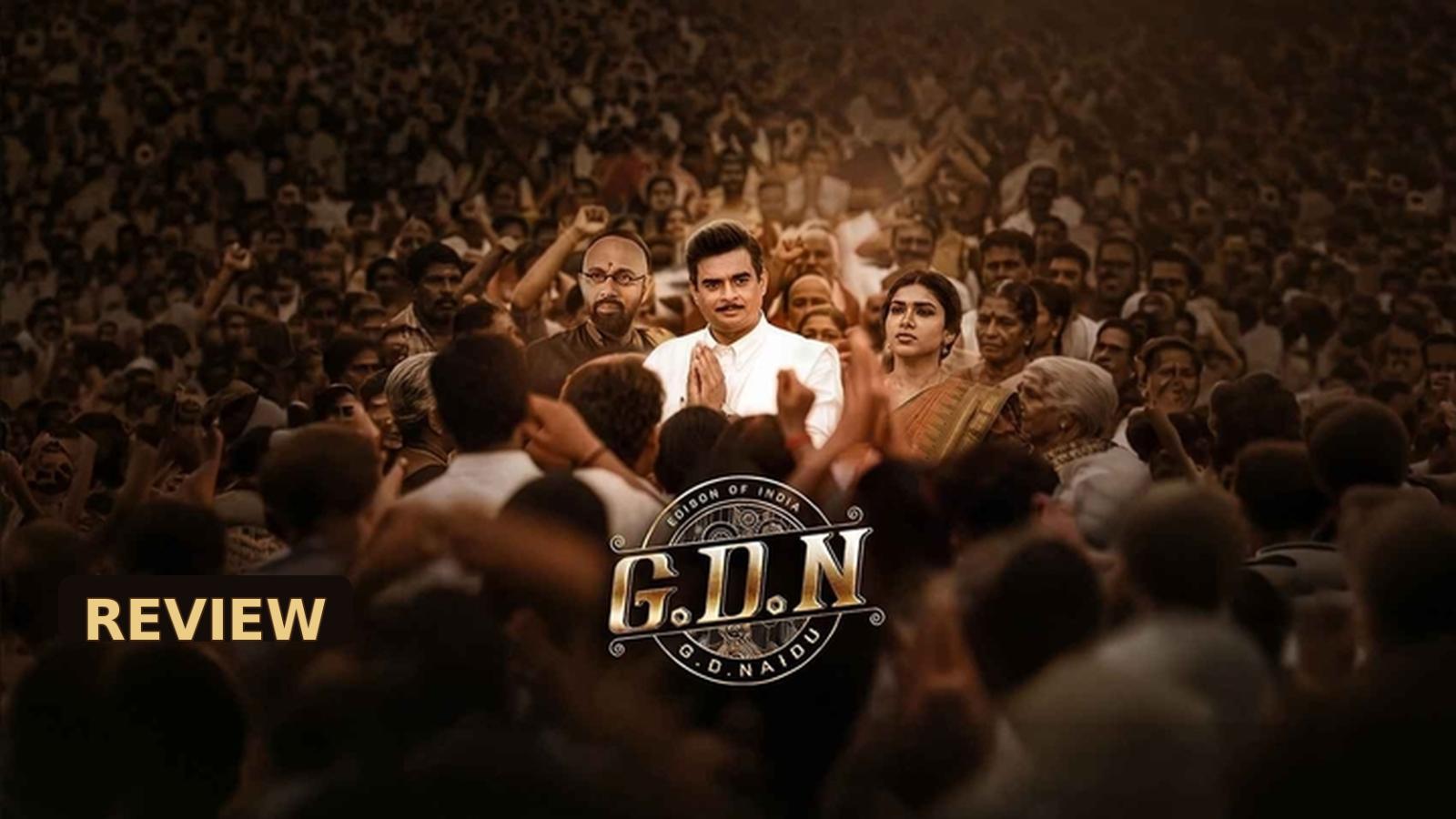
G.D.N. follows the life of Gopalaswamy Duraiswamy Naidu, widely known as GD Naidu, the celebrated inventor and industrialist from Coimbatore. The film opens with a debate over whether a man once branded a lunatic, terrorist and tax dodger deserves a place in school history. It then moves back to the early 1910s, tracing Naidu’s growing fascination with machines after seeing Robert Stanes’ motorcycle. From dismantling that motorcycle to understand its mechanics to building electric motors, expanding a major bus business and experimenting across engineering, agriculture and automobiles, Naidu’s journey grows rapidly. At the same time, he faces resistance from rivals, government authorities and the Income Tax department.
Overview
Directed by Krishnakumar Ramakumar and co-written with Madhavan, G.D.N. is an ambitious biographical drama that attempts to capture the extraordinary scale of GD Naidu’s achievements. The film is visually polished and packed with historical incidents, inventions and personalities. However, its biggest weakness is that it often presents Naidu’s life as a sequence of milestones rather than as an emotionally absorbing journey.
Performances
R Madhavan anchors the film with a committed performance as GD Naidu. His physical transformation across different periods is convincing, and he effectively portrays Naidu’s confidence, curiosity and restless drive. Some expressions occasionally feel exaggerated, but his performance remains the film’s strongest element. Sathyaraj brings authority and warmth as Ramaiah Pillai, while Jayaram is effective as Income Tax officer Ambalapara Krishnan. Dushara Vijayan adds energy as Ranganayaki and shares solid screen presence with Madhavan. Vinay Rai, Karunakaran, Priyamani and the rest of the ensemble offer dependable support, though several characters suffer from limited development.
Technical Aspects
Krishnakumar Ramakumar deserves credit for mounting GD Naidu’s expansive life on a large canvas. The production design, period settings and recreation of inventions add scale and authenticity. However, the screenplay moves too quickly between major events. Setbacks are sometimes followed immediately by successes, leaving little room for dramatic build-up. Historical personalities and international encounters create curiosity but often appear only briefly. Some archival-style sequences and AI-generated imagery also feel inconsistent with the otherwise polished visual presentation.
Music
The music supports the narrative but rarely stands out independently. The background score attempts to add grandeur to Naidu’s inventions, confrontations and emotional moments. It works in selected scenes, but it cannot fully compensate for the screenplay’s emotional distance.
Editing
At around two hours and 27 minutes, the film is lengthy yet still feels rushed because it tries to cover too much. The editing frequently jumps between inventions, relationships, business expansion and legal conflicts. A tighter narrative built around fewer defining chapters could have delivered a more powerful and emotionally coherent biopic.
Positives
Madhavan’s performance, impressive transformation, fascinating subject, Sathyaraj and Jayaram, Dushara Vijayan, historical episodes, strong production scale.
Negatives
Emotionally distant screenplay, rushed milestones, underdeveloped characters, uneven pacing, convenient resolutions, inconsistent period recreation, distracting AI visuals.
Analysis
GD Naidu’s life naturally offers the ingredients for a compelling biographical drama. His curiosity, inventions, entrepreneurial instinct and clashes with authority make him an ideal cinematic subject. G.D.N. succeeds in showing audiences how broad his achievements were, from transportation and electrical engineering to agriculture and mechanical experimentation.
The problem is that the film rarely stays with a major event long enough to make audiences feel its emotional weight. Important victories, failures and relationships are presented almost like entries on a timeline. Naidu’s personal equations with Chellamma and Ranganayaki are especially underexplored, while the Income Tax conflict receives considerable screen time without giving all the opposing characters enough complexity.
The auction sequence could have been one of the most powerful moments in the film, but its convenient resolution weakens the impact. Similarly, appearances by historical figures and international encounters are interesting but brief.
Madhavan’s performance ultimately keeps the film watchable. He communicates Naidu’s intelligence, ambition and stubborn determination with conviction. As a result, G.D.N. works better as an informative introduction to an extraordinary Indian innovator than as a deeply moving biographical drama.
Bottom Line: Glossy Biography
Rating: 2.5/5