

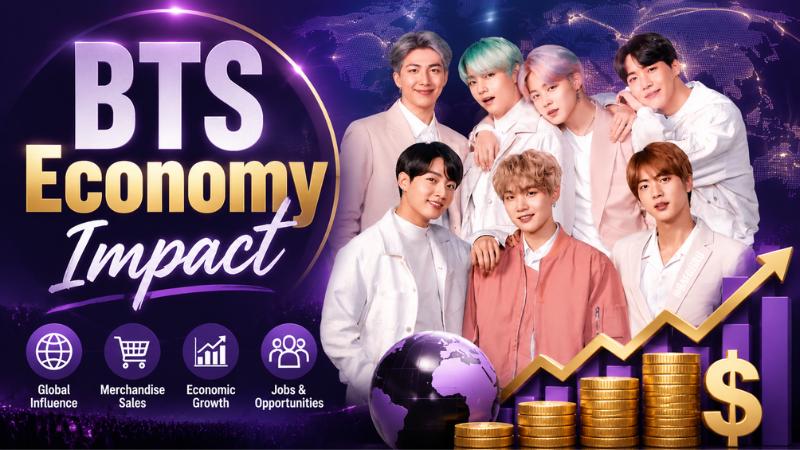
BTS Economy Impact: How A Small K-Pop Label Built A $50 Billion Cultural Force
BTS is not just one of the world’s biggest music groups. The seven-member South Korean boy band has also become a major cultural and economic force for South Korea, with estimates suggesting that the group’s overall contribution to the country’s economy over its first decade may be worth tens of billions of dollars.
The story is even more striking because BTS did not come from one of South Korea’s biggest entertainment companies. The group was formed under Big Hit Entertainment, a small label founded by Bang Si-hyuk in 2005. Before BTS became a global name, the company had struggled financially and was far from the powerful entertainment giant it is known as today.
From A Struggling Label To A Global Brand
Big Hit Entertainment was once a small company trying to survive in South Korea’s competitive music industry. According to the source material, the label had faced serious financial pressure in its early years and depended on limited resources, staff commitment, and long-term belief in its future.
The turning point came when Bang Si-hyuk decided to invest in a hip-hop-oriented idol group built around Kim Namjoon, who later became RM, the leader of BTS. The group officially debuted on June 13, 2013. At the time, few could have predicted that BTS would become one of the most successful music acts in the world.
BTS And South Korea’s Economic Growth
BTS’s economic value goes beyond album sales, concerts, and merchandise. Various estimates have linked the group’s influence to tourism, Korean consumer goods, language learning, global interest in Korean culture, and the wider growth of K-pop.
A widely cited Hyundai Research Institute estimate placed BTS’s annual economic impact on South Korea at around $4.65 billion, roughly 0.3 percent of the country’s GDP. This made the group’s economic contribution comparable to a major Korean company such as Korean Air, though still far below industrial giants like Samsung and Hyundai.
The group’s influence also helped boost South Korea’s cultural exports. Fans travelling to Korea, buying Korean products, learning the language, and consuming Korean entertainment all became part of what many call the “BTS effect.”
Global Breakthrough Changed Everything
BTS’s international rise accelerated after 2017, when the group gained major recognition in the United States. Their strong online fandom, known as ARMY, helped push the group into global pop culture at a scale rarely seen for a non-English-speaking act.
The group later achieved several major milestones, including topping the Billboard Hot 100 with “Dynamite” in 2020. BTS became the first all-South Korean act to reach No. 1 on the Billboard Hot 100, marking a historic moment for K-pop and Asian music globally.
Their success was not limited to one song. BTS also achieved strong album sales, stadium tours, streaming records and brand partnerships, turning the group into one of South Korea’s most visible cultural exports.
HYBE’s Rise From Big Hit’s Success
The success of BTS transformed Big Hit Entertainment into HYBE Corporation. Big Hit went public on the Korean stock exchange in 2020 and later changed its name to HYBE as part of a broader expansion plan. Pitchfork reported that the company founded by Bang Si-hyuk in 2005 had become one of South Korea’s most powerful entertainment players due to the success of BTS.
HYBE then expanded into a multi-label entertainment company. It became home to several major acts and also strengthened its global presence through acquisitions. In 2021, HYBE announced a $1.05 billion deal to acquire Ithaca Holdings, bringing major global names including Justin Bieber and Ariana Grande under its wider business network.
This growth shows how BTS’s success did not only benefit the group. It changed the direction of an entire entertainment company and helped reshape how the global music industry viewed K-pop.
Military Service And The Comeback Question
BTS members paused group activities as they completed South Korea’s mandatory military service. Reuters reported that Suga became the seventh and final member to complete service in June 2025, raising expectations around the group’s future comeback.
The group’s return has been closely watched by fans, investors, and the entertainment industry. HYBE’s stock movements and market expectations show how strongly BTS is connected not only to pop culture but also to business confidence around K-pop.
Why The BTS Effect Still Matters
The most important part of the BTS story is not just the money. It is the way one music group helped South Korea strengthen its soft power across the world. BTS made Korean music, language, fashion, food, tourism, and entertainment more visible to global audiences.
Their rise also proved that a group from a smaller company could compete with the biggest names in global pop. From a financially struggling label to a multibillion-dollar entertainment corporation, the BTS journey has become one of the most powerful examples of modern cultural growth.
As BTS moves into its second decade, the big question is whether the group can repeat the scale of its first global run. Even if the numbers change, their impact on South Korea’s economy, K-pop and global entertainment is already historic.