
3I/ATLAS Comet Older Than Sun, Webb Study Finds
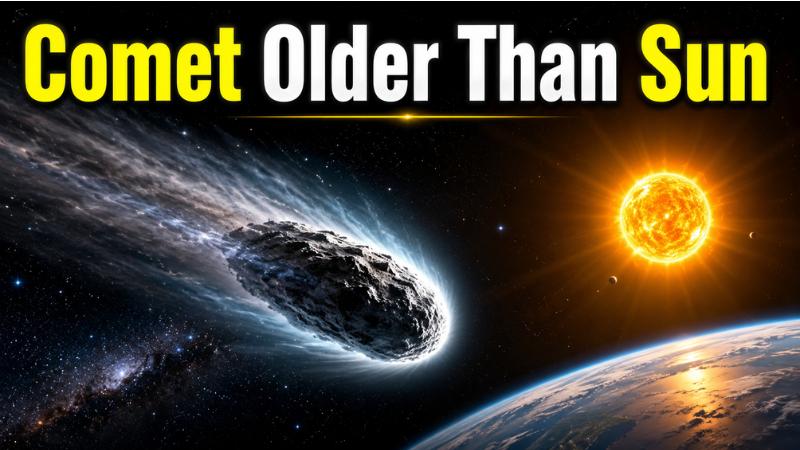
June 23, 2026: Interstellar comet 3I/ATLAS, the third known object to enter the Solar System from beyond our cosmic neighbourhood, has given scientists a rare look at material that may be older than the Sun itself.
Using the James Webb Space Telescope, astronomers studied the comet after it passed around the Sun in late 2025. As the object warmed, frozen material on its surface turned into gas and dust, creating a bright coma around the comet. This allowed scientists to study its chemical composition in detail.
Researchers now estimate that 3I/ATLAS may have formed around 10 to 12 billion years ago. That makes it far older than the Sun, which formed about 4.5 billion years ago. The finding has made the comet one of the most important interstellar visitors ever observed.
Why 3I/ATLAS Is Important
3I/ATLAS did not originate in our Solar System. Its path shows that it came from interstellar space and was only passing through before heading back into deep space. Such objects are extremely rare, and only a few have been confirmed so far.
The comet’s journey gave scientists a short but valuable chance to study material from another star system. Unlike ordinary comets formed around the Sun, 3I/ATLAS carries chemical clues from a much older and colder region of space.
Webb Finds Unusual Chemical Clues
The James Webb Space Telescope used its powerful instruments to detect chemical signatures around the comet. Scientists found water, carbon dioxide, and carbon monoxide, along with unusual isotope patterns.
One of the biggest findings was the presence of very high levels of deuterium, also known as heavy hydrogen. The amount was far higher than what is normally seen in comets from our Solar System.
This suggests that 3I/ATLAS formed in an extremely cold environment, where ice remained frozen and largely unchanged for billions of years. Scientists believe the comet may have come from a dense, frozen cloud around an ancient star system.
A Window Into The Early Galaxy
Researchers also found unusual carbon isotope levels in the comet. The lower presence of carbon-13 compared with carbon-12 points to an ancient origin, because younger star systems usually contain more carbon-13 after many generations of stars have formed and died.
These chemical fingerprints suggest that 3I/ATLAS may have formed during a major period of star formation in the universe, often called “cosmic noon.” This was a time when galaxies were producing stars at a much higher rate than they do today.
What Scientists Can Learn
The discovery helps astronomers understand how planets, comets, and icy bodies may have formed around stars long before the Solar System existed. It also gives researchers a chance to compare our own Solar System with older planetary systems elsewhere in the galaxy.
Scientists say the comet’s chemistry may also help answer a larger question: how common are the ingredients for life beyond Earth? While the comet does not show evidence of life, its ancient material contains clues about the kinds of chemical environments that existed in other star systems.
A Rare Visitor That Will Not Return
3I/ATLAS is not a threat to Earth. It passed through the Solar System at a safe distance and is now moving away. Once it leaves, it is not expected to return.
For astronomers, the comet’s brief visit was a major scientific opportunity. Its age, unusual chemistry, and interstellar origin make it a natural time capsule from a period long before the Sun and planets were born.