
Farmer Shortage May Become New Threat To Future Food Security
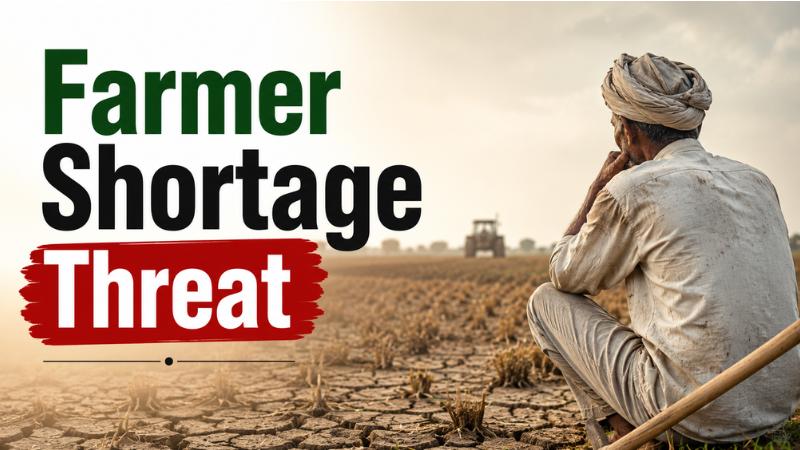
Food security is often linked to farmland, rainfall, climate change, and crop production. But a new study suggests that another major risk is quietly growing: the world may not have enough people to farm the land.
Researchers say the availability of agricultural workers could become a key factor in future food supplies. Even if suitable farmland exists, food production may suffer if there are too few farmers and farm workers to cultivate it.
Study Highlights Hidden Food Security Risk
The research was led by Professor Hyungjun Kim at the KAIST KI Institute for Climate, Environment, and Energy, along with researchers from the University of Tokyo.
The study looked at how a shrinking agricultural workforce could affect the future use of cropland. Researchers used future social and climate scenarios to understand how population changes, economic growth, climate conditions, and labour availability may influence food production.
Their findings show that agricultural workforce shortages could reduce the amount of farmland that can actually be used in many parts of the world.
Farmland Alone May Not Be Enough
Food security discussions usually focus on whether the world has enough land to grow crops. However, this study adds a new warning: land cannot produce food by itself.
If rural populations continue to fall and younger generations move away from farming, some agricultural land may remain underused. In some regions, a shortage of farm workers could become a bigger limitation than climate or soil conditions.
This means countries may need to look beyond irrigation, seeds, and machinery when planning future food systems. They may also need policies that support farming communities and make agricultural work more sustainable and attractive.
Rural Depopulation Adds Pressure
Falling birth rates and migration from villages to cities are already changing rural life in many countries. As economies grow, younger workers often shift to urban jobs in industries, services, and technology.
This trend may reduce the number of people available for agriculture. Over time, the decline in farming populations could affect crop production, especially in regions where agriculture still depends heavily on human labour.
The study suggests that future food planning should include demographic changes along with climate and land-use projections.
Technology May Not Fully Solve The Problem
Modern agriculture is becoming more advanced. Tractors, drones, automation, artificial intelligence, and precision farming tools can help farmers manage larger areas with fewer workers.
But researchers warn that technology alone may not solve the labour shortage problem. Many farming systems still require skilled workers for planting, monitoring, harvesting, and managing local conditions.
If the farming workforce continues to shrink faster than technology can replace it, productivity gains may not be enough to protect food supplies.
Migration Policies Could Shape Food Supply
The study also points to the role of migration in agriculture. In many developed countries, migrant workers play an important role in farm labour.
Restrictions on international migration could worsen labour shortages in countries where the rural workforce is already shrinking. At the same time, some lower-income countries may continue to have a larger share of agricultural workers.
This shows that food security is not only an environmental or economic issue. It is also connected to population movement, labour policy, and rural development.
Future Food Planning Needs A Wider View
Climate change, droughts, floods, and heat waves remain major threats to global agriculture. But this study shows that human factors may be just as important.
A country may have suitable land, better seeds, and improved technology, but food production can still face pressure if there are not enough people to work in agriculture.
The warning is clear: the future of food may depend not only on how much farmland is available, but also on whether enough farmers remain willing and able to cultivate it.
For governments and food planners, the study adds a new priority. Protecting future food security may require stronger rural economies, better support for farmers, smarter migration policies and new ways to attract younger workers into agriculture.