
Court Ruling Ends a Long-Running Legal Chapter
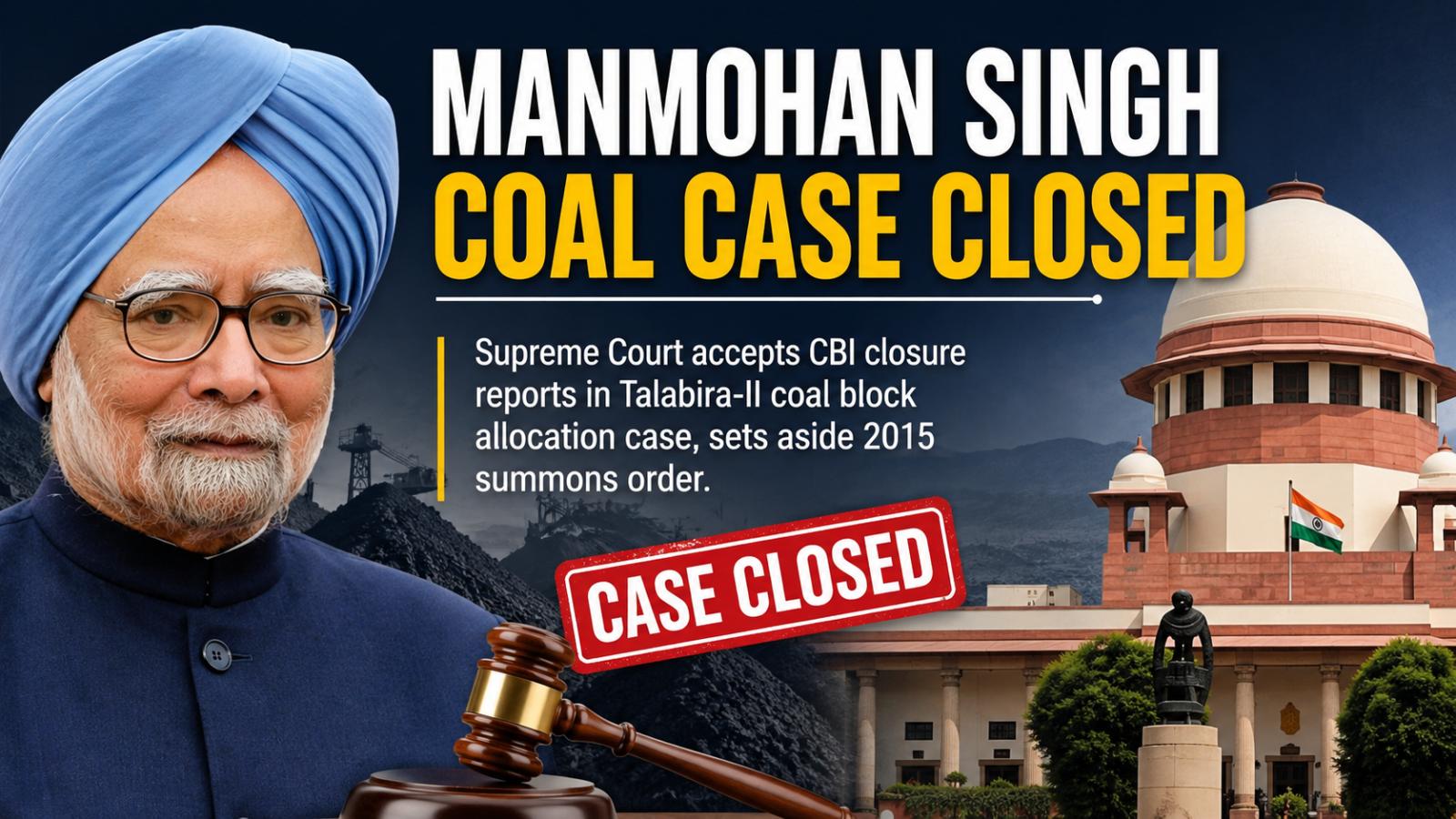
The Supreme Court has accepted the CBI’s closure reports in the Talabira-II coal allocation case and set aside the 2015 summons against former Prime Minister Manmohan Singh. The ruling closes a legal chapter that influenced public debate over his leadership and legacy.
Supreme Court Closes Manmohan Singh Coal Block Case
The Manmohan Singh coal block case has been formally closed after the Supreme Court accepted closure reports filed by the Central Bureau of Investigation. The court also set aside the 2015 order that had summoned the former Prime Minister as an accused.
The ruling, delivered on Wednesday, July 29, 2026, concerned the allocation of the Talabira-II coal block in Odisha. The case had remained pending for more than a decade and had become closely connected with the wider political debate surrounding coal block allocations during the second United Progressive Alliance government.
Why the Manmohan Singh Coal Block Case Was Closed
A Supreme Court bench headed by Chief Justice Surya Kant examined two closure reports submitted by the CBI. The bench concluded that there was no adequate reason for the special CBI court to reject the investigating agency’s findings and initiate criminal proceedings.
The Supreme Court consequently allowed the appeal, set aside the summoning order, and accepted the CBI closure reports. The decision brought the criminal proceedings against Singh and the other individuals covered by the reports to an end.
The ruling is frequently described as a “clean chit.” Legally, however, the court’s decision involved accepting the investigating agency’s closure reports and overturning the order that had summoned Singh. The case did not proceed to a completed criminal trial, resulting in an acquittal.
What Was the Talabira-II Coal Block Case?
The case arose from the 2005 allocation of the Talabira-II coal block in Odisha to Hindalco Industries. Manmohan Singh was serving as Prime Minister and was also handling the coal portfolio at the time.
Following its investigation, the CBI filed closure reports after concluding that the available evidence did not justify prosecution. However, in March 2015, a special CBI court rejected the agency’s conclusions and summoned Singh, industrialist Kumar Mangalam Birla, former coal secretary PC Parakh, and others.
The accused were called to face proceedings involving allegations of criminal conspiracy and offences under anti-corruption laws. Singh challenged the order before the Supreme Court, arguing that there was no evidence of criminal intent or an improper exchange of benefits.
The Supreme Court stayed the proceedings in April 2015. The matter subsequently remained unresolved for approximately eleven years.
Supreme Court Examined the Case Despite Singh’s Death
Manmohan Singh died in December 2024 while his appeal was still pending. His death could have resulted in the appeal being disposed of without a detailed examination of the summoning order.
The Supreme Court nevertheless reviewed the CBI reports and the special court’s decision. The bench observed that it was necessary to determine whether the trial court had been justified in rejecting the closure reports and taking cognisance of the alleged offences.
After reviewing the material, the court found no sufficient reason to continue with the 2015 order.
Ruling Separates Political Debate From Criminal Liability
The wider coal allocation controversy had a major effect on Indian politics during the final years of the UPA government. Allegations relating to coal blocks became part of a broader public debate over corruption, administrative responsibility, and decision-making within the government.
Although Singh was not accused of receiving personal financial benefits, the controversy damaged his public image and contributed to criticism that his government had failed to prevent administrative irregularities.
The Supreme Court’s latest decision does not reconsider every political or administrative controversy connected with coal allocations. It specifically addresses whether the criminal proceedings arising from the Talabira-II allocation were legally sustainable.
By accepting the CBI closure reports, the court has separated the political criticism surrounding the allocation from the evidence required to continue a criminal prosecution.
Verdict Renews Discussion About Manmohan Singh’s Legacy
During his final press conference as Prime Minister in January 2014, Singh said that history would be kinder to him than contemporary media or the Opposition.
The closure of the Talabira-II proceedings has renewed discussion around that statement. The ruling does not erase the political difficulties faced by the UPA government, but it removes a significant criminal case that had remained associated with Singh for more than a decade.
For the former Prime Minister, the legal conclusion came after his death. For the public record, however, the verdict provides final judicial closure in one of the most closely watched cases connected with his years in office.