Edit

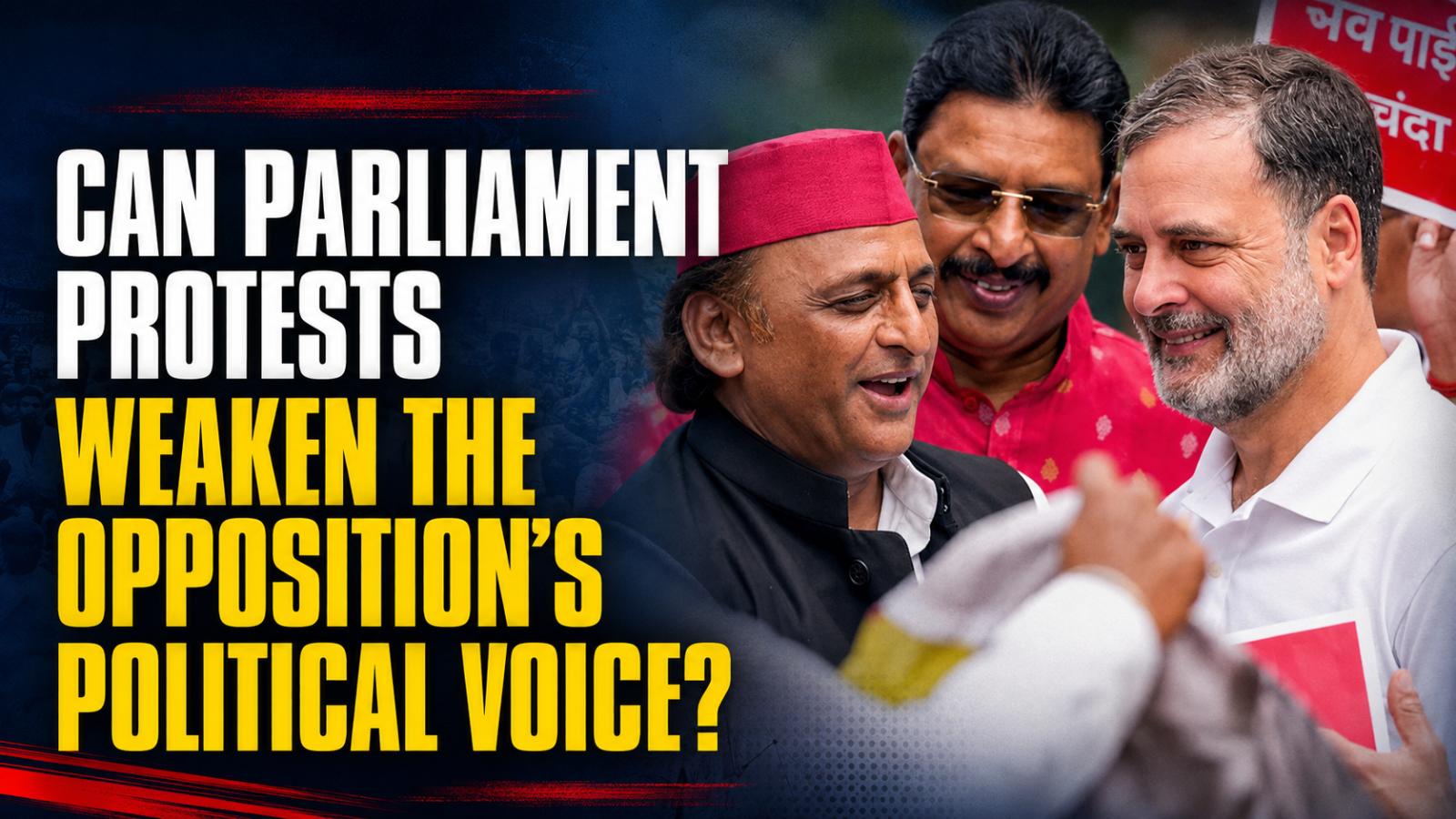
Can Parliament protests weaken the Opposition’s political voice?

Can Parliament protests weaken the Opposition’s political voice?
Parliament protests and Opposition strategy have come under focus during the Monsoon Session. Frequent adjournments are affecting Question Hour scrutiny and debate over government bills, raising concerns that Opposition parties may be surrendering their strongest democratic platform.

 

Question Hour scrutiny reduced by repeated adjournments

Opposition protests during the Monsoon Session have repeatedly interrupted proceedings, delayed scheduled business and forced the Lok Sabha to adjourn. The demonstrations may increase pressure on the government, but they also carry a political cost for the parties leading them.

Parliament is one of the few institutions where Opposition MPs can directly question ministers, challenge government claims and demand information on public policy. When proceedings stop, the government loses legislative time, but the Opposition loses access to its most effective accountability tools.

Congress MP Shashi Tharoor recently raised this issue while addressing an event organised by India’s International Movement to Unite Nations. He acknowledged that demonstrations, slogans, sit-ins and other peaceful protests are legitimate in a democracy. However, he argued that Parliament must remain a place for questions, evidence and reasoned political disagreement.

Question Hour gives MPs an opportunity to seek official information about government programmes, spending and administrative decisions. Ministers must respond on record, while starred questions allow members to ask supplementary questions and challenge incomplete replies.

For Opposition MPs, this process is especially important. Ministers and ruling-party representatives have easier access to the executive and government departments. Opposition members largely depend on parliamentary procedures to obtain public answers.

Zero Hour and Rule 377 offer additional opportunities to raise urgent matters, constituency grievances and issues of wider public interest. When disruptions consume the working day, these matters may never reach the floor of the House.

Protests can be effective when the government appears unwilling to discuss a controversial issue. They can attract media attention and force political negotiations. However, continuous disruption risks replacing sustained parliamentary scrutiny with short-lived public visibility.

Debate over government bills remains essential

The impact of disruption becomes clearer when legislation is passed without detailed discussion. During the current Monsoon Session, the Lok Sabha passed the Tribunals Reforms Bill, 2026 on August 10 amid Opposition protests and without a full debate.

The government may face criticism for passing a bill without adequate deliberation. Yet its parliamentary majority remains intact. Opposition parties, meanwhile, lose the chance to question the bill’s provisions, propose amendments and explain their objections to the public.

A parliamentary debate serves a broader purpose than determining whether the government has enough votes. It allows MPs to identify legal or administrative problems, examine possible consequences and require ministers to justify their decisions.

Committees can provide further scrutiny by studying evidence, consulting stakeholders and recommending changes. Even when the government rejects those recommendations, the objections and responses become part of the legislative record.

That record is important because it shows why a law was introduced and what concerns were raised before its passage. Without meaningful debate, citizens receive little information beyond the government’s formal statement explaining the bill.

Opposition leaders, including Rahul Gandhi, have alleged that microphones belonging to their MPs were switched off during proceedings. The government and parliamentary authorities have rejected or disputed these allegations. A functioning House is the proper place for both sides to present their claims and allow the public to judge them.

The Opposition does not need to abandon protest, but it must consider when disruption stops serving its purpose. If protests repeatedly prevent questions and debates, the government may continue using its majority while avoiding sustained scrutiny.

Votes decide whether a bill passes, but debate determines whether the government is forced to defend it. By allowing Parliament to function, Opposition parties gain the opportunity to test policies, expose weaknesses and build a stronger public case.

What is your response?

joyful Joyful 0%
cool Cool 0%
thrilled Thrilled 0%
upset Upset 0%
unhappy Unhappy 0%
AD
AD
AD
AD
AD
AD
AD
AD
AD
AD