
Parliament Passes Two Major Amendment Bills Amid NEET Row
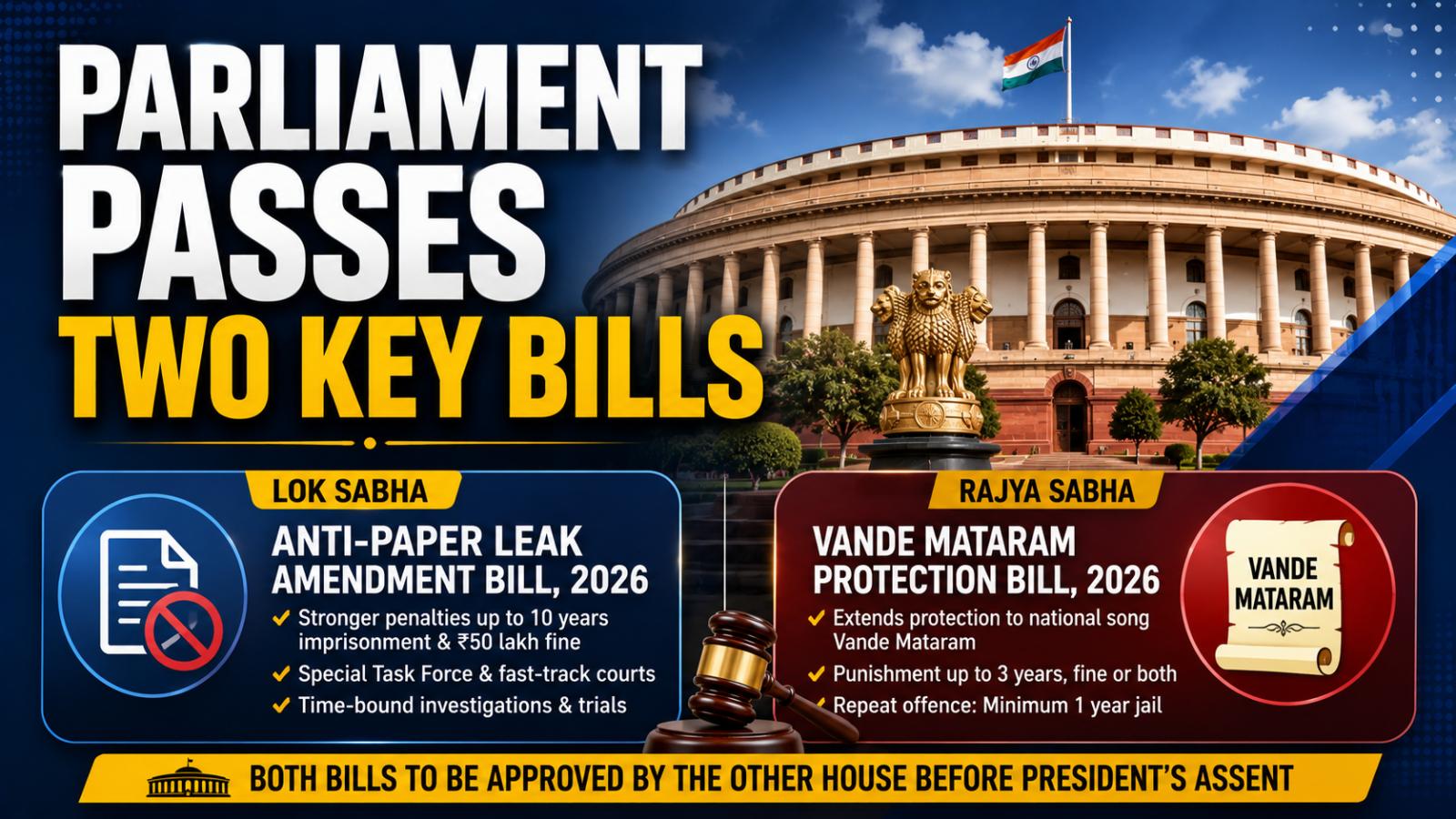
The Lok Sabha passed a tougher anti-paper leak Bill with stricter penalties, fast-track courts, and time-bound investigations, while the Rajya Sabha approved legal protection for Vande Mataram amid Opposition protests over the NEET paper leak controversy.
Lok Sabha, Rajya Sabha Pass Key Bills Amid NEET Row
New Delhi, Wednesday, July 29, 2026: The Lok Sabha and Rajya Sabha passed two separate amendment Bills on Wednesday amid protests and heated exchanges linked to the NEET-UG paper leak controversy.
The Lok Sabha approved legislation strengthening India’s anti-paper-leak law, while the Rajya Sabha passed a Bill extending statutory protection to the national song, Vande Mataram. Both measures were cleared in their respective Houses during the Monsoon Session of Parliament.
However, the Bills address different subjects and are at separate stages of the legislative process. Each must still be approved by the other House before being sent to the President for assent.
Lok Sabha Clears Anti-Paper-Leak Amendment Bill
The Lok Sabha passed the Public Examinations (Prevention of Unfair Means) Amendment Bill, 2026, by voice vote. Introduced on July 27 by Union Minister Jitendra Singh, the legislation seeks to strengthen the Public Examinations Act enacted in 2024.
The existing law covers examinations conducted by agencies including the Union Public Service Commission, Staff Selection Commission, National Testing Agency, Railway Recruitment Boards and Institute of Banking Personnel Selection.
Under the proposed amendment, an individual found guilty of using unfair means could face imprisonment ranging from five to 10 years and a fine of up to ₹50 lakh. The punishment for organised examination crime would include imprisonment ranging from seven to 10 years and a minimum fine of ₹10 crore.
Service providers involved in examination malpractice could face fines of up to ₹5 crore. Their period of debarment from conducting public examinations would also be increased from four years to eight years. Track Courts and Time-Bound Investigations
Apart from increasing penalties, the amendment seeks to address delays in investigating and prosecuting paper-leak cases.
It empowers the central government to establish a Special Task Force for investigating examination offences. Investigations would generally have to be completed within two months of the case being registered.
Every state and Union Territory would also be required to designate a Sessions Court as a Special Fast-Track Court. Trials would be conducted on a day-to-day basis and are expected to be completed within three months of the chargesheet being filed.
The legislation also provides for the seizure of properties belonging to convicted offenders. Appeals from the Special Fast-Track Courts would be heard by a two-judge High Court bench. was passed following days of disruptions over the NEET paper leak and the alleged use of police force against student protesters. Opposition members demanded accountability from the government, while the Centre maintained that stronger penalties and faster trials were necessary to protect students and restore confidence in public examinations.
Rajya Sabha Passes Vande Mataram Protection Bill
In a separate development, the Rajya Sabha passed the Prevention of Insults to National Honour (Amendment) Bill, 2026.
The legislation seeks to amend the Prevention of Insults to National Honour Act, 1971, which currently protects the National Flag, the Constitution, and the national anthem, Jana Gana Mana.
The amendment extends the provision concerning the national anthem to Vande Mataram. It makes intentionally preventing the singing of the national song or disturbing an assembly engaged in singing it punishable with imprisonment of up to three years, a fine or both.
The Bill does not expressly make an individual’s decision not to sing an offence. Its wording focuses on intentionally preventing the singing or causing a disturbance during such an assembly. A second or subsequent conviction under the provision would carry a minimum prison term of one year. Taram was composed by Bankim Chandra Chattopadhyay and became an important symbol during India’s freedom movement. The government introduced the amendment during commemorations marking 150 years of the song.
The Rajya Sabha debate also witnessed Opposition protests concerning the handling of demonstrations over the NEET paper leak. Opposition members later staged a walkout while demanding a response from Union Home Minister Amit Shah.
Both Bills Await Further Approval
Although both Bills cleared one House of Parliament on July 29, they have not yet completed the legislative process.
The anti-paper-leak amendment must be passed by the Rajya Sabha, while the National Honour amendment must receive Lok Sabha approval. They will become law only after both Houses pass them and the President grants assent.