

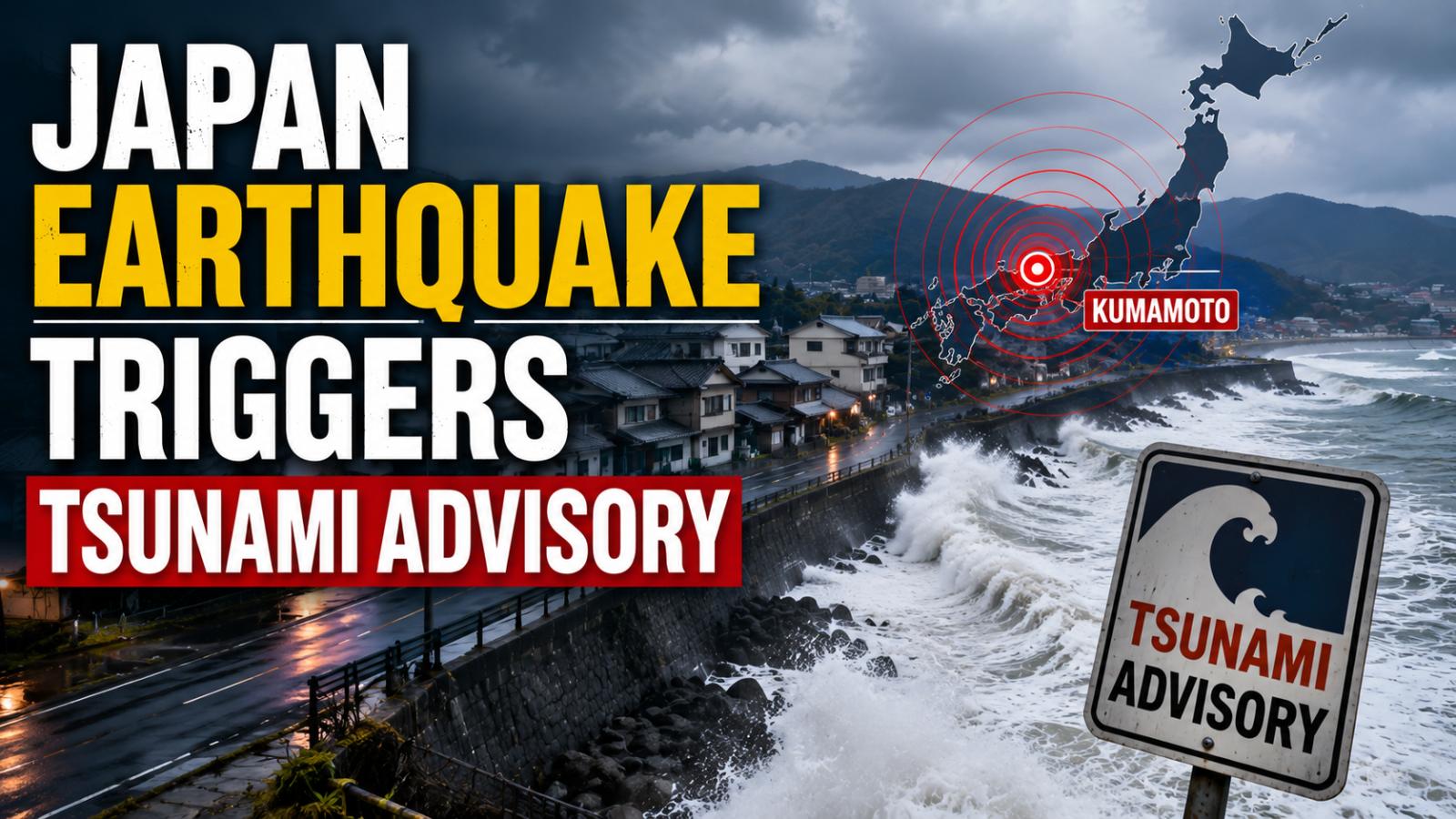
Powerful Quake Strikes Southern Japan
A preliminary 7.1-magnitude earthquake struck near Kumamoto in Japan’s Kyushu region on July 28, 2026, prompting a tsunami advisory. Coastal residents were urged to move to higher ground while authorities assessed possible damage, injuries, and transport disruptions.
Southern Japan Hit by 7.1 Quake, Tsunami Advisory Issued
A preliminary 7.1-magnitude earthquake struck near Kumamoto Prefecture in southern Japan on Tuesday, July 28, 2026, prompting authorities to issue a tsunami advisory for parts of the Kyushu coast. Residents in low-lying coastal areas were urged to move to safer ground and follow official instructions while emergency teams assessed the situation.
The earthquake was recorded at approximately 4:29 pm local time and occurred at a shallow depth of around 10 kilometres beneath the sea surface, according to initial information attributed to the Japan Meteorological Agency. The magnitude and depth remained preliminary and could be revised after further analysis.
Kumamoto Earthquake Tsunami Advisory 2026 Issued
Following the powerful tremor, authorities issued a tsunami advisory and began monitoring coastal areas for changes in sea level. Initial reports indicated that waves measuring up to one metre were possible.
People near beaches, ports, river mouths, and other waterfront locations were advised to move to higher ground and stay away from the coast until authorities confirmed that the danger had passed.
Emergency earthquake alerts were also reported across several prefectures on Kyushu, including Kumamoto, Nagasaki, Kagoshima, Fukuoka, Saga, Oita, and Miyazaki. Such alerts are intended to give residents a brief opportunity to protect themselves from strong shaking, falling objects, and other immediate hazards.
The Pacific Tsunami Warning Center subsequently indicated that the earthquake did not pose a wider tsunami threat beyond areas close to Japan. Local effects could still be dangerous, however, because tsunami waves can arrive repeatedly and strong coastal currents may continue after the first surge.
Damage and Injury Checks Underway
There were no immediate confirmed reports of major damage or casualties during the first updates following the earthquake. Local authorities began inspecting homes, roads, railway lines, ports, and other public infrastructure in the affected region.
Transport operators and utility providers were also expected to inspect their facilities before allowing normal services to resume. Strong earthquakes can temporarily interrupt rail operations, electricity supplies, and mobile networks, even when widespread structural damage is not reported.
Residents were urged to remain cautious because aftershocks may follow a major earthquake. People in affected areas should keep emergency supplies nearby, secure heavy furniture, avoid visibly damaged buildings, and rely on information issued by government agencies rather than unverified social-media posts.
Why Southern Japan Faces Earthquake Risk
Japan lies along the Pacific Ring of Fire, an extensive seismic zone surrounding the Pacific Ocean. The United States Geological Survey says around 90 percent of the world’s earthquakes occur within this broad belt.
The country’s location near multiple tectonic boundaries makes earthquakes relatively common. Japan has consequently developed strict construction standards, nationwide earthquake alerts, and detailed evacuation procedures intended to reduce casualties and infrastructure damage.
Kyushu has experienced serious seismic activity before, including the damaging Kumamoto earthquake sequence of 2016. That experience has increased awareness of emergency drills, temporary evacuations, and rapid infrastructure inspections among communities in the region.
The July 28 earthquake remains a developing event. Its magnitude, depth, tsunami status and impact figures may be revised as the Japan Meteorological Agency and local authorities examine additional data.
Residents and travellers in Kyushu should continue monitoring official updates and follow any coastal evacuation or public-safety instructions without delay.