
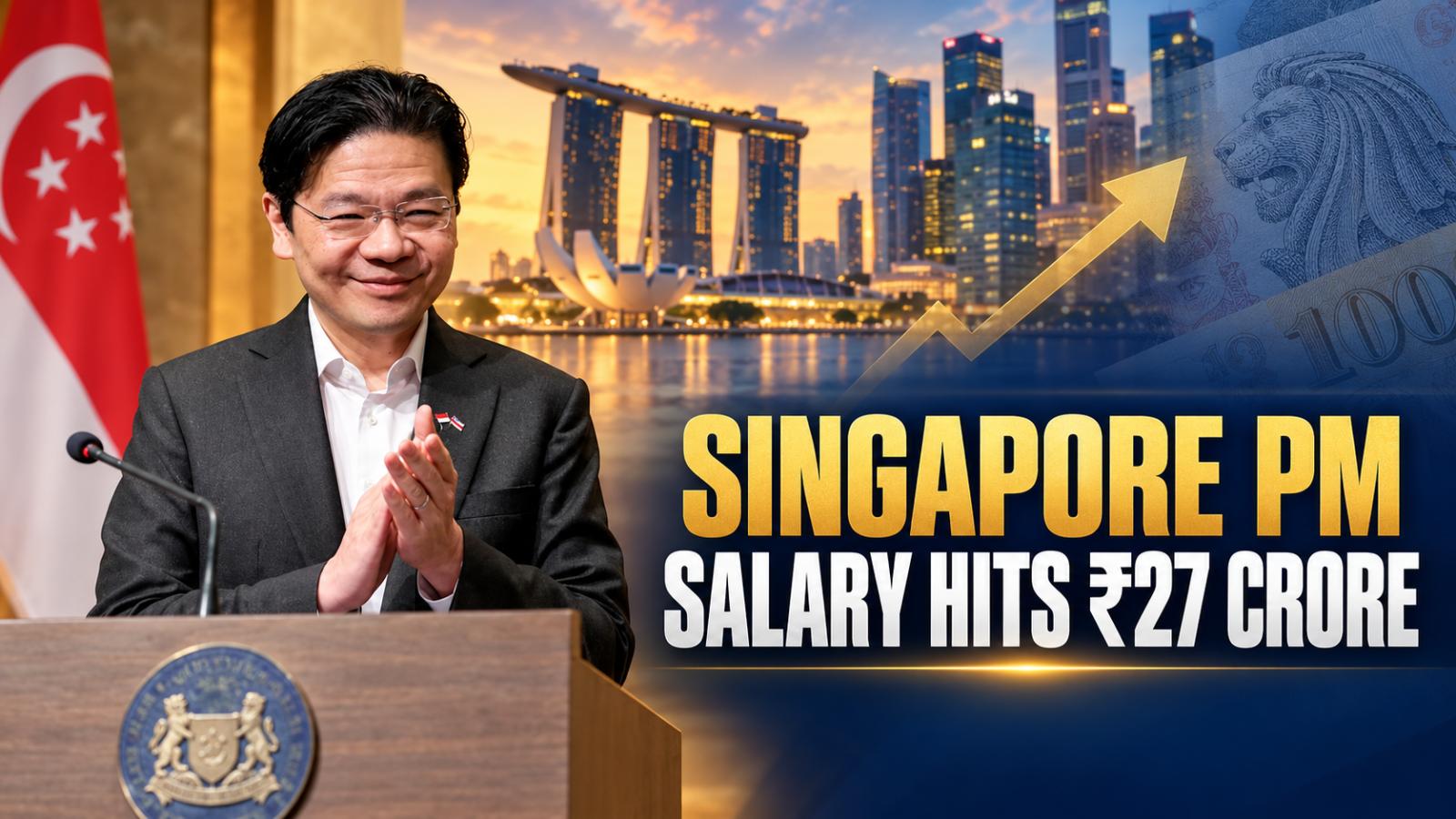
Singapore Prime Minister Lawrence Wong announced the revised political salary framework in Parliament. From October 15, his annual benchmark pay will rise to SgD 3.6 million, or nearly Rs 27 crore, while other increases will be performance-based.
Singapore PM Salary Rises by 64 PercentSingapore Prime Minister Lawrence Wong is set to receive a major salary increase under a revised political remuneration framework, reinforcing his position as one of the world’s highest-paid government leaders.
Wong’s annual benchmark salary will rise by about 64 percent, from SgD 2.2 million to SgD 3.6 million. Based on the rupee conversion cited in the original report, his revised pay is worth approximately Rs 27 crore a year, compared with around Rs 16.5 crore under the existing benchmark.
The new framework takes effect on October 15, 2026. Wong announced the decision in Parliament after an independent committee completed its review of salaries for political appointment holders and Members of Parliament.
Singapore’s government accepted the committee’s recommendations, but ministers will not immediately move to the full revised benchmarks. Existing political officeholders will initially receive a one-time adjustment of up to nine percent, depending on their performance, responsibilities and previous salary adjustments.
The prime minister’s salary is calculated at twice the benchmark for an entry-level minister, known as the MR4 grade. As the MR4 benchmark rises from SgD 1.1 million to SgD 1.8 million, the prime minister’s corresponding benchmark increases to SgD 3.6 million.
Lawrence Wong Promises to Donate Entire IncreaseAcknowledging the sensitivity of the decision, Wong said he would donate the full increase in his prime ministerial salary to suitable charitable causes for the next five years, provided he remains in office.
The government will continue paying him according to the approved framework, after which he will personally donate the additional amount. Wong said the decision was his own and clarified that he did not expect other political officeholders to make the same commitment.
He acknowledged that the sums involved were far higher than what most Singaporeans earn and said he understood why political salaries attracted intense public scrutiny.
Wong nevertheless defended the revision, arguing that Singapore must continue attracting highly capable people into political service. He said potential candidates often have successful private-sector careers and may already face a substantial reduction in income if they enter politics.
Political Salaries Revised After 15-Year FreezeSingapore’s ministerial salary benchmarks had remained unchanged for about 15 years. A committee recommended an increase in 2017, but the government did not implement it. Another review scheduled for 2023 was postponed because of economic uncertainty.
The government says private-sector, civil-service and judicial salaries increased during that period, leaving ministerial remuneration behind its intended benchmark.
Singapore links ministerial pay to the earnings of top private-sector professionals while applying a discount to reflect the public-service nature of political office. Officials argue that transparent and competitive salaries help recruit qualified leaders and support clean governance.
Under the revised system, deputy prime ministers and senior cabinet members will also have higher benchmark ranges. However, actual ministerial remuneration will vary according to grade, performance and portfolio responsibilities.
MPs’ monthly allowances will rise from SgD 13,750 to SgD 18,500 beginning October 15. Adjustments for the president, speaker and deputy speaker will also take effect on that date.
Salary Hike Revives Debate Over Leadership PayThe announcement has renewed debate over whether political leaders should receive compensation comparable to highly paid private-sector professionals.
Supporters of Singapore’s model argue that competitive salaries help attract experienced candidates, reduce financial barriers to public service and promote accountability through a transparent compensation system.
Critics are likely to focus on the gap between political salaries and the income of ordinary households, particularly amid concerns over living costs and economic inequality. The revised prime ministerial benchmark also considerably exceeds the compensation of many leaders in the United States, Europe and other major economies.
The full benchmarks should not be interpreted as immediate automatic salaries for every minister. Most ministers will receive an initial adjustment of no more than nine percent, with future movement inside the new ranges determined by individual performance and responsibilities.
Wong said the central question was whether Singapore could continue building strong political leadership for the future. His charity pledge may reduce some personal criticism, but the scale of the revision ensures that political pay will remain a closely watched public issue.