
Iran Drone Swarm Claim Raises New Air Warfare Concerns
A US pilot’s reported account of a jellyfish-like Iranian drone swarm before an F-15E crash has raised questions about Iran’s drone warfare capabilities. Officials have not confirmed the exact cause of the crash, but the claim has sparked fresh debate on the future of air combat.
Iran’s ‘Jellyfish’ Drone Swarm Claim Raises Questions After US F-15E Jet Crash
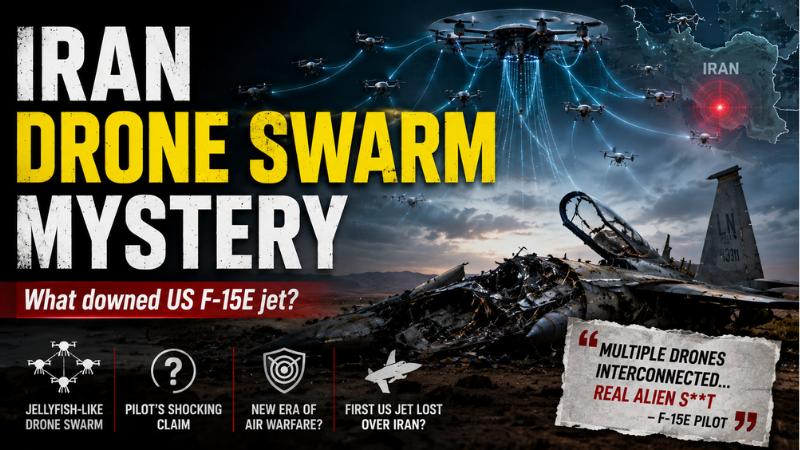
A US F-15E Strike Eagle crash over Iran has triggered fresh debate after the rescued pilot reportedly described seeing a strange formation of Iranian drones moving together like a “jellyfish” before the aircraft went down.
According to reports, the incident took place on April 3 during the Iran conflict. While the exact cause of the crash has not been officially confirmed, the pilot’s account has drawn attention because it may point to a new level of Iranian drone coordination and battlefield technology.
Pilot Describes Unusual Drone Formation
The pilot reportedly told officials that several drones appeared to be connected or moving in a coordinated pattern, with smaller drones below a larger platform. The formation was described as resembling a jellyfish in the sky.
The claim has raised concern among defence analysts because such a system could function like an airborne minefield, making it difficult for traditional aircraft and radar systems to respond quickly.
However, intelligence officials are reportedly treating the account with caution. The pilot had suffered injuries after ejecting, and investigators are still examining whether the drones directly caused the crash or were only present in the area.
What Is A ‘Jellyfish’ Drone Swarm?
A jellyfish-like drone swarm is believed to involve multiple unmanned aerial vehicles operating together through a networked system. A larger “mothership” drone may act as a command platform, while smaller drones move below or around it.
Such systems can use mesh networking, where drones communicate with each other and continue operating even if one part of the formation is disrupted. This allows them to move as a group, share data, and possibly launch coordinated attacks.
If Iran has developed or acquired this capability, it would mark a significant development in drone warfare.
Why The Claim Matters
Drone swarms are considered difficult to counter because they can operate at lower altitudes, spread across a wide area, and overwhelm conventional air defence systems. They are also cheaper than manned aircraft, making them attractive in modern conflicts.
Defence experts believe such technology can reduce the advantage of advanced fighter jets by creating new threats in contested airspace. Even if a swarm does not directly shoot down an aircraft, it can distract pilots, interfere with movement, and complicate battlefield awareness.
Iran Has Not Confirmed Details
Iran has not publicly confirmed the use of a jellyfish-style drone swarm in the incident. After the crash, Iranian officials only said a new air defence system had been used, without giving specific technical details.
Earlier reports had suggested other possible causes, including an infrared air defence system or a shoulder-fired missile. The latest drone-swarm theory remains one of several possibilities being examined.
A New Phase In Drone Warfare?
The reported incident has renewed global focus on the rapid rise of drone warfare. Countries such as China and Russia have long been associated with advanced swarm technologies, but Iran has also spent years investing in drones as a way to offset the military strength of larger powers.
If the pilot’s description is confirmed, it could signal a major shift in how future air battles are fought. For now, the incident remains under investigation, but it has already shown how low-cost drones and networked systems are becoming serious challenges for even advanced military aircraft.