
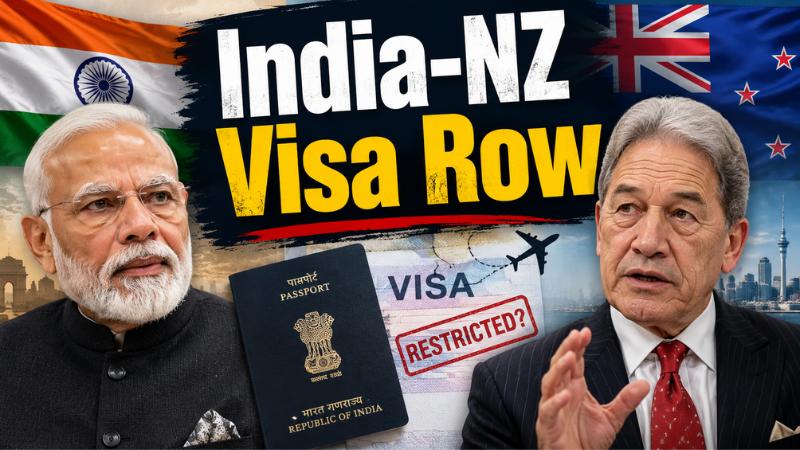
India-New Zealand FTA Row: Peters Alleges Visa Rule Changes Target Indians
New Zealand Foreign Minister Winston Peters has alleged that immigration-related terms linked to the India-New Zealand Free Trade Agreement have been quietly changed in a way that could affect Indian students, workers, and professionals.
The allegation has triggered a political row in New Zealand, with the ruling National Party rejecting the claim and calling it misinformation. The dispute comes as the trade agreement awaits formal ratification by the New Zealand Parliament.
Peters Claims Indians Are Being Targeted
Winston Peters, who leads New Zealand First and is part of the ruling coalition, claimed that immigration policy settings under the India-New Zealand FTA were being made more restrictive for Indian citizens.
According to Peters, the alleged changes would treat Indian nationals differently from citizens of other countries that have similar trade agreements with New Zealand. He said officials had warned ministers that such changes could affect New Zealand’s relationship with India and damage the country’s reputation as a place to do business.
Peters also claimed that the Indian government had not been informed about the alleged policy shift.
What Peters Alleged
Peters said the proposed restrictions could affect temporary employment entry visas, partner and family visa provisions, and the ability of Indian workers to count temporary work experience toward residency requirements.
He alleged that a labour market or economic needs test could be applied only to Indian citizens. He also claimed Indian nationals may be blocked from applying for temporary employment entry visas from within New Zealand.
However, Peters has not publicly released the official briefing he cited, saying he was bound by Cabinet confidentiality rules.
National Party Rejects The Claim
New Zealand Trade Minister Todd McClay rejected Peters’s allegations and said the claims were wrong. He accused New Zealand First of spreading misinformation for political gain.
McClay defended the India-New Zealand FTA, saying the agreement would give New Zealand exporters access to India’s large market and strengthen bilateral trade ties.
The FTA bill passed its first reading in Parliament with support from the National Party, ACT and the opposition Labour Party. New Zealand First opposed the bill.
What The India-New Zealand FTA Offers
The India-New Zealand Free Trade Agreement includes temporary mobility provisions for Indian professionals, students, and young workers.
Under the agreement, New Zealand will provide around 1,667 three-year Temporary Employment Entry visas each year for Indian nationals, capped at 5,000 visa holders at any time. These visas are mainly linked to skilled and specialised occupations.
The deal also includes 1,000 annual working holiday visas for young Indians, along with expanded student work rights and temporary entry provisions for service suppliers.
The agreement does not provide an automatic pathway to permanent residency.
Why The Issue Matters For Indians
The row is important for Indian students and professionals because the FTA was expected to create clearer temporary work and study-linked opportunities in New Zealand.
Any change in immigration settings could affect Indian workers in sectors such as healthcare, teaching, engineering, information technology, and specialised services.
For Indian students, clarity on post-study work rights and temporary employment options remains important before the agreement is fully implemented.
Immigration Becomes A Political Flashpoint
The controversy comes ahead of New Zealand’s general election in November. Immigration has become a sensitive political issue in the country, especially in debates involving Indian and South Asian migrants.
Peters had earlier opposed the India-New Zealand FTA, arguing that it could increase immigration from India. His latest claim takes a different position, alleging that the government is now trying to restrict Indian migration under the deal.
Current Status Of The FTA
The India-New Zealand FTA has been signed but is still awaiting full ratification by the New Zealand Parliament.
For now, the key issue remains unresolved. Peters has not released the document behind his claim, while the National Party has denied the allegation.
Until the final immigration settings are made public, Indian students, workers and professionals planning to use the FTA route will have to wait for official clarity from New Zealand authorities.