
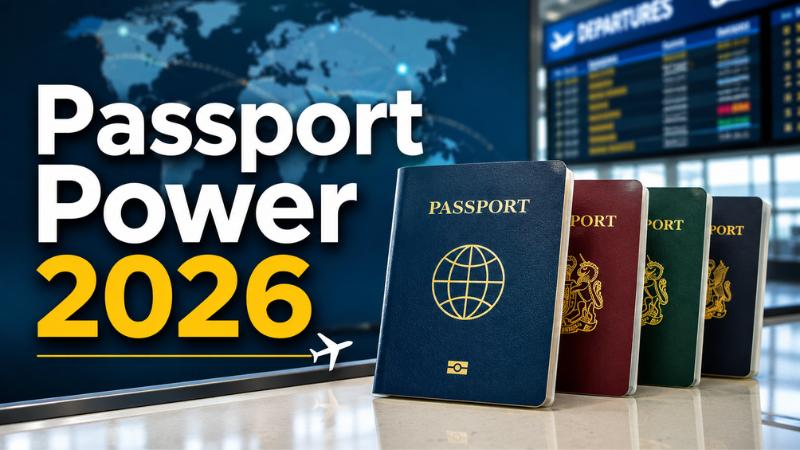
Singapore Tops 2026 Passport Index, India Rises To 80th Rank
Singapore leads the 2026 passport ranking with access to 192 destinations, while India moves up to 80th as global citizenship proof rules continue to differ.Singapore Tops 2026 Passport Index As India Moves Up; Citizenship Proof Rules Differ Globally
A passport is often seen as a simple travel document, but it also reflects how easily citizens of a country can move across borders. The latest Henley Passport Index 2026 shows Singapore continuing to hold the top position, while India has improved its ranking. At the same time, the legal use of passports as proof of citizenship varies widely from country to country.
Singapore Remains World’s Strongest Passport
Singapore has retained its position as the world’s most powerful passport in 2026. According to the Henley Passport Index, Singapore passport holders can travel to 192 destinations without needing a visa in advance.
The ranking is based on the number of destinations passport holders can access through visa-free, visa-on-arrival, or electronic travel authorisation arrangements. The index uses data from the International Air Transport Association and is widely followed as a measure of global mobility.
Top Passports In 2026
Asian and European countries dominate the upper ranks of the 2026 list. Japan, South Korea, and the United Arab Emirates share the second position with access to 188 destinations.
Sweden follows with access to 187 destinations, while several European countries, including Belgium, Denmark, Finland, France, Germany, Ireland, Italy, Luxembourg, the Netherlands, Norway, and Spain, offer access to 186 destinations.
Australia, the United Kingdom, Canada, and Malaysia also feature in the top 10, while the United States remains at the 10th position with access to 179 destinations.
India Ranked 80th In Passport Index
India is ranked 80th in the 2026 Henley Passport Index, showing an improvement of five places compared with the previous ranking. Indian passport holders currently have access to around 56 destinations through visa-free, visa-on-arrival, or electronic travel authorisation facilities.
Although India remains behind many advanced economies in terms of passport strength, the improvement suggests gradual progress in global mobility for Indian travellers. Easier access to more destinations can benefit people travelling for tourism, business, education, and family visits.
Why Passport Strength Matters
A stronger passport reduces the need for lengthy visa applications and allows citizens to travel more freely. Countries with wider diplomatic relations, stronger visa-waiver agreements, and higher international trust usually perform better in passport rankings.
Passport power is not decided only by economic strength. It is also influenced by diplomacy, border policies, and international agreements between governments.
Passport As Citizenship Proof: Rules Differ By Country
While a passport is commonly used as proof of identity and nationality, not all countries treat it as final proof of citizenship. In many countries, a valid passport is accepted as strong evidence of citizenship for routine purposes.
Countries such as the United States, the United Kingdom, Australia, and New Zealand generally accept passports as proof of citizenship in most situations. Several other countries, including Japan, Ireland, Italy, and many European Union nations, also treat passports as strong evidence for regular administrative use.
When A Passport May Not Be Enough
In some countries, a passport may not be considered enough in legal or citizenship-related cases. Canada, Germany, and France may ask for additional records such as birth certificates, citizenship certificates or nationality documents in certain situations.
India has also clarified that a passport is primarily a travel document and should not automatically be treated as definitive proof of Indian citizenship. Authorities may rely on other official records when citizenship status needs to be verified.
China also gives more importance to domestic identity and nationality systems for citizenship verification rather than relying only on passports.
Why There Is No Single Global Rule
There is no universal rule on whether a passport alone proves citizenship. Each country follows its own nationality laws and administrative procedures.
Authorities may ask for additional documents because passports can remain valid even after citizenship changes, administrative errors, fraud during issuance, or later disputes over nationality.
For most daily uses, a passport remains a strong document for identity and nationality. However, in immigration, legal or citizenship-related matters, separate supporting documents may still be required depending on the country.
Key Takeaway For Travellers
The 2026 passport rankings show Singapore leading global mobility, while India has made a small but notable improvement. However, the wider citizenship debate shows that a passport’s legal value depends on the country and the situation in which it is used.
For travellers, a strong passport means easier global movement. For legal citizenship matters, it is always important to check the rules of the country concerned.