
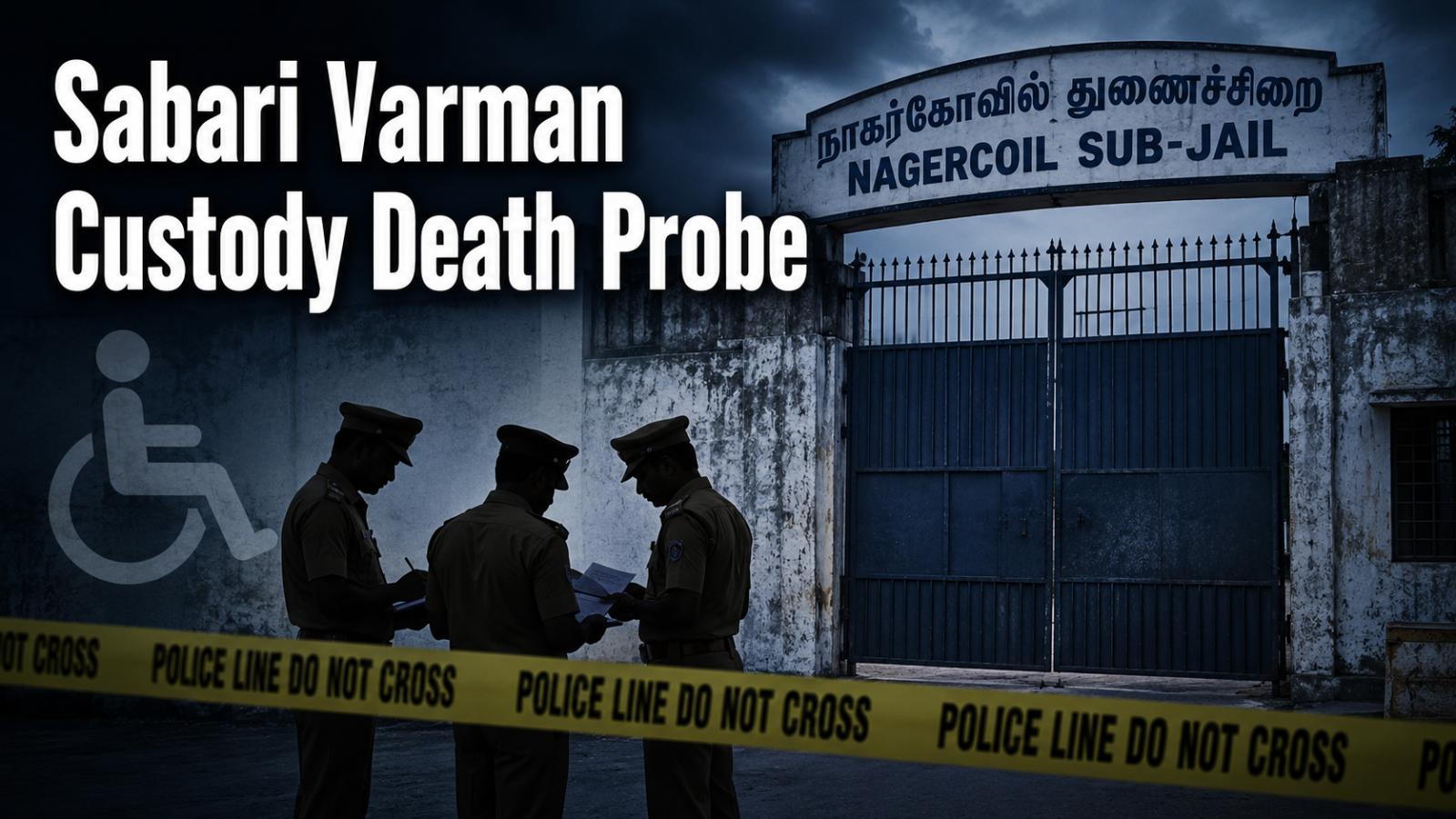
Nagercoil Custody Death: Three Prison Staff Held After Autopsy Finds 19 Injuries
The Sabari Varman custody death has triggered protests and a political controversy in Tamil Nadu after a postmortem examination reportedly found 19 injuries on the body of the 35-year-old remand prisoner. Sabari Varman, a shopkeeper and person with a disability from Ethancadu in Kanniyakumari district, died on July 13, 2026, after being found unconscious inside the Nagercoil prison.
Three prison staff members were subsequently arrested and suspended following an inquiry involving eyewitness statements and CCTV recordings. Sabari Varman’s relatives have alleged that he was assaulted inside the prison, while the precise medical cause of his death and the responsibility of those involved remain under investigation.
Who Was Sabari Varman?
S Sabari Varman was a 35-year-old grocery shop owner from Ethancadu, near South Thamaraikulam in Kanniyakumari district. Reports described him as a person with a disability.
South Thamaraikulam police arrested him on July 9 for allegedly possessing and selling banned tobacco products from his shop. Police reports differed slightly over the quantity recovered, with some reports mentioning 15 packets and others referring to approximately 200 grams of banned tobacco products.
After being produced before a Nagercoil court, he was remanded to judicial custody and lodged in the Nagercoil prison. The allegations related to the tobacco products had not been proved in court at the time of his death.
Disabled Man Dies in Judicial Custody
The disabled man died in judicial custody on the morning of July 13, four days after he was remanded. Prison authorities said he was found unconscious after developing a sudden health problem inside his cell.
Sabari Varman was taken from the prison to Kanniyakumari Government Medical College Hospital in Asaripallam at approximately 6.05 am. Doctors declared him dead on arrival.
Prison and police officials initially said that he had suffered a health emergency. Preliminary claims suggested a possible cardiac arrest, but officials acknowledged that the exact cause could be established only after the postmortem examination.
Postmortem Reportedly Finds 19 Injuries
The Sabari Varman postmortem report became a central part of the case after doctors reportedly documented 19 injuries on his body. The injuries were said to have been found on areas including his elbows, forearms, knees, and legs.
A panel of doctors from government medical colleges in Kanniyakumari, Tirunelveli, and Thoothukudi conducted the postmortem on July 14. The independent panel was constituted after Sabari Varman’s family demanded that doctors from outside the district participate in the examination.
The reported discovery of 19 injuries on Sabari Varman’s body intensified suspicions surrounding the circumstances of his death. However, the presence of injuries does not by itself establish the final medical cause of death or the individual responsibility of the accused staff members. Those questions must be determined through the medical, police, and judicial investigations.
Three Prison Staff Arrested in Nagercoil
In a major development in the Nagercoil custodial death case, three prison employees were arrested late on July 14 and placed under suspension.
Police identified them as chief jail warden Thirumalai Nambi Suresh and jail wardens Jagen and Sivakumar. Investigators reportedly questioned eyewitnesses and examined CCTV recordings from the prison before taking action against them.
Early reports had focused primarily on the arrest of one prison warden. Later reports confirmed that the inquiry had widened and that three members of the prison staff had been arrested.
Police sources alleged that Sabari Varman had been assaulted and restrained inside the prison after he made loud noises and caused a disturbance on Sunday night. These details remain allegations under investigation and have not yet resulted in a final judicial finding.
Family Alleges Custodial Torture
Sabari Varman’s relatives staged a protest outside the government medical college hospital after being informed about his death. They alleged that he had been healthy when arrested and was later subjected to custodial torture.
The family initially refused to accept the body and demanded a transparent postmortem examination and an impartial Kanniyakumari jail death investigation. They also briefly blocked a road near the hospital.
Relatives claimed that injuries were visible across his body and alleged that he had been beaten without consideration for his disability. They demanded that everyone involved in the alleged assault be identified and prosecuted.
The family also reportedly sought government employment for Sabari Varman’s wife.
Police Accounts Face Questions
Before the autopsy findings were reported, a police official rejected the family’s allegations and said that Sabari Varman did not have external injuries when he was arrested or medically examined before being remanded.
Police also maintained that he became unwell inside the prison and was transported to the hospital. One police account referred to sudden cardiac arrest as a possible explanation for his death.
Later reports about the injuries and the arrests of three prison staff members raised additional questions about what happened between Sabari Varman’s admission to the prison on July 9 and his death on July 13.
Investigators are expected to compare the medical examination conducted before his remand with the final autopsy findings. CCTV footage, statements from prisoners, prison records, and the actions of staff members on duty are also likely to be examined.
Udhayanidhi Stalin Demands Government Response
Tamil Nadu Leader of the Opposition Udhayanidhi Stalin condemned the incident and demanded appropriate action against the officials concerned. The Tamil Nadu Legislative Assembly’s official website identifies Udhayanidhi as Leader of the Opposition and C Joseph Vijay as Chief Minister.
Speaking about the Udhayanidhi Stalin Sabari Varman case response, the DMK leader questioned how a person reported to have been healthy at the time of his arrest died after being lodged in prison.
He asked Chief Minister C Joseph Vijay, who holds the police portfolio, to explain the circumstances surrounding the death. Udhayanidhi also repeated the family’s allegations that Sabari Varman was beaten despite being a person with a disability.
He further accused the police of following different standards in similar gutka-related cases. Udhayanidhi claimed that a TVK functionary arrested in Erode in another tobacco case had been released on bail while Sabari Varman was remanded to judicial custody.
The allegations concerning unequal treatment represent the opposition’s political position and require independent verification through the respective case records.
Investigation Into Nagercoil Prison Death Continues
The Nesamony Nagar police registered a case in connection with the death. Kanniyakumari Superintendent of Police R Stalin also conducted an inquiry at the prison, while Nagercoil Judicial Magistrate R Sathyamoorthy held inquiries at the hospital.
Investigators are examining whether the injuries were inflicted inside the prison, who was present at the time, and whether any officials attempted to conceal evidence. One report said police had also identified five prisoners who may have assisted those involved, although further investigation was required before action could be taken.
The Tamil Nadu judicial custody death case has intensified calls for accountability and protection for vulnerable prisoners. Political parties, including the CPI and Naam Tamilar Katchi, have demanded a murder case and compensation for Sabari Varman’s family.
The arrest and suspension of three prison staff members are significant developments. However, the final cause of death, the exact sequence of events, and the criminal responsibility of each person involved must be established through the ongoing investigation and judicial process.
Until those findings are released, the Nagercoil prison violence allegations should be reported as allegations rather than established conclusions.