

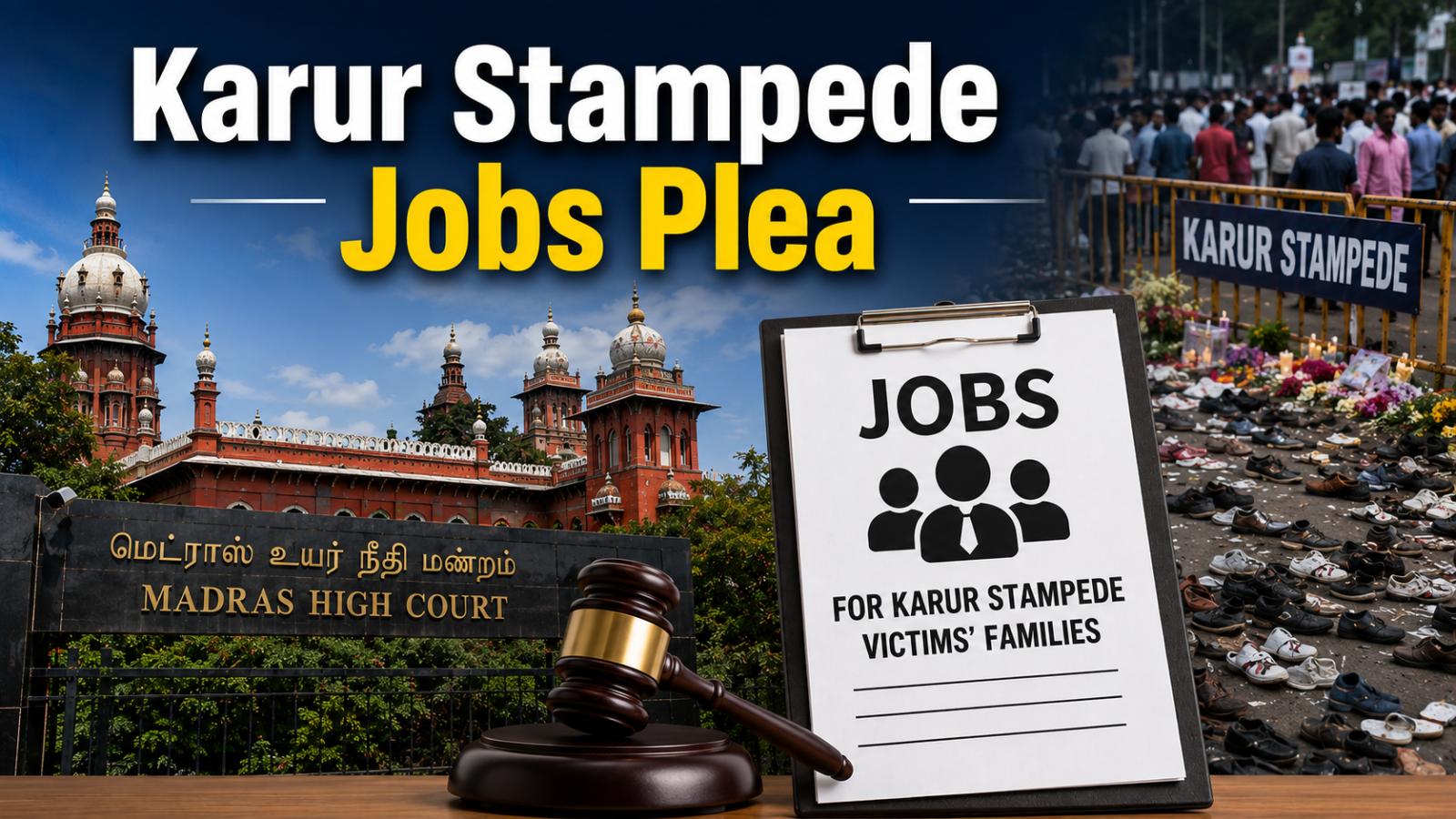
Karur Stampede Jobs Plea: Madras HC Challenge Explained
The Karur stampede jobs plea filed before the Madurai bench of the Madras High Court has raised important questions over the Tamil Nadu government’s proposal to provide government jobs to the families of those who died in the Karur stampede. The petition argues that public employment must follow equality, fairness, transparency, and a clear legal policy.
Madras HC Karur Stampede Plea
A petition has been filed before the Madurai bench of the Madras High Court challenging the Tamil Nadu government’s proposed move to provide government jobs to the families of 41 people who died in the Karur stampede.
The plea was moved by Madurai-based lawyer Theeran Thirumurugan. It seeks directions to restrain senior state officials from issuing or implementing appointment orders linked to the Karur stampede until the related proceedings before the Supreme Court reach a conclusion.
The petition has made the Chief Secretary, Additional Chief Secretary, Secretary of the Personnel and Administrative Reforms Department, Secretary of the Home Department, Secretary of the Revenue and Disaster Management Department, and the Karur District Collector as respondents.
Tamil Nadu Govt Jobs For Stampede Victims
The case centres on the Tamil Nadu government’s proposal to provide public employment to the next of kin of the Karur stampede victims. According to the petitioner, appointment orders are expected to be issued during Chief Minister C. Joseph Vijay’s proposed visit to Karur on July 10.
The plea argues that government jobs cannot be granted only as an act of executive sympathy or generosity. It states that public employment is a valuable constitutional opportunity and must be offered only through a process that satisfies legal standards.
The petitioner has also questioned whether the state has any uniform policy for offering permanent government jobs to families affected by such tragedies.
Karur Stampede Victims Families Jobs
The plea says that while the suffering of the Karur stampede victims’ families cannot be ignored, any decision to provide government employment must follow a proper legal framework.
It argues that every eligible person has a constitutional right to compete for public employment. If permanent jobs are given to one group of families without a clear policy, it may raise questions over equal opportunity in public service.
The petition has therefore described the proposed appointments as legally questionable in the absence of defined rules, eligibility criteria, and transparent procedures.
Madras High Court Plea Tamil Nadu Jobs
The Madras High Court plea on Tamil Nadu jobs also refers to Articles 14 and 16 of the Constitution. Article 14 deals with equality before the law, while Article 16 deals with equal opportunity in matters of public employment.
The petitioner argues that the proposed appointments could affect the principle of public employment equality if they are made without a uniform policy. The plea says state action must be fair, transparent, and non-arbitrary, especially when it concerns government jobs.
The petition further states that compassionate or relief-based appointments should not become a one-time executive decision without legal backing.
Karur Stampede Appointment Orders
The plea seeks to stop the authorities from issuing or implementing the proposed Karur stampede appointment orders until the Supreme Court proceedings connected to the incident are completed.
According to the petitioner, giving irreversible administrative benefits before the outcome of the case could create avoidable legal and administrative complications.
The plea also says the state has not explained the legal basis under which these jobs are being offered to the families affected by the tragedy.
Articles 14 And 16 Government Jobs Debate
The case has now brought the Articles 14 and 16 government jobs debate into focus. The petitioner’s main argument is that government jobs must be filled through a fair and equal process, and not through selective executive decisions.
The plea does not oppose relief for victims’ families but questions whether permanent public employment can be granted without a Tamil Nadu compassionate job policy or a uniform framework for similar incidents.
This issue could have wider importance because governments often announce compensation or assistance after tragedies, but permanent government jobs involve constitutional and recruitment-related questions.
Karur Stampede Supreme Court Case
The petition also points to the pending Karur stampede Supreme Court case. The petitioner argues that authorities should wait until the legal proceedings reach finality before issuing appointment orders.
The plea says that moving ahead before the Supreme Court process is completed may complicate the matter further, especially if the legality of such appointments is later questioned.
Why The Case Matters
The Karur stampede case update is important because it involves both humanitarian concerns and constitutional principles. On one side, the victims’ families are seeking support after a major tragedy. On the other hand, the plea argues that government employment must remain open, fair, and legally consistent for all eligible citizens.
The Madurai bench of the Madras High Court will now have to consider whether the proposed employment relief can be allowed immediately or whether it should be stopped until a clear legal position emerges.
For now, the Karur stampede jobs plea has placed the Tamil Nadu government’s proposal under judicial scrutiny, with the petitioner insisting that public employment must follow equality, fairness, transparency, and a legally valid policy.