

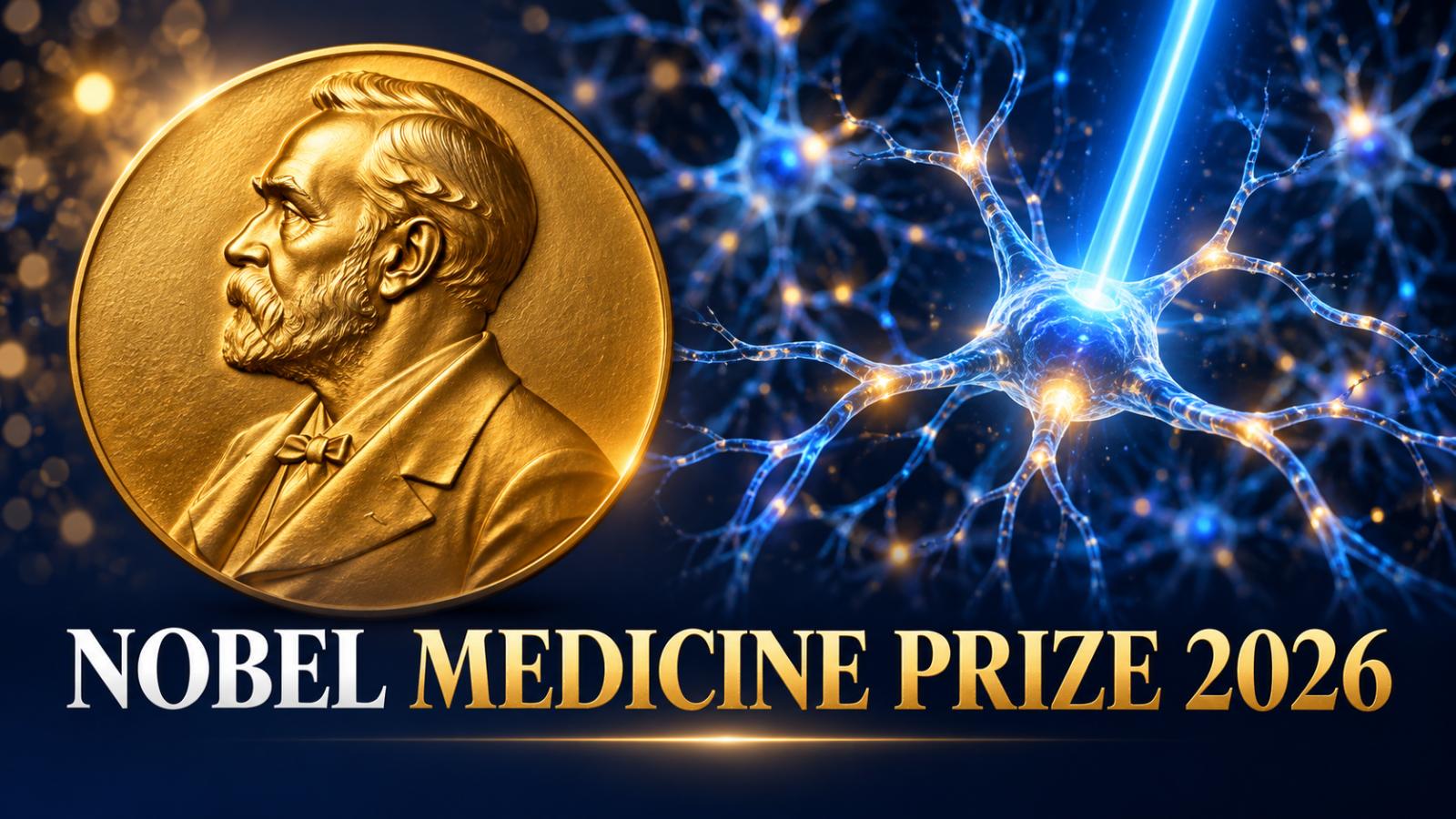
Nobel Medicine Prize Recognises Optogenetics Pioneers
Karl Deisseroth, Peter Hegemann and Georg Nagel have jointly won the 2026 Nobel Prize in Physiology or Medicine for discoveries concerning light-gated ion channels and optogenetics.
The Nobel Assembly at Karolinska Institutet announced the award on Monday, October 5. Their work helped establish a method that allows researchers to control selected nerve cells using light, opening new ways to investigate how brain circuits influence memory, emotions and behaviour. The breakthrough connects discoveries in a microscopic alga with a powerful tool for studying the nervous system.
How Algae Helped Unlock Brain Research
The foundation of the technique emerged from Hegemann and Nagel’s research into Chlamydomonas, a single-celled green alga. They identified channelrhodopsin, a light-sensitive protein that functions as an ion channel. When exposed to blue light, the channel opens and allows charged particles to move across the cell membrane. This movement changes the cell’s electrical activity.
Deisseroth subsequently used the gene for channelrhodopsin in nerve cells, enabling researchers to trigger electrical signals with blue light. The supplied report describes a breakthrough published in 2005, followed by a demonstration in the brains of living mice in 2007. Together, these advances helped establish optogenetics as a practical method for investigating the activity of specific groups of neurons.
Why Optogenetics Matters
Understanding the brain requires more than observing which cells become active. Researchers also need to investigate how particular cells contribute to an action, experience or response.
Optogenetics allows scientists to influence selected nerve cells with precise timing and examine the resulting effects. This gives researchers a way to explore the role of individual circuits within the brain’s complex networks.
The method has become valuable for studying processes associated with learning, memory, emotions and behaviour. Researchers are also investigating potential applications in restoring vision. Those efforts represent an area of continuing research rather than a general treatment available for all forms of visual impairment.
Medicine Award Opens Nobel Week
The Nobel Prize in Physiology or Medicine is among the original awards established through Alfred Nobel’s will and has been presented since 1901. The Nobel Assembly at Karolinska Institutet selects the laureates following an evaluation of nominations. According to the supplied report, the announcement took place at the Nobel Forum in Solna, near Stockholm, and opened the 2026 Nobel announcement week.
Awards in Physics, Chemistry, Literature, Peace and Economic Sciences are scheduled to follow, with the final announcement expected on October 12. The Medicine prize highlights how fundamental discoveries can develop into research tools that change scientists’ understanding of human biology. Editorial note: The official Nobel announcement could not be independently accessed during verification. This rewrite follows the supplied report and omits its unclear prize-money figure.