
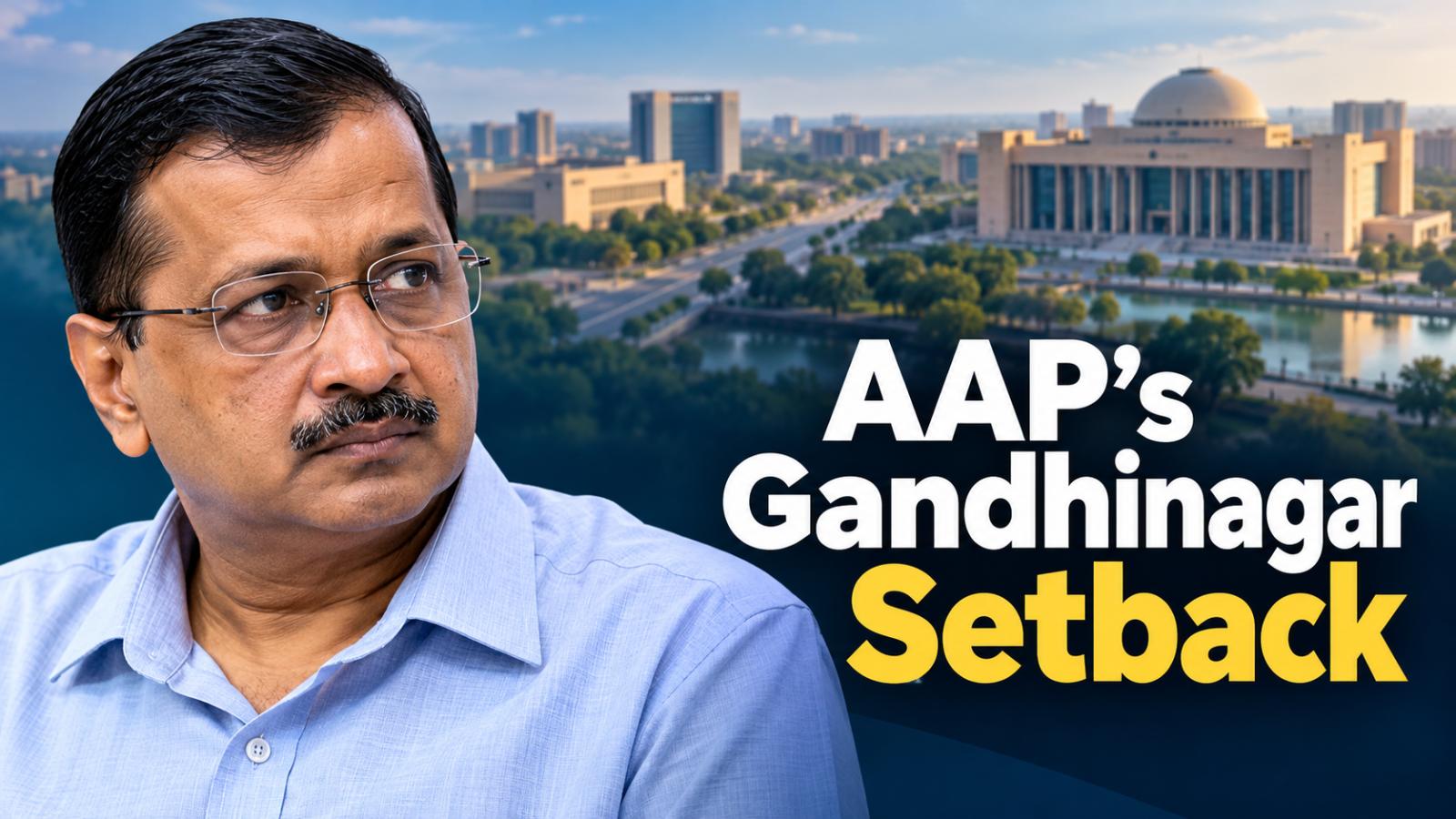
The Aam Aadmi Party suffered a setback in the Gandhinagar Municipal Corporation elections, losing its only seat as its vote share fell sharply. The outcome poses a challenge to Arvind Kejriwal’s efforts to strengthen the party in Gujarat ahead of the 2027 Assembly elections.
According to the figures in the supplied article, AAP’s vote share declined from 21.77% in 2021 to 4.38% in 2026—a fall of 17.39 percentage points. This represents a relative decline of approximately 80%, leaving the party without representation in the 44-member corporation.
The result contrasts with AAP’s earlier foothold in the state capital. However, a municipal election reflects a local contest and cannot, by itself, establish how voters across Gujarat will choose in an Assembly election.
BJP Strengthens Control With 38 Seats
The BJP retained control of the corporation by winning 38 of its 44 seats. Its vote share increased from 46.49% in 2021 to 56.65% in 2026, a gain of 10.16 percentage points. The commanding seat tally underlines the BJP’s strength in Gandhinagar and leaves its opponents with limited representation in the civic body. An Independent candidate secured one seat.
Both the BJP and Congress increased their vote shares while AAP’s share declined. These figures show a changing electoral balance, but they do not establish exactly how individual voters moved between parties.
Congress Gains Votes And Municipal Seats
Congress improved its vote share from 28.02% to 37.05%, an increase of 9.03 percentage points. Its seat tally also rose from two to five. The BJP and Congress therefore registered broadly similar gains in vote share, although their increases were not identical. Congress’s improved performance strengthened its position relative to AAP, but the party remained well behind the BJP in seats.
The outcome highlights the difficulty of converting a substantial vote share into municipal representation. Despite securing more than one-third of the votes, Congress won only five seats, while the BJP secured a large majority.
Kejriwal Faces Gujarat Strategy Test Before 2027
Gujarat has been an important part of Kejriwal’s ambition to expand AAP beyond Delhi and Punjab. The party has campaigned on education, healthcare, electricity subsidies and welfare, seeking to establish itself as another option in a state traditionally dominated by the BJP and Congress. AAP’s local electoral breakthrough in Surat in 2021 provided momentum for its subsequent Assembly campaign. In 2022, the party won five Gujarat Assembly seats and secured 12.92% of the vote. That performance contributed to its recognition as a national party in April 2023.
The Gandhinagar result now raises questions about whether AAP can retain support and build a lasting local organisation. Ahead of 2027, the party faces the task of strengthening its presence, developing credible candidates and turning its welfare agenda into sustained voter support. For Kejriwal, the setback adds pressure to reassess the Gujarat campaign. The result offers a warning from one important urban contest, while the wider Assembly battle will depend on conditions and political choices across the state.