
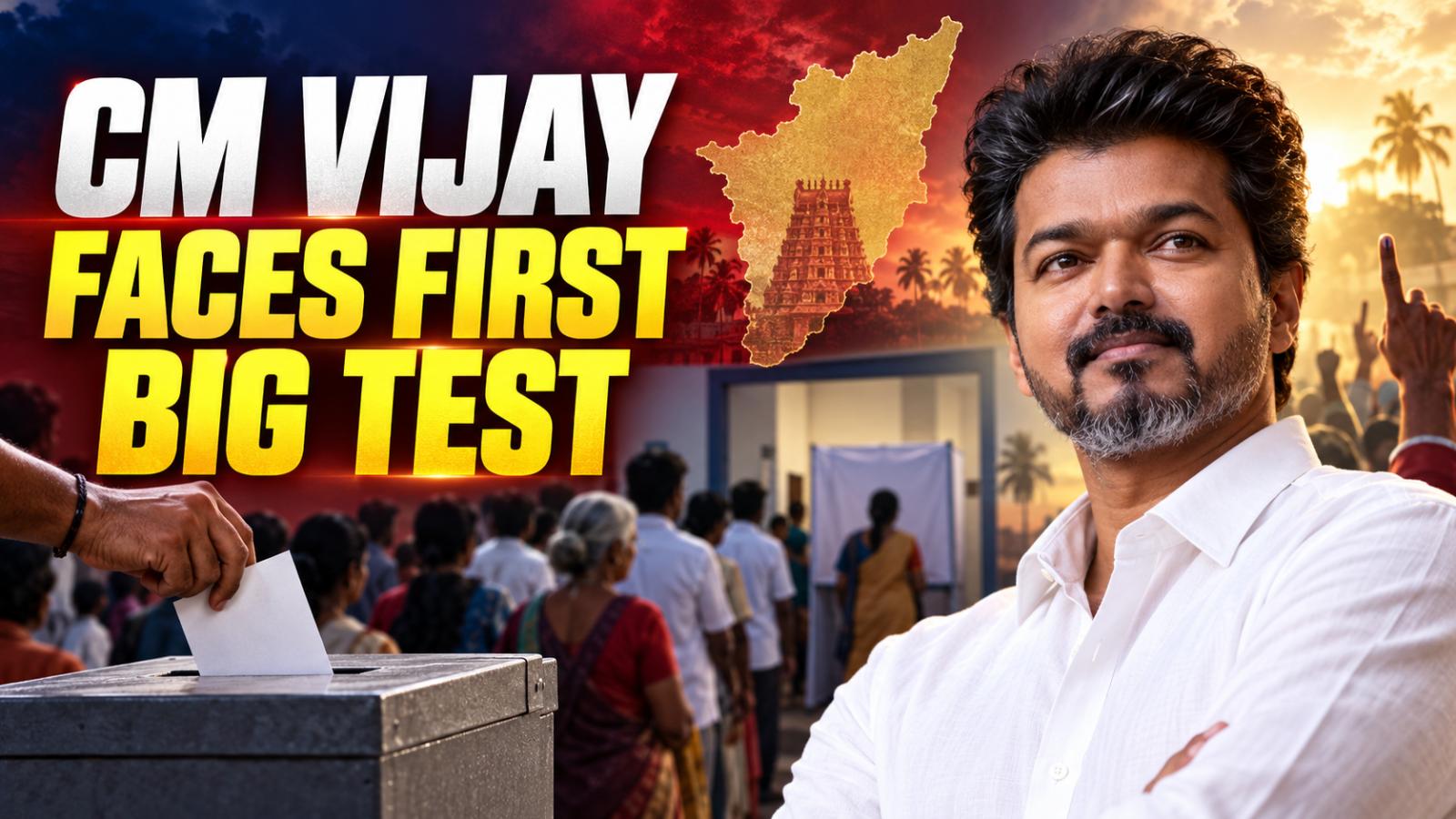
The Election Commission has scheduled polling for the Madurantakam and Dharapuram Assembly by-elections on Tuesday, October 6, 2026, with counting on Friday, October 9. The contests in Tamil Nadu will provide an early electoral assessment of Chief Minister C. Joseph Vijay’s government after its first 100 days in office.
Vijay Government Faces Its First Major Electoral Test
Chief Minister C. Joseph Vijay’s government is preparing for its first significant test at the ballot box, a little over 100 days after it assumed power in Tamil Nadu. The upcoming Assembly by-elections are expected to offer an early indication of how voters view the new administration’s performance, priorities and political direction.
Vijay entered the Chief Minister’s Office after transforming his cinema popularity into a statewide political campaign. His government has since focused on establishing its administrative identity and demonstrating that it can convert electoral enthusiasm into effective governance.
Although a by-election cannot provide a complete assessment of public opinion across Tamil Nadu, the results will carry considerable political importance. A victory would strengthen the government’s claim that its public support remains intact, while an unexpected setback could give opposition parties an opportunity to question its early performance.
The elections will also test the organisational strength of Vijay’s party after its success in the state election. Maintaining political momentum requires more than popularity around a single leader, particularly in constituency-level contests where candidates, local issues and booth-level networks can influence the final outcome.
By-Polls Scheduled in Madurantakam and Dharapuram
The Election Commission has announced by-elections for five Assembly constituencies across Tamil Nadu, Puducherry and West Bengal, along with one Parliamentary constituency in Assam. Polling is scheduled for October 6, 2026, while votes will be counted on October 9.
In Tamil Nadu, elections will be held in only two of the seven vacant Assembly constituencies: Madurantakam and Dharapuram. These contests will attract statewide attention because they are the first electoral battles taking place after Vijay’s government completed its initial 100 days.
Local factors are likely to remain important in both constituencies. Candidate selection, community equations, development concerns and the effectiveness of campaign organisations could prove as influential as the overall assessment of the state government.
The opposition is expected to frame the contests as a referendum on Vijay’s early governance. The ruling party, meanwhile, will seek to present them as an opportunity to reaffirm the mandate it received in the Assembly election.
Court Cases Delay Elections in Five Vacant Seats
By-elections in the remaining five vacant Tamil Nadu constituencies have not been included in the current schedule because of pending court proceedings connected to election petitions.
According to the report, six of the seven seats were previously represented by the AIADMK, while the Trichy East constituency was won by TVK chief C. Joseph Vijay. Legal challenges relating to the earlier election results have prevented the Election Commission from proceeding with by-polls in all the vacant constituencies simultaneously.
As a result, the Madurantakam and Dharapuram elections will provide only a limited snapshot of the political mood. Nevertheless, their timing ensures that every campaign statement, candidate announcement and final vote share will be closely examined by the ruling party and its opponents.
The delayed elections could produce a longer cycle of political tests for Vijay’s government, with the remaining constituencies potentially going to the polls after the legal disputes are resolved.
Results Could Shape the Government’s Early Political Narrative
Vijay’s government may benefit from the absence of strong anti-incumbency because it has been in power for only a short period. However, voter expectations are often highest during the opening months of a new administration, especially when a government comes to power promising a different political and administrative approach.
The ruling party will need to convince voters that its first 100 days have created a credible foundation for longer-term governance. Opposition parties will focus on unfulfilled expectations, administrative shortcomings and constituency-specific concerns to challenge that narrative.
A clean victory in both seats would boost Vijay’s authority and reinforce his party’s electoral momentum. A split verdict could suggest a more competitive political environment, while defeats would intensify scrutiny of the government’s early record and campaign machinery.
Whatever the outcome, the Madurantakam and Dharapuram by-polls will be viewed as Vijay’s first major encounter with voters after becoming Chief Minister. The results will not determine the government’s future on their own, but they could significantly influence Tamil Nadu’s political debate in the months ahead.