

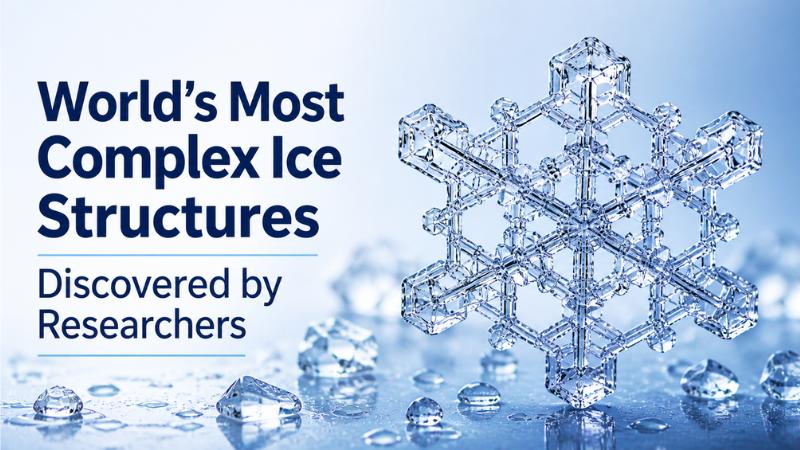
Physicists Discover Most Complex Ice Forms Ever Identified
Scientists have identified new, highly complex forms of ice, revealing surprising behaviors of water under extreme conditions. Water is far more complex than it appears. While commonly known as a simple frozen substance, ice can exist in multiple solid forms depending on temperature and pressure. Since the early 1900s, scientists have identified over 20 different phases of ice, each with a unique molecular arrangement. Recent advancements in simulations suggest that thousands of additional forms could theoretically exist, especially in extreme environments such as distant planets and icy moons.
In the past year, researchers have made significant progress by discovering three new types of ice, including some of the most complex structures ever observed. These breakthroughs were achieved by applying extreme pressure to water using advanced laboratory techniques. By carefully controlling how water is compressed, scientists observed unusual structural transformations, highlighting how sensitive water molecules are to changes in their environment.
One of the most remarkable discoveries is a phase known as ice XXI. Initially appearing disordered, this structure revealed a repeating molecular pattern when studied closely. It consists of an intricate arrangement of 152 molecules, making it one of the most complex ice forms ever recorded. Soon after, scientists identified another phase called ice XXII, which is even more complex, with a repeating pattern involving 304 molecules. These findings show that water does not always transition directly into its most stable state but often moves through intermediate phases.
Researchers have also discovered a rare form called plastic ice VII, where water molecules remain in a solid structure but rotate rapidly in place. This unusual phase occurs under extreme heat and pressure and was detected using advanced neutron-based techniques. Such forms of ice are believed to exist deep within icy planets and moons, offering valuable insights into extraterrestrial environments and planetary science.
These discoveries have important implications beyond physics. Understanding how water behaves under different conditions can impact fields like materials science and pharmaceuticals, where changes in crystal structures can influence performance and stability. As experimental techniques continue to improve, scientists expect to uncover even more surprising forms of ice, proving that even the most familiar substances can still hold extraordinary secrets.