
Centre Clarifies Indian Passport and Citizenship Rules
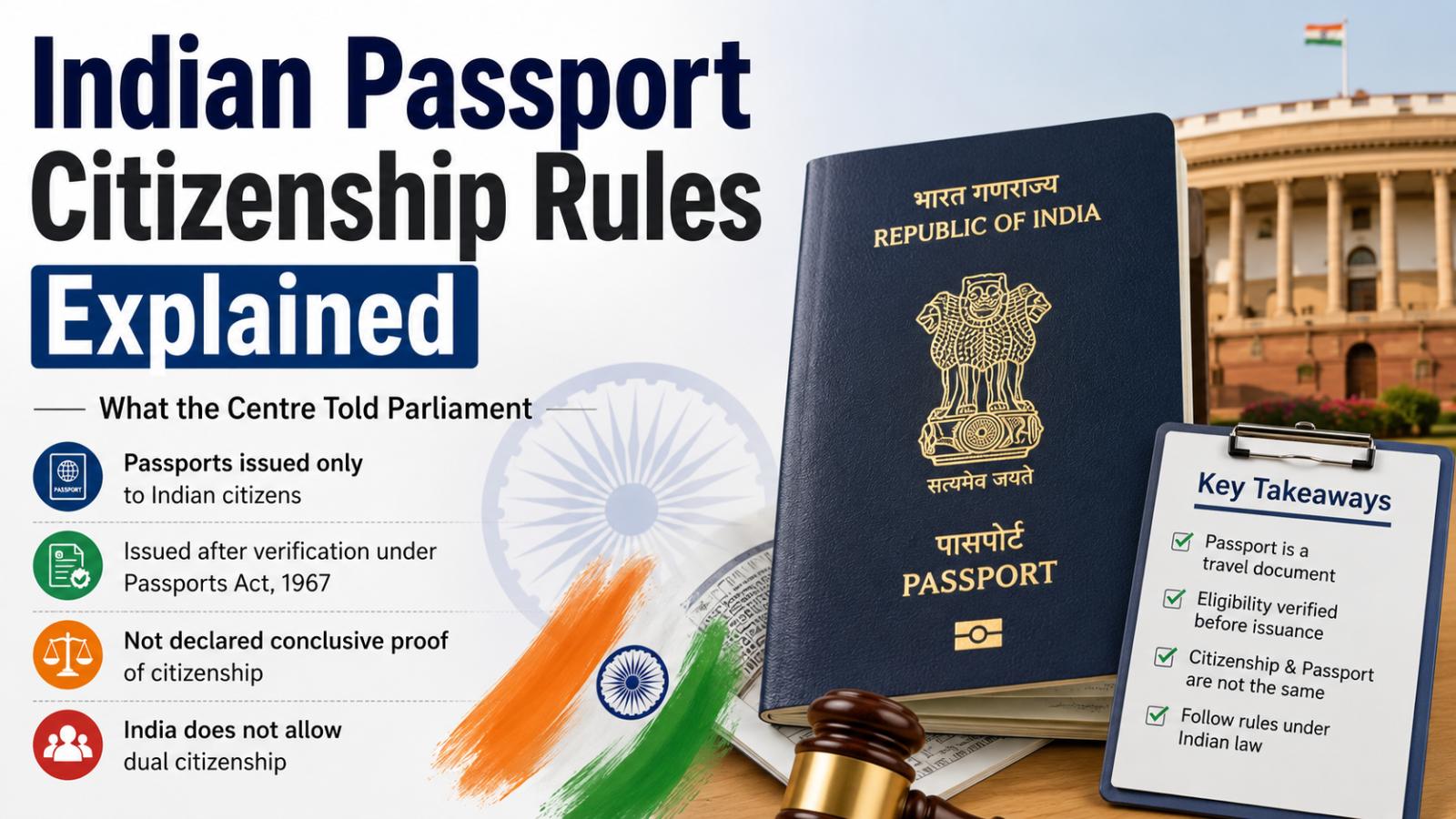
The Centre has told Parliament that Indian passports are issued to eligible Indian citizens following verification under the Passports Act, 1967. However, it did not directly declare a passport conclusive standalone proof of citizenship, renewing discussion about citizenship documents in India.
Is Indian Passport Proof of Citizenship? Centre Clarifies
Is an Indian passport conclusive proof of citizenship? The Union government has clarified that Indian passports are issued to eligible Indian citizens after verification, but it has stopped short of describing the document as definitive or conclusive proof of citizenship.
The clarification was provided in a written reply in the Rajya Sabha after MP Abdul Wahab raised questions about passport eligibility, citizenship verification, foreign nationality and India’s position on dual citizenship. Minister of State for External Affairs Kirti Vardhan Singh said passports are issued under the Passports Act, 1967, through an established verification process.
Is Indian Passport Conclusive Proof of Citizenship?
The government did not provide a direct yes-or-no response when asked whether an Indian passport should be treated as conclusive proof of Indian citizenship.
Instead, the minister described it as a travel document issued by the Government of India to regulate the departure of Indian citizens from the country. The reply also emphasised that the document is granted only after the prescribed verification process has been completed.
In practical terms, the response distinguishes between eligibility for a passport and the passport’s status as standalone legal evidence. Citizenship is checked before an eligible applicant receives a passport, but the Centre has not declared that the document must conclusively settle every citizenship-related question.
What the Passports Act, 1967 Says
The Passports Act, 1967 governs the issue of passports and travel documents and regulates departure from India. Its provisions include application procedures, grounds for refusing a passport, passport duration, revocation and penalties for violations.
The government’s Parliament reply said that an applicant’s eligibility is examined through the verification system prescribed under the Act and its rules. Therefore, obtaining an Indian passport involves citizenship-related scrutiny, identity checks and other required verification.
However, the latest reply did not identify any single government-issued document as universally conclusive proof of Indian citizenship.
What Happens After Acquiring Foreign Citizenship?
The Centre also reiterated that India does not permit dual citizenship under its existing constitutional and statutory framework.
Section 9 of the Citizenship Act, 1955 states that an Indian citizen who voluntarily acquires the citizenship of another country ceases to be an Indian citizen, subject to the provisions and determination process laid down in the law.
This means Indian citizenship and Overseas Citizenship of India status should not be treated as the same. OCI provides specified facilities to eligible foreign citizens of Indian origin, but it is not equivalent to holding full Indian citizenship.
How Can a Foreign National Become Eligible?
A foreign national does not become an Indian citizen merely by obtaining identity or residence documents. Indian citizenship may be acquired through legally recognised routes such as birth, descent, registration or naturalisation, depending on the person’s circumstances and statutory eligibility.
After citizenship has been legally granted and the necessary records have been updated, the person may apply for an Indian passport through the regular passport application and verification process.
Why the Clarification Matters
The Parliament reply is significant because it addresses two related but separate questions. First, the government maintains that Indian passports are issued following citizenship and identity verification. Second, it has not explicitly labelled the passport as conclusive standalone proof of citizenship in every legal or administrative situation.
For citizens, the safest approach is to retain supporting records connected with birth, parentage, naturalisation or registration, particularly when citizenship status must be established before a competent authority.
The original report and Parliament-related details were supplied in the uploaded source material.