
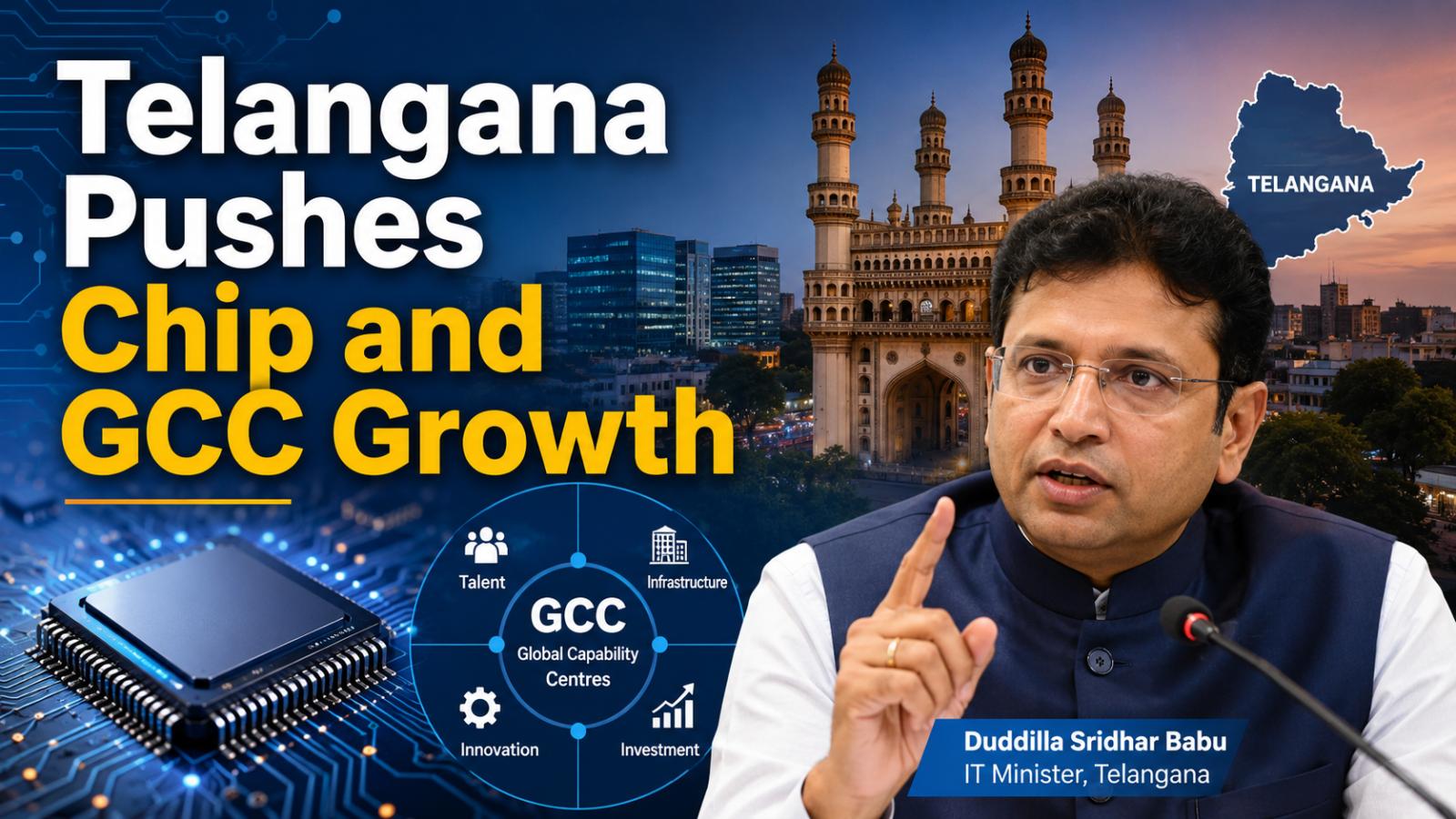
Sridhar Babu Outlines Telangana’s Chip and GCC Growth Vision
Telangana IT Minister D Sridhar Babu said the state will continue seeking ISM 2.0 support for chip manufacturing while positioning Hyderabad as a growing GCC hub. He also outlined plans to attract technology investment to tier-2 and tier-3 cities.Sridhar Babu Outlines Telangana’s Chip and GCC Growth Vision
Bengaluru: Telangana is seeking stronger support under the India Semiconductor Mission for semiconductor projects while accelerating Hyderabad’s growth as a Global Capability Centre hub, state IT Minister Duddilla Sridhar Babu said at the Rising Bharat Summit 2026.
Explaining the Telangana ISM support sought for semiconductor projects, Babu said the state possesses a strong chip-design ecosystem but requires central incentives to move into large-scale semiconductor manufacturing. He also outlined plans to expand technology investment beyond Hyderabad into Telangana’s tier-2 and tier-3 cities.
Infrastructure and Talent Drive Hyderabad’s GCC Growth
Babu attributed Hyderabad’s growing appeal among multinational companies to investments made over several decades in physical infrastructure, digital connectivity, skilled talent, and innovation.
He highlighted the Outer Ring Road, international airport, and HITEC City as major projects that improved Hyderabad’s connectivity and business environment. Optical-fibre networks extending to villages have also strengthened Telangana’s ability to support technology operations outside the capital.
According to the minister, companies evaluate talent availability, land, infrastructure, and government support before selecting an investment destination. Telangana has therefore increased its focus on reskilling and upskilling professionals in artificial intelligence, cybersecurity, and data analytics.
Diverse Industries Establish GCCs in Hyderabad
Hyderabad’s GCC ecosystem is no longer limited to conventional software companies. Babu said capability centres representing aerospace, defence, pharmaceuticals, hospitality, financial services, and beauty technology have established operations in the city.
The banking, financial services, and insurance sector is also expanding rapidly. The combination of technology expertise and established industries gives Hyderabad an advantage when competing with Bengaluru, Chennai, Pune, Mumbai, Noida, and international technology destinations.
Babu said Telangana provides industrial approvals and licences within 21 days. Applications that are not cleared within the stipulated period may qualify for deemed approval under the state’s ease-of-doing-business framework.
Telangana Seeks ISM Support for Semiconductor Projects
Turning to semiconductor manufacturing, Babu alleged that Telangana had experienced “step-motherly treatment” in the allocation of incentives under the India Semiconductor Mission.
He said Hyderabad already hosts leading chip-design companies and professionals who design semiconductors for Indian and international businesses. However, proposals seeking support for manufacturing facilities must be considered by the Central Government under the mission.
The minister argued that states with established technical capabilities should receive fair opportunities to develop manufacturing capacity. Telangana will continue presenting its case to the Centre and hopes to receive an appropriate share of support under ISM 2.0.
He clarified that Telangana was not opposing semiconductor investments approved in other states. Instead, it wanted the Centre to encourage every state capable of building a competitive chip-manufacturing ecosystem.
GCC Expansion Planned Beyond Hyderabad
The Telangana government is also developing policies to attract GCCs and technology companies to tier-2 and tier-3 cities. Incentives and subsidies are being considered for companies establishing operations outside Hyderabad.
Babu said digital infrastructure and skilled workers are already available in smaller cities and villages. Distributing investment more widely could create employment opportunities while reducing excessive dependence on Hyderabad.
The government wants Global Capability Centres to evolve into “Value Centres” that undertake innovation, research, product development, and strategic decision-making rather than functioning only as back-office operations.
Telangana Prepares for AI and Data Centre Investment
Data centres are another important part of Telangana’s technology strategy because artificial intelligence companies require substantial computing capacity.
Acknowledging concerns about water and electricity consumption, Babu said the state was developing the necessary power, water, and physical infrastructure to support future data-centre investments.
Telangana’s broader strategy combines GCC expansion, semiconductor manufacturing, artificial intelligence, skilled talent, and decentralised technology development. Its success, however, may depend partly on securing Central Government support for major chip-manufacturing proposals.