
SpaceX Starfall Capsule Launch Comes Amid $600 Billion IPO Selloff
SpaceX is facing a defining week as it prepares to test its new Starfall re-entry capsule while investors question the company’s valuation after a sharp post-IPO market selloff.
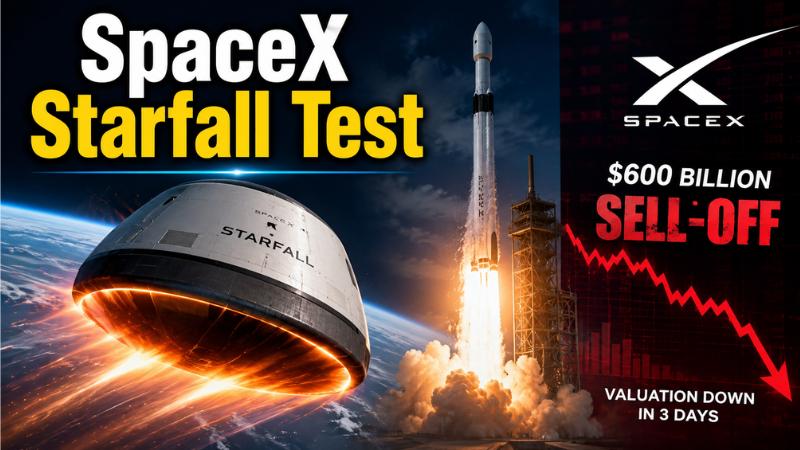
The Starfall mission is scheduled for launch on June 23 aboard a Falcon 9 rocket from Cape Canaveral Space Force Station in Florida. The mission is expected to test whether the compact spacecraft can safely return cargo and space-manufactured materials from orbit back to Earth.
At the same time, SpaceX is dealing with pressure in the stock market after reportedly losing nearly $600 billion in market value over three trading sessions following its historic IPO listing.
What Is The SpaceX Starfall Capsule?
Starfall is a small autonomous re-entry vehicle designed to bring valuable payloads back from low-Earth orbit. Unlike SpaceX’s Dragon spacecraft, which is built to carry crew and cargo, Starfall is focused mainly on frequent and lower-cost cargo return.
The capsule has a disc-shaped design and is expected to use a heat shield during atmospheric re-entry before deploying parachutes for splashdown in the Pacific Ocean. The test mission will check its re-entry performance, parachute system, communication stability and recovery process.
The project is important because it could support the future of in-space manufacturing. Some materials, medicines, and advanced technologies may be produced more efficiently in microgravity, but companies need reliable return vehicles to bring those products safely back to Earth.
Why The Starfall Mission Matters
If successful, Starfall could help SpaceX build a new class of spacecraft focused not on astronauts, but on returning high-value materials from space.
This could open fresh commercial opportunities in pharmaceuticals, advanced materials, research payloads, and orbital manufacturing. SpaceX is also expected to use data from the mission to improve future cargo-return systems.
For the space industry, the mission is more than just another launch. It is a test of whether returning products from orbit can become faster, cheaper, and more routine.
IPO Euphoria Meets Market Reality
While SpaceX is pushing ahead with its space technology plans, investors are taking a closer look at the company’s financial position after its recent IPO rally.
The company’s valuation had reportedly climbed close to $3 trillion after strong investor demand. Much of that enthusiasm came from Elon Musk’s long-term vision, SpaceX’s rocket business, satellite network, and its positioning around artificial intelligence infrastructure.
However, the excitement has cooled after the company announced plans to raise money through a bond offering. Investors were surprised because SpaceX had already disclosed a large cash position, raising questions about why it needed more funds.
Investor Concerns Grow Over Losses
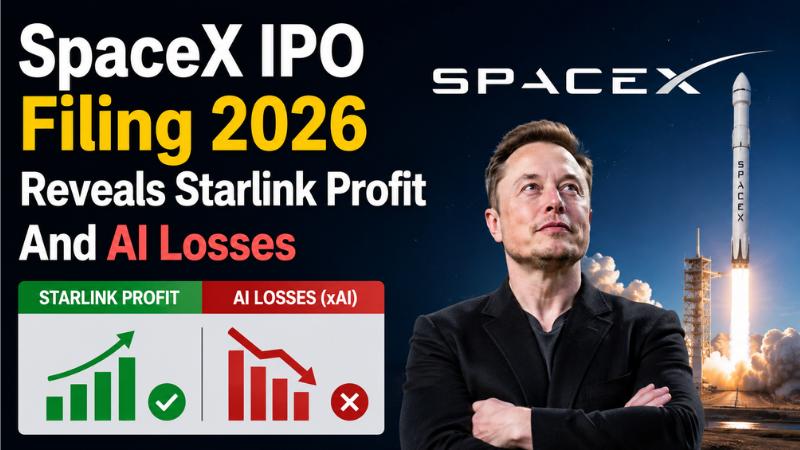
The selloff also reflects concern over profitability. SpaceX has reported strong revenue growth, but it continues to spend heavily on Starship development, AI infrastructure, data centres, and other expansion plans.
Investors may still believe in the company’s long-term vision, but the recent decline shows that markets are becoming more selective. Companies linked to artificial intelligence and future technology are now being judged not only on ambition, but also on financial discipline and visible returns.
A Crucial Test For SpaceX
The Starfall mission and the IPO selloff together show the two sides of SpaceX’s current journey.
On one side, the company is attempting to prove new space technology that could support future industries beyond Earth. On the other, investors are asking whether its valuation is justified by today’s business performance.
Even after the market decline, SpaceX remains one of the world’s most closely watched technology companies. The success of Starfall may not solve investor concerns immediately, but it could strengthen the company’s argument that its long-term space economy plans are more than just ambition.
For now, SpaceX has two tests ahead: proving Starfall can return safely from orbit and proving to investors that its future growth can match its massive valuation.