

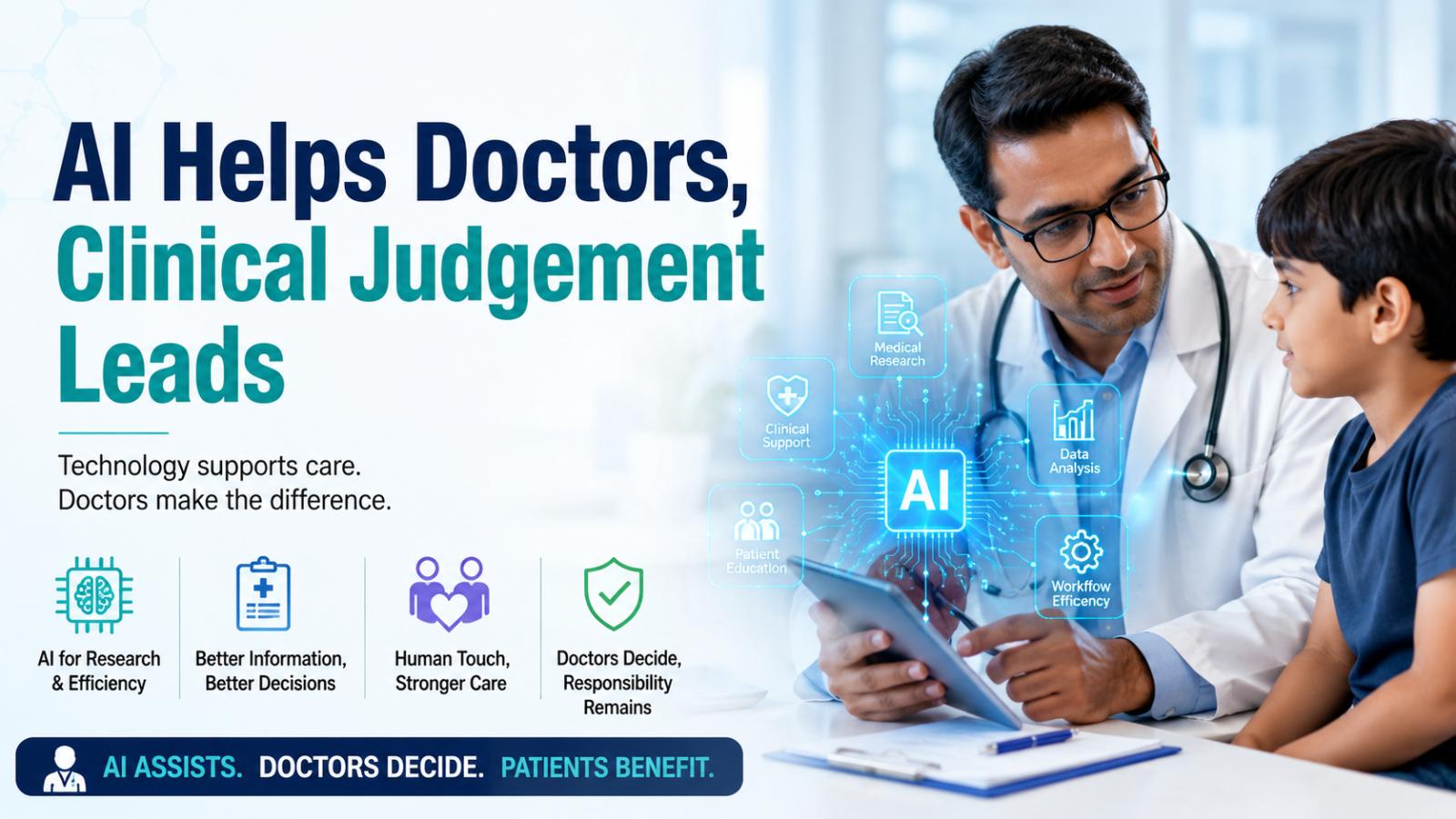
Why AI Cannot Replace Doctors’ Clinical Judgement
Artificial intelligence is helping doctors review research, organise records, and improve patient communication. However, clinical judgement, empathy, and treatment responsibility remain with medical professionals, making AI a support tool rather than a replacement for doctors.
Technology Is Becoming a Medical Assistant
Artificial intelligence is helping doctors review research, organise records, and explain treatments more clearly. Yet specialists say AI cannot replace doctors’ clinical judgement because diagnosis, empathy, physical examination, and ethical responsibility still depend on trained medical professionals.
New Delhi, July 23, 2026: Artificial intelligence is increasingly becoming part of everyday medical work, but doctors continue to remain responsible for every diagnosis and treatment decision.
Dr Nikhil Rajvanshi, a paediatric pulmonologist, allergy specialist and sleep specialist, says he uses AI regularly to manage information and reduce time-consuming administrative work. However, he does not depend on it to diagnose illnesses, prescribe medicines, or make independent clinical decisions.
Instead of viewing AI as a replacement for doctors, he believes it should be treated as an intelligent assistant that allows medical professionals to spend more time with patients.
How Doctors Use AI in Daily Practice
Modern doctors must manage consultations while also reviewing new studies, monitoring changing clinical guidelines, maintaining records, and preparing information for patients.
AI tools can help summarise lengthy medical research, compare recommendations from different guidelines, and organise academic notes. They can also support doctors while preparing presentations, improving documentation, and creating educational material in a language that patients and families can understand.
These tasks may appear routine, but together they occupy a significant part of a doctor’s working day. Reducing that workload can give doctors more time to listen to patients, answer questions, and explain treatment plans without rushing.
For families dealing with childhood asthma, allergies, chronic coughing, sleep disorders, or recurring respiratory infections, reassurance and clear communication can be as important as receiving a prescription.
Why AI Cannot Replace Doctors’ Clinical Judgement
AI systems can process large amounts of information quickly, but they cannot fully understand the individual circumstances surrounding every patient.
Two children with similar symptoms may have different medical histories, living conditions, environmental exposure, emotional needs, and treatment goals. Identifying these differences requires examination, observation, experience, and direct communication.
A doctor may notice how a child breathes while entering the consultation room or recognise worry in a parent’s voice. Medical professionals also build relationships with families over repeated visits, allowing them to understand changes that may not appear in a test report.
AI cannot reproduce this combination of clinical intuition, empathy, and long-term trust.
It can provide information, but the treating doctor must decide whether that information is accurate, relevant and suitable for the individual patient.
Medical AI Can Still Produce Incorrect Answers
One of the biggest risks is assuming that every AI-generated response is correct because it appears detailed or confident.
AI systems can misunderstand medical questions, provide incomplete information, or generate answers that sound convincing despite containing errors. In healthcare, even a minor mistake can compromise patient safety.
Doctors must therefore verify AI-generated information using trusted clinical guidelines, peer-reviewed evidence, and the patient’s actual medical condition. Responsibility for treatment must remain with the qualified medical professional.
Proper AI training is also becoming important for doctors. Medical professionals need to understand how to ask precise questions, recognise unreliable answers, and know when an AI suggestion should be ignored.
Privacy and Accountability Remain Essential
The growing use of AI in hospitals also raises concerns about patient privacy, data security, and transparency.
Healthcare institutions require clear policies that outline how patient information is processed, stored, and protected. Patients should also understand when technology is being used as part of their care.
AI should strengthen the relationship between doctors and patients rather than create confusion about who is responsible for a medical decision.
Doctors and AI Can Work Together
AI is likely to become increasingly common in hospitals, helping organise information, improve workflows, and provide quicker access to medical knowledge.
However, the future of healthcare is unlikely to become a competition between doctors and machines. A safer model is one in which AI handles information-based tasks while doctors provide judgment, communication, ethical responsibility, and human understanding.
Technology can help doctors work more efficiently. It cannot replace compassion, clinical experience or the trust patients place in the medical professional caring for them.