
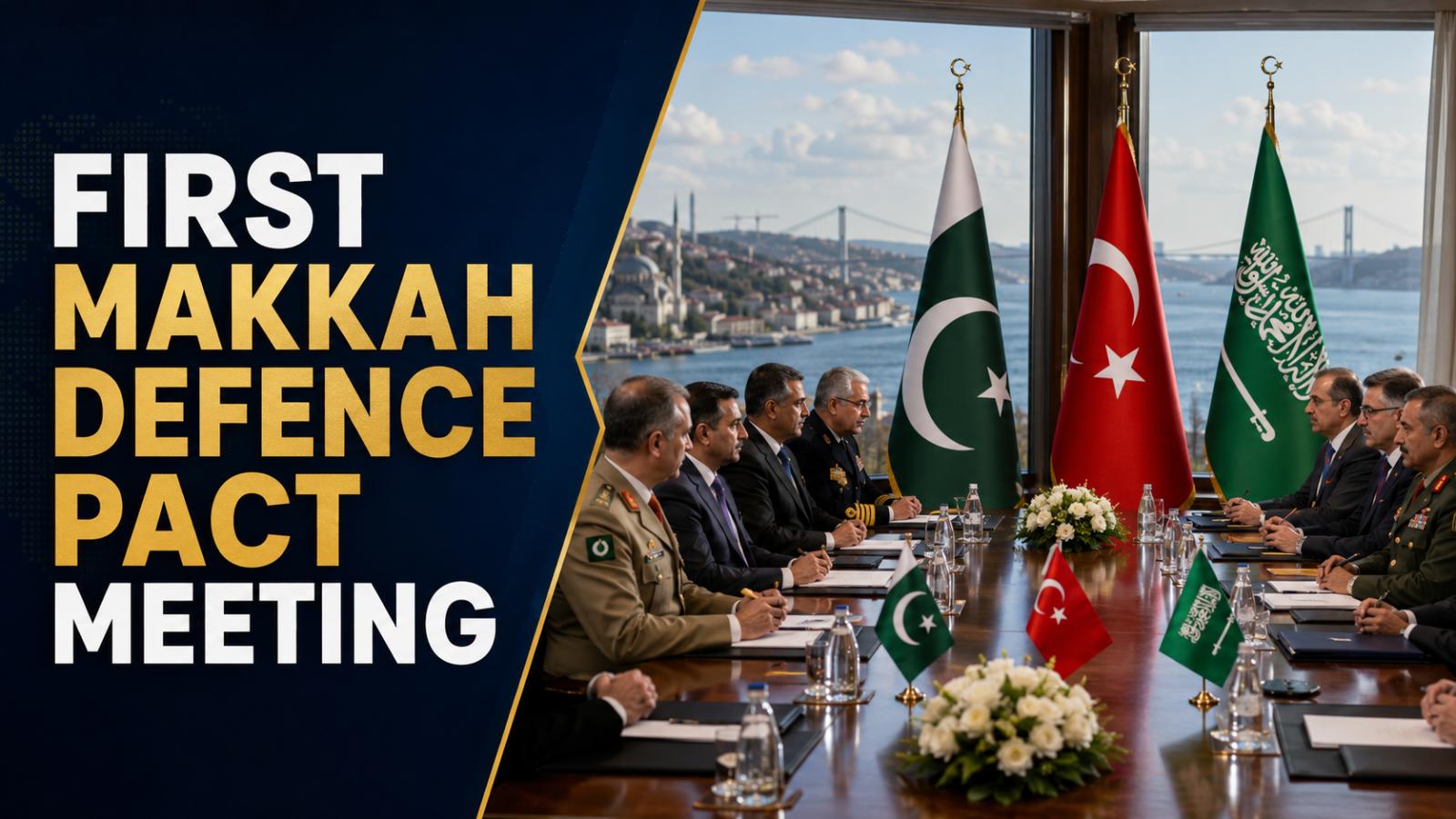
Pakistan, Türkiye and Saudi Arabia will hold the inaugural meeting of the Makkah Accord’s Strategic Political and Defence Committee.
Pakistan sends senior delegation to Istanbul meetingPakistan, Türkiye and Saudi Arabia are set to hold the first meeting of a high-level committee created under their new trilateral Makkah Joint Defence Agreement in Istanbul on Monday.
The inaugural session of the Strategic Political and Defence Committee will bring together senior diplomatic and military officials from the three countries. The meeting marks the first formal step toward implementing the defence pact signed in Makkah on August 7.
Pakistan will be represented by Deputy Prime Minister and Foreign Minister Mohammad Ishaq Dar, Defence Minister Khawaja Muhammad Asif and Chief of Army Staff and Chief of Defence Forces Field Marshal Syed Asim Munir.
Pakistan’s Foreign Office said the country’s participation reflects its longstanding ties with Türkiye and Saudi Arabia and its stated commitment to regional peace and stability.
Türkiye hosts foreign and defence leadershipTürkiye’s delegation will include Foreign Minister Hakan Fidan, National Defence Minister Yaşar Güler and Chief of the General Staff General Selçuk Bayraktaroğlu. Saudi Arabia will also send its foreign and defence ministers and senior military leadership. The committee is expected to discuss how the three countries will coordinate political consultations, military planning and defence cooperation under the agreement.
The session could also address military interoperability, defence technology, joint production and mechanisms for responding to security threats. The complete agenda, however, had not been publicly released before the meeting.
Türkiye’s Foreign Ministry officially confirmed Istanbul as the venue and said the session would be the committee’s first meeting since the pact was established.
Makkah Defence Pact includes collective security clauseThe Makkah Joint Defence Agreement contains a collective-defence provision stating that an armed attack against one of the three signatories will be regarded as an attack against all.
Pakistan, Türkiye and Saudi Arabia have described the pact as defensive and intended to strengthen deterrence rather than target a particular country. Its collective-security language has drawn comparisons with Article 5 of the NATO treaty, although the new pact’s command structure and operational procedures have not been fully disclosed.
The agreement brings together three countries with different strategic strengths. Türkiye is a NATO member with a large military and expanding defence industry, Pakistan possesses significant armed forces and nuclear capabilities, while Saudi Arabia has substantial financial and energy influence.
The Istanbul meeting is expected to show how the broad commitments announced in Makkah could be translated into institutional and operational cooperation. The pact was signed amid growing security concerns and military tensions across West Asia.
Makkah Accord could attract additional membersThe agreement has the potential to expand beyond its three founding countries. Bangladesh has indicated that it is considering participation, although no formal accession has been completed.
Pakistan has said the arrangement is open to other countries willing to accept its principles, including peaceful dispute resolution and collective security. Any expansion would increase the pact’s geopolitical importance and could influence defence alignments across South Asia, the Gulf and the wider Muslim world.
The inaugural committee meeting will be closely watched for signs of a permanent institutional structure, joint military exercises or coordinated defence procurement. It may also clarify how the agreement will operate alongside Türkiye’s NATO obligations and the separate security relationships maintained by Pakistan and Saudi Arabia with other global powers. The Istanbul session represents the transition of the Makkah Accord from a political declaration to a working defence framework among the three signatories.