
Andy Burnham Emerges As Top UK PM Contender After Starmer Resignation
London, June 22, 2026: British politics has entered a crucial leadership moment after Keir Starmer announced his resignation as Prime Minister and Labour Party leader, opening the race for a new leader at a time of growing pressure within the ruling party.
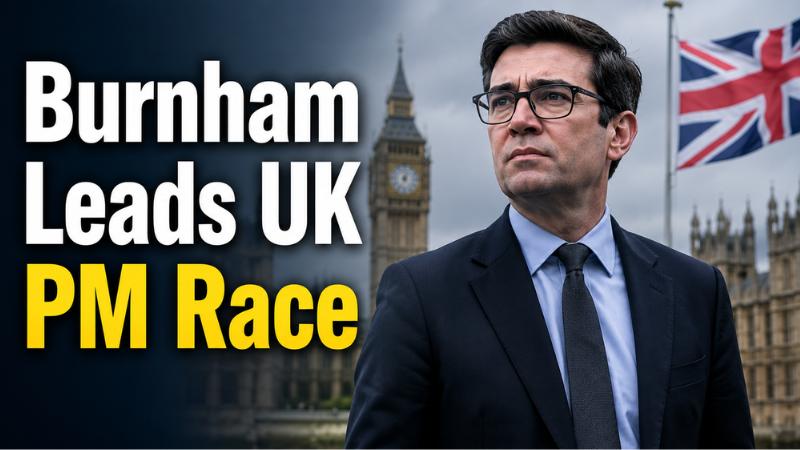
At the centre of the spotlight is Andy Burnham, the former Greater Manchester mayor and newly elected Makerfield MP, who is widely being discussed as one of the strongest contenders to replace Starmer. Known across British politics as the “King of the North,” Burnham’s return to Westminster has added fresh momentum to the Labour leadership debate.
For global readers, including those in India, the leadership change matters because Britain’s next Prime Minister will influence key areas such as UK-India relations, trade, immigration policy, student visas, work opportunities, and the country’s wider foreign-policy direction.
Why Andy Burnham Is Suddenly In Focus
Andy Burnham’s rise in the current leadership discussion is not sudden in political terms. He has been a familiar Labour figure for more than two decades and has built a reputation as a politician who speaks strongly for regions outside London.
Burnham served as MP for Leigh from 2001 to 2017 and held several senior roles in government, including Health Secretary, Culture Secretary, and Chief Secretary to the Treasury under former Prime Minister Gordon Brown.
After leaving Westminster, he became the first directly elected Mayor of Greater Manchester in 2017. That move reshaped his political image. Instead of being seen only as a Westminster politician, Burnham became known as a regional leader focused on transport, public services, housing, and devolution.
His latest win in the Makerfield by-election has brought him back to Parliament at a sensitive moment for Labour. With Starmer stepping down, Burnham is now being viewed by many supporters as a leader who can offer the party a different direction.
The ‘King Of The North’ Image
Burnham’s nickname, “King of the North,” became popular during the Covid-19 pandemic, when he publicly challenged the then Conservative government over financial support for northern England during lockdown restrictions.
He argued that workers and businesses in northern regions were not receiving fair treatment compared with London and the South East. That confrontation made him a symbol of northern England’s frustration with what many saw as London-centred politics.
The nickname also carried a pop-culture reference to Game of Thrones, but in British politics it came to represent something more serious: regional identity, working-class concerns and the demand for stronger local powers.
That image continues to help Burnham. At a time when Labour is trying to rebuild public trust and respond to internal criticism, his supporters believe he can speak to voters who feel ignored by traditional Westminster politics.
Can Burnham Reconnect Labour With Working-Class Voters?
One of the biggest reasons Burnham is gaining attention is his perceived ability to reconnect Labour with working-class voters.
Many Labour supporters believe the party needs a leader who can speak more directly to communities outside London, especially in northern England and post-industrial towns. Burnham’s political brand fits that argument because he has spent years highlighting regional inequality, public transport, local jobs, and public services.
As mayor, Burnham focused heavily on regional devolution and local governance. His most visible project was the Bee Network, Greater Manchester’s integrated transport system, which brought buses and trams under a more unified structure.
He also pushed for skills programmes, local economic development, and affordable housing. Supporters say these efforts helped raise Greater Manchester’s national profile and showed that devolved leadership can deliver practical results.
However, critics argue that Burnham’s record is not perfect. Some point to unmet targets on homelessness, while others say certain transport reforms were already in planning before his tenure. These questions are likely to return if he formally moves closer to the Prime Minister’s office.
Starmer’s Exit Changes Labour’s Direction
Keir Starmer’s resignation has created one of the most important moments for Labour since it returned to power. The party must now choose a leader who can steady the government, manage internal divisions and prepare for future electoral challenges.
Burnham’s advantage is that he already has national recognition, a clear political identity, and a strong support base among members who want a more regional and working-class-focused Labour message.
His challenge is equally clear. Being popular in northern England is different from leading the entire United Kingdom. A Prime Minister must appeal not only to Labour members, but also to voters across England, Scotland, Wales, and Northern Ireland.
That means Burnham will need to show that his leadership can go beyond regional identity and offer a national plan on the economy, public services, immigration, foreign policy and Britain’s place in the world.
What Makes Burnham A Strong Contender?
Burnham has three clear strengths in the current race.
First, he has experience in both national and regional government. He has served in Parliament, worked in senior cabinet roles and led one of the UK’s most important city-regions.
Second, he has a strong personal brand. The “King of the North” label gives him a clear identity at a time when voters often respond to leaders who appear direct and recognisable.
Third, he is seen by many Labour supporters as someone who can speak to voters who have drifted away from the party or feel disconnected from national politics.
These strengths explain why Burnham’s return to Westminster has created so much interest. His supporters see him as a practical, emotionally direct, and regionally rooted leader who could reset Labour’s image.
The Big Question Before Labour
The central question now is whether Burnham can convert public attention into party support.
A leadership race requires more than popularity. It demands backing from MPs, party members, and senior figures. Burnham will also need to convince critics that he has a serious national programme and not just a strong regional reputation.
His past defeats in Labour leadership contests may also be discussed again. Burnham previously attempted to lead the Labour Party but did not succeed. This time, however, the political environment is different. He returns with years of mayoral experience, stronger public recognition, and a clearer political identity.
Why This Matters Beyond Britain
The next UK Prime Minister will inherit major domestic and international responsibilities. Britain is dealing with economic pressure, public-service challenges and questions over immigration, trade and global partnerships.
For India and the wider global audience, the leadership change could influence visa policy, business ties, student movement, technology cooperation, and the future tone of UK foreign policy.
That is why Burnham’s rise is not just a British political story. It is also a global leadership story at a time when the UK is searching for stability and direction.
What Happens Next?
Labour is expected to move through its leadership process as attention remains fixed on Burnham and other possible contenders. If Burnham continues to gain support, he could move from being the “King of the North” to becoming the face of Britain’s next government.
For now, Andy Burnham has returned to Westminster at exactly the moment Labour is looking for a new direction. Whether he becomes the next UK Prime Minister or not, his comeback has already reshaped the race to replace Keir Starmer.