Why ITPI’s Authority Over Planning Colleges Is Under Scrutiny
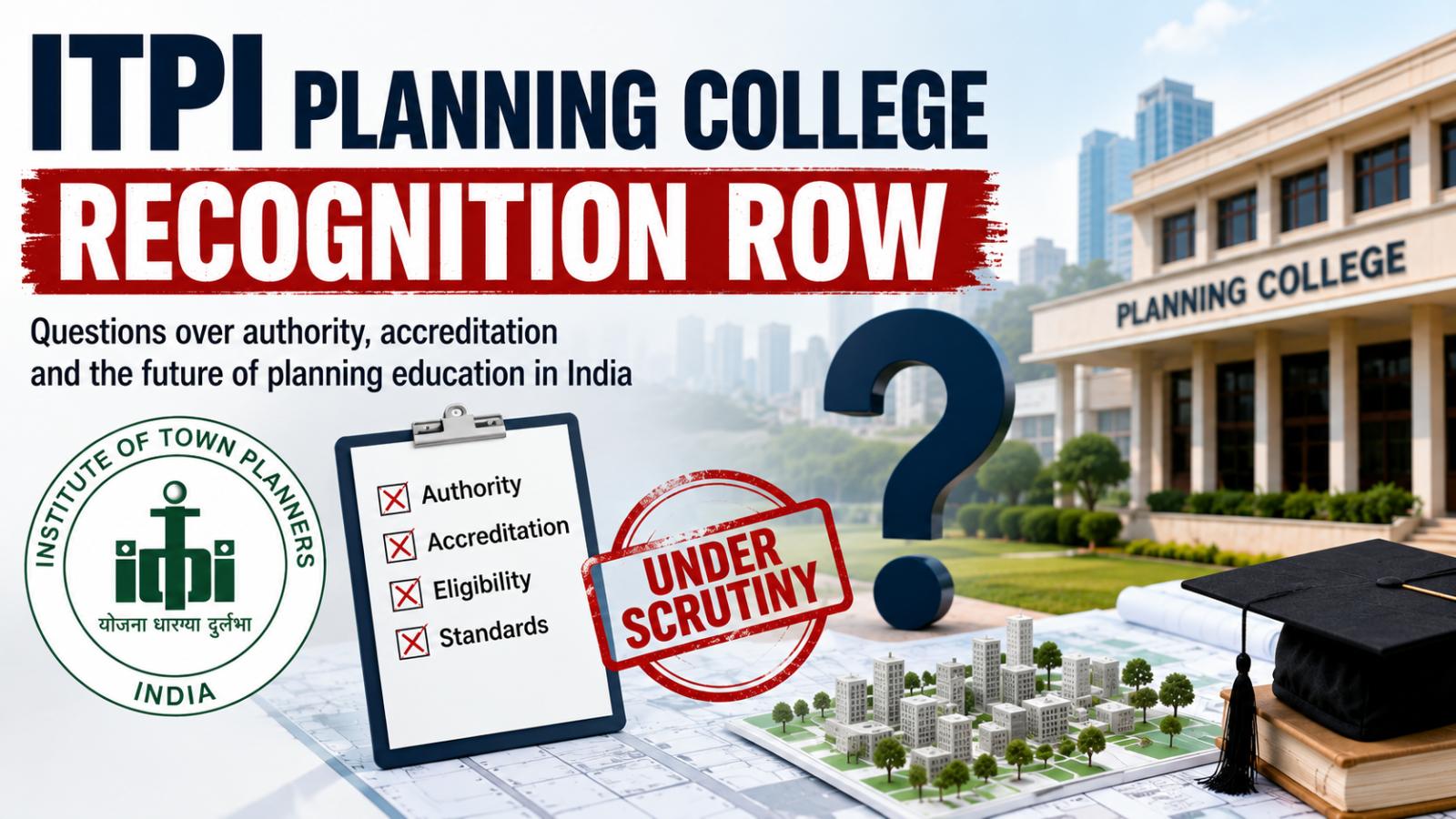
The ITPI planning college recognition row has renewed concerns about who can legally approve planning institutions in India. Experts say the professional body can grant membership but cannot provide statutory accreditation to colleges or academic programmes.
Why ITPI’s Authority Over Planning Colleges Is Under Scrutiny
The ITPI planning college recognition row has triggered a wider debate over the regulation of town planning education in India. Planning professionals have questioned whether the Institute of Town Planners, India, can legally recognise or accredit colleges offering planning courses.
The controversy is significant for students because several institutions describe their courses as being recognised or accredited by ITPI. Experts argue that this wording may create confusion about the legal status, academic validity, and employment value of such programmes.
ITPI’s Recognition Authority Questioned
Former town planning professor P M Rawal said ITPI is a professional organisation rather than a statutory regulatory body established through an Act of Parliament. According to him, this means the organisation can promote the planning profession and grant membership, but cannot affiliate, accredit, or legally recognise educational institutions.
This position is supported by a NITI Aayog report on urban planning capacity, which describes ITPI as a non-statutory professional body whose membership system is voluntary. The report also highlights the absence of a statutory system for registering every qualified urban planner in India.
ITPI’s published membership rules primarily explain the eligibility requirements for professionals seeking associate or fellow membership. They do not give the organisation the same statutory powers available to bodies established under specific legislation.
Difference Between Membership and College Accreditation
Professional membership and academic accreditation serve different purposes.
ITPI membership may indicate that a planner meets the organisation’s professional eligibility requirements. However, accreditation involves formally evaluating an institution or programme and confirming that it meets legally prescribed academic standards.
Professionals involved in the dispute say colleges should not use terms such as “ITPI recognised” when they mean only that graduates may be eligible to apply for ITPI membership.
ITPI President Pradeep Kapoor acknowledged that the organisation is non-statutory and does not have the authority to affiliate, recognise or accredit planning institutions. He said colleges would be asked to replace such descriptions with clearer wording explaining that eligible graduates may apply for membership.
ITPI-KSOU M Plan Programme Under Focus
The debate has also brought renewed attention to an earlier arrangement between ITPI and Karnataka State Open University.
Under the dual-certification programme, candidates who completed ITPI’s Associateship Examination could receive an Associateship certificate from ITPI and a Master of Planning degree from KSOU. Archived programme documents on ITPI’s website describe this dual-certification structure.
Former Karnataka chief planner B Mahindra alleged that the eligibility and qualification standards under the arrangement were inadequate. He also claimed that the matter had attracted scrutiny from regulatory and investigative authorities. These remain allegations attributed to Mahindra in the published report.
The debate is particularly important because UGC material referring to AICTE policy says qualifications in fields including architecture and town planning were not recognised when obtained through distance education at diploma, bachelor’s or master’s levels.
KSOU’s current postgraduate programme list includes courses such as MA, MCom, MBA, MSc, MCA and MSW, but it does not list a Master of Planning programme.
Why Planning Education Standards Matter
Town planners influence land use, transport systems, housing, drainage, public amenities, and environmental management. Weak educational standards can therefore have consequences beyond individual careers.
Professionals say properly trained planners are needed to address traffic congestion, waterlogging, unplanned construction, shrinking public spaces, inadequate infrastructure, and environmental degradation in rapidly expanding cities.
NITI Aayog has previously recommended creating a statutory National Council of Town and Country Planners. Such a body could regulate professional standards, maintain a reliable national register and clarify the roles of educational institutions, professional associations and government regulators.
What Planning Students Should Verify
Students considering a B Plan, M Plan, or related planning qualification should independently check the institution’s university affiliation, UGC status, and programme-specific approval.
They should also distinguish between eligibility for professional membership and formal academic recognition. A statement saying graduates can apply for ITPI membership does not necessarily mean ITPI has accredited the college or validated its degree.
The controversy has exposed the need for clearer descriptions on college websites and a stronger regulatory framework for planning education. For students, this distinction could determine whether a qualification is accepted by universities, employers, and government recruitment bodies.