Plot:
The story begins with Tesla, the son-in-law of archaeology officer Prabhakar, discovering the book of Nagabandham. Zulfiqar Ali kills Tesla and his wife Revathi to get the book and later threatens Prabhakar and Parvati to bring him the Brahma Lotus from the Ranganathaswamy Temple.
When Prabhakar steals the Brahma Lotus, it falls into Bhairava Kona, a mysterious place from where no one returns alive. Rudra enters the region to earn money for his sister’s wedding. Whether he finds the Brahma Lotus and stops the villains forms the main plot.
Performances:
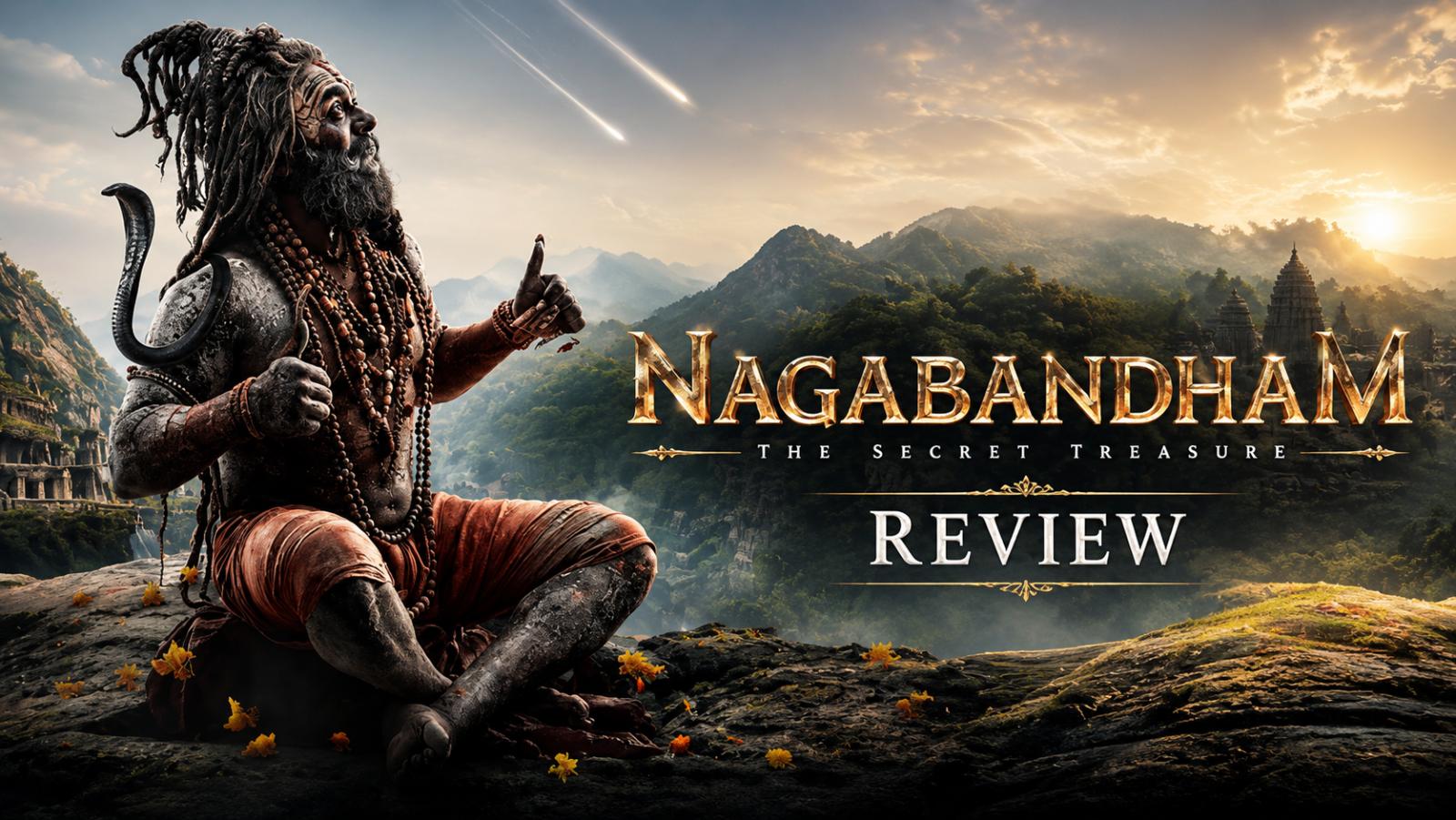
Virat Karna appears in dual roles as Rudra and a Naga Sadhu. He looks convincing in action scenes and carries the heroic portions well, but his emotional performance could have been stronger.
Nabha Natesh gets a solid role as Parvati and performs well in both positive and grey-shaded moments. Jagapathi Babu, Murali Sharma and Mahesh Manjrekar add weight to the film with their experience.
Rishab stands out as the antagonist with strong body language. Aishwarya Menon, Anasuya and other supporting actors have limited scope.
Technical Aspects:
The production values are rich, and the makers deserve credit for mounting the film on a large scale. The temple sets, fantasy locations and devotional visuals are impressive.
Soundararajan’s cinematography is one of the film’s biggest strengths. The visual presentation gives the film a grand mythological feel. However, the screenplay lacks consistency and the long runtime becomes a major drawback.
Music:
Junaid Kumar and Abhishek Puthipalli’s music supports the devotional mood of the film. The song Namore works well, and the background score adds intensity to a few key scenes. However, some songs disturb the flow and slow down the narrative.
Editing:
Editing is one of the weaker areas of Nagabandham. The film runs for more than three hours, and several portions feel stretched. A sharper edit with at least 20 to 30 minutes trimmed could have made the film more engaging.
Positives:
- Grand production values
- Strong mythological backdrop
- Good cinematography
- Nabha Natesh’s performance
- Rishab’s villain act
- Devotional and action blocks work in parts
Negatives:
- Excessive runtime
- Weak emotional depth
- Repetitive screenplay
- Underused supporting characters
- Songs affect the flow
- Some key motivations are not clearly explained
Analysis:
Nagabandham tries to blend mythology, fantasy, mystery and adventure on a large scale. The film explores themes connected to Shiva philosophy, temple secrets, Brahma Lotus and the sacrifices of Naga saints. The scenes involving Bhairava Kona, Naga Sadhus and temple-based action sequences are visually appealing. The devotional tone also works in a few portions, especially where the film highlights faith and tradition.
However, the film struggles to maintain grip throughout. The story has an interesting premise, but the narration becomes repetitive after a point. Some characters needed better writing, and a few important questions appear to be saved for the second part. Overall, Nagabandham is a visually rich mythological fantasy with good scale and a few strong moments, but the weak screenplay and long runtime reduce its impact.
Bottomline: Visual Watch
Rating: 2.5/5