
Maharashtra's electoral mapping shows strong rural participation, with Gadchiroli leading, while urban areas like Mumbai face significant challenges.
Maharashtra, 25th April 2026
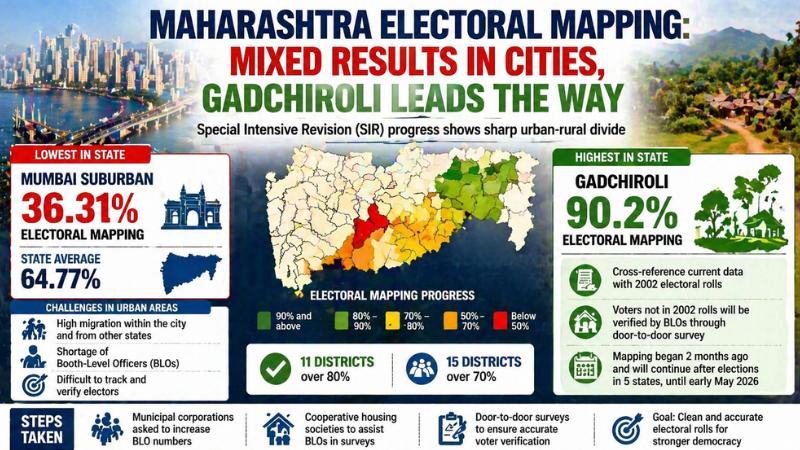
The Special Intensive Revision (SIR) of electoral mapping in Maharashtra is yielding mixed results, with urban areas like Mumbai, Thane, and Pune facing significant setbacks. Meanwhile, the rural district of Gadchiroli stands out, recording the highest participation in the state. According to the Maharashtra State Election Commission (SEC), Mumbai Suburban has only achieved 36.31% electoral mapping, the lowest in the state and far below the state’s average of 64.77%. In stark contrast, Gadchiroli has achieved a remarkable 90.2% participation rate.
The SEC launched the electoral mapping initiative to cross-reference current voter data with the 2002 electoral rolls—the last year this revision took place. Voters listed in the 2002 rolls do not need to submit additional documentation to prove their Indian citizenship for voter eligibility. However, voters whose names are absent from these rolls will undergo verification by Booth-Level Officers (BLOs) through a door-to-door survey process.
This mapping exercise, which began two months ago, is slated to conclude after the upcoming elections in five other states wrap up in the first week of May 2026. The Election Commission of India (ECI) aims to achieve 80% verification through this mapping process. To date, 11 of Maharashtra’s 36 districts have surpassed the 80% threshold, with 15 more crossing the 70% mark, most of them rural districts. Gadchiroli remains the only district to have achieved over 90% mapping so far.
Mumbai’s slow progress can be attributed to a combination of high migration levels, both from within the city and from other states, making it challenging to track electors accurately. Furthermore, there is a shortage of BLOs in the city, further impeding the process. S Chockalingam, the Chief Electoral Officer, noted that intra-city migration and the insufficient number of BLOs have been major factors in the delay. To address these issues, municipal corporations have been instructed to increase BLO numbers, and cooperative housing societies have been asked to assist BLOs in the upcoming door-to-door surveys, as per the instructions from the Election Commission of India.