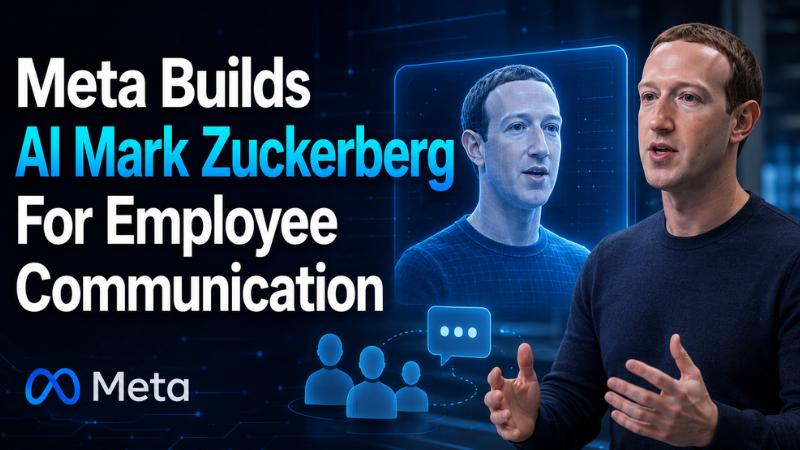
Meta is reportedly developing an AI-powered version of Mark Zuckerberg to improve internal communication and strengthen employee connection with the company’s leadership.
Meta Develops AI Version Of Mark Zuckerberg
Meta is working on an artificial intelligence-powered version of its CEO Mark Zuckerberg as part of its growing focus on workplace AI and internal communication. The project is still in its early stages, but it aims to create a photorealistic AI character that can interact with Meta employees in a more personal and direct way. The AI version of Zuckerberg is being designed to reflect his speech style, tone, personality, and views on the company’s long-term strategy.
The idea behind the project is to make communication between Meta’s top leadership and its global workforce more engaging. As Meta operates across several countries and teams, it can be difficult for employees to feel closely connected to the CEO’s thinking and direction. The AI character may help bridge that gap by offering responses that sound similar to Zuckerberg’s own communication style.
AI Character To Mirror Zuckerberg’s Views
Zuckerberg is reportedly directly involved in shaping the AI character. He is said to be helping train the system by feeding it his latest thoughts on Meta’s future, business direction, product goals, and artificial intelligence strategy. The model is also being fine-tuned to match his mannerisms and style of explanation so that employees receive responses that feel closer to direct communication from the CEO.
The AI character is not meant to simply act as a chatbot with general answers. Instead, it is being developed as a company-specific communication tool that can represent Zuckerberg’s views more accurately. This could help employees understand Meta’s strategy, priorities, and leadership thinking in a faster and more interactive format.
If successfully developed, the system could be useful during internal updates, employee queries, strategy discussions, onboarding, and company-wide communication. It may allow workers to ask questions and receive answers that reflect the CEO’s current perspective without requiring Zuckerberg to personally respond to every query.
Superintelligence Labs Leads The Project
The AI Zuckerberg character is being developed under Meta’s Superintelligence Labs, a division focused on building advanced artificial intelligence systems. The project reflects Meta’s larger plan to integrate AI into multiple areas of its operations, from product development and workplace tools to communication, automation, and future computing platforms.
Meta has been placing heavy emphasis on AI as a central part of its business future. The company is competing with major players such as OpenAI and Google, both of which are moving quickly in the artificial intelligence space. By creating internal AI tools and advanced AI characters, Meta appears to be strengthening its position in the race to build more capable and practical AI systems.
Zuckerberg’s involvement also shows how seriously the company is treating AI development. He has reportedly been spending significant time coding, reviewing engineering work, and guiding AI-related projects. His direct participation suggests that artificial intelligence is not just another product area for Meta, but a key part of the company’s long-term identity.
Meta Also Building A CEO Agent
Along with the AI character designed for employee interaction, Meta is also reportedly developing a separate “CEO agent” that can support Zuckerberg’s own workflow. This AI agent may be able to perform tasks such as retrieving information, organizing details, and helping with decision-making support. While the AI character is focused on communication with employees, the CEO agent appears to be aimed at productivity and executive assistance.
This dual approach shows how Meta is exploring different uses of artificial intelligence inside the company. One system may help employees feel more connected to leadership, while another may help executives manage information and tasks more efficiently. Together, these tools reflect the rise of agentic AI, where AI systems are designed not only to respond to questions but also to perform practical tasks.
The development also raises wider questions about how companies may use AI versions of leaders in the future. If AI avatars of CEOs become common, businesses could use them for training, announcements, employee support, or strategy communication. However, such systems would also need clear boundaries to avoid confusion between human leadership and AI-generated responses.
AI Becomes Central To Meta’s Future
Meta’s AI Mark Zuckerberg project highlights the company’s ambition to bring artificial intelligence deeper into its workplace and business strategy. The effort comes at a time when major technology companies are racing to develop AI assistants, autonomous agents, enterprise tools, and personalized digital characters. Meta’s work on a CEO-like AI avatar could become an early example of how leadership communication may evolve in large organizations.
The project also reflects a broader shift in how AI is being used. Earlier AI tools mainly answered questions or generated content, but newer systems are becoming more personalized, interactive, and task-oriented. A photorealistic AI character based on a real executive could make internal communication more dynamic, but it will also require strong safeguards, transparency, and accuracy.
For Meta, the project may help demonstrate its confidence in AI-powered workplace transformation. By building an AI character modeled on Zuckerberg and a separate CEO agent for executive tasks, the company is showing that it wants to use AI not only in consumer products but also inside its own leadership structure.
As the project develops, its success will depend on how naturally the AI communicates, how accurately it reflects Zuckerberg’s current thinking, and how employees respond to interacting with a digital version of their CEO. If it works well, Meta’s AI-powered CEO character could become a major example of how artificial intelligence may reshape corporate communication in the coming years.


 Joyful
0%
Joyful
0%
 Cool
0%
Cool
0%
 Thrilled
0%
Thrilled
0%
 Upset
0%
Upset
0%
 Unhappy
0%
Unhappy
0%