
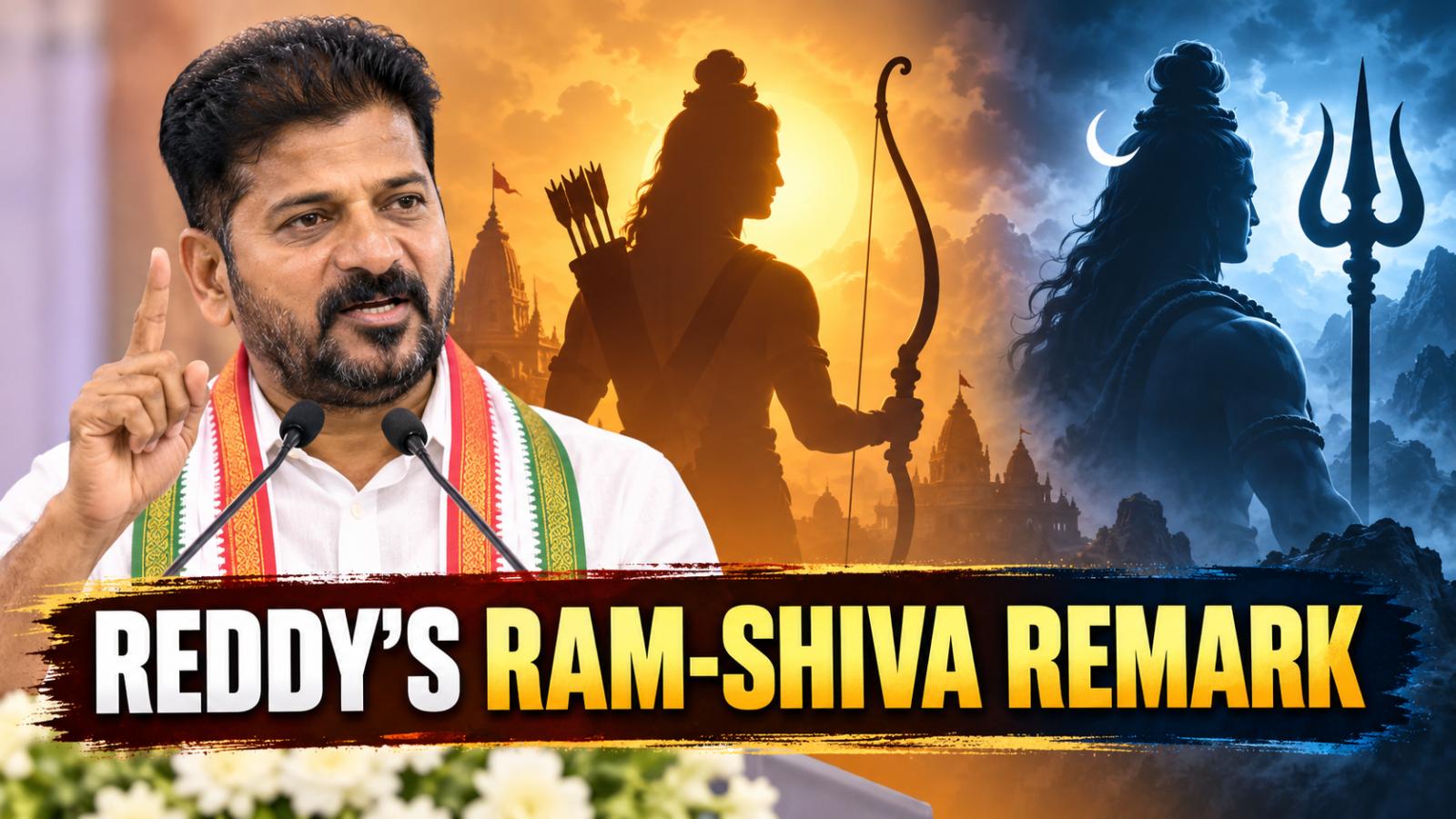
Telangana Chief Minister Revanth Reddy has drawn criticism from BJP leaders after contrasting the political use of Lord Ram and Lord Shiva during a conclave in New Delhi on September 28. Reddy described Shiva as the god of the poor and Ram as the god of the rich while arguing that the BJP has made Ram a prominent part of its political identity. His remarks have since become the centre of a dispute over religion and regional identity.
Reddy also compared political and cultural patterns in northern and southern India. He associated the north with the slogan “Jai Shri Ram” and said “Har Har Mahadev” was more commonly heard in the south. He questioned why BJP leaders invoke the former more often than the latter. These were Reddy’s characterisations, rather than a description of how all people in either region worship.
What Revanth Reddy said at the conclave
The chief minister’s comments formed part of a wider criticism of the BJP’s use of religious symbols in politics. He alleged that the party had appropriated Lord Ram as a political symbol and linked his rich-and-poor comparison to his view of the BJP. Reporting on the speech also says Reddy made clear that both Ram and Shiva are revered deities.
His remarks about Aryan and Dravidian identities added another dimension to the debate. By connecting those identities with different religious symbols, Reddy drew a sharp north-south distinction that BJP leaders have challenged. The comments have prompted discussion about the use of faith and regional identity in political arguments.
BJP leaders reject the comparison
Union Minister Bandi Sanjay Kumar criticised Reddy’s statement, accusing him of using deities to divide people. BJP leaders rejected the suggestion that devotion to Ram or Shiva belongs to one region or political group, and called the chief minister’s comparison divisive.
The disagreement is now focused on both Reddy’s words and the political point he was making. Reddy framed the comparison as criticism of the BJP; BJP leaders say the comparison itself creates an unnecessary divide. His claim that Ram represents the rich and Shiva the poor remains a political remark attributed to him, not a religious or regional fact.