
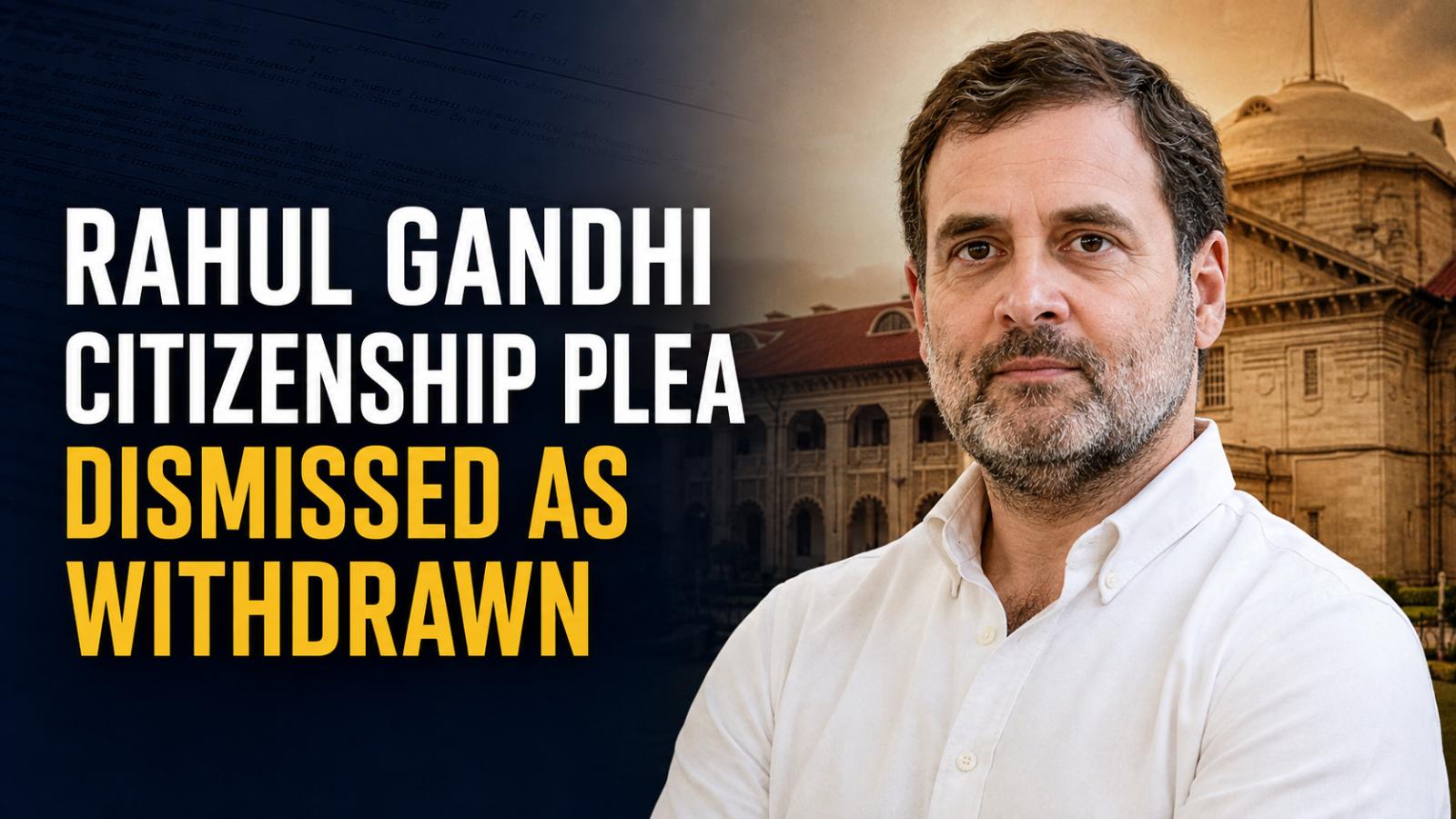
The Allahabad High Court permitted the withdrawal of a plea challenging Rahul Gandhi’s Indian citizenship. The court said the petitioners failed to produce a document supporting their British-citizenship allegation; it did not issue a final ruling on Gandhi’s citizenship.
The Allahabad High Court’s Lucknow Bench has dismissed as withdrawn a petition alleging that Congress leader Rahul Gandhi was a British citizen and therefore ineligible to continue as the Lok Sabha member from Rae Bareli.
A division bench comprising Justice Shekhar B. Saraf and Justice Abdhesh Kumar Chaudhary passed the order on Monday, August 31, 2026. The petitioners withdrew the case after the bench observed that they had not placed any document on record establishing their allegation.
The procedural distinction is important: the court did not deliver a final verdict declaring or determining Rahul Gandhi’s citizenship. It permitted the petitioners to withdraw their plea and consequently dismissed it as withdrawn.
Rahul Gandhi citizenship plea questioned MP eligibilityThe petition was filed by advocate Ashok Pandey and another petitioner, seeking a writ of quo warranto against Gandhi. Such a writ can be sought to question whether an individual is legally qualified to hold a public office.
The petitioners claimed that Gandhi was a citizen of the United Kingdom and challenged his eligibility to represent Rae Bareli in the Lok Sabha. Their argument referred to Backops Limited, a company reportedly incorporated in Britain in 2003.
They alleged that records connected to the company had identified Gandhi as a director, major shareholder and British national. On that basis, they asked the High Court to examine whether he could remain an Indian citizen and continue as an MP.
Allahabad High Court finds no supporting documentWhen the bench asked the petitioner appearing in person to establish the basis of the allegation, he could not produce company-formation records, documents from Britain’s Registrar of Companies or a declaration showing that Gandhi had described himself as a British citizen.
The only material relied upon was described as an alleged University of Cambridge confirmation letter concerning the studies of a person named Raul Vinci. The court said that document did not prove the citizenship allegations raised in the petition.
Following the court’s observations about the absence of supporting material, the petitioner sought permission to withdraw the case. The bench accepted the request and dismissed the writ petition as withdrawn.
British citizenship allegation dates back several yearsSimilar allegations concerning Gandhi’s citizenship have appeared in legal petitions and political statements for years. The High Court noted that related writ petitions had previously been filed in 2015 and 2019.
In the 2015 proceedings, a coordinate bench indicated that the Central government was the appropriate authority to examine such a citizenship issue under Section 9(2) of the Citizenship Act, 1955.
The latest bench also recorded that a representation submitted on May 3, 2019, had been acknowledged by the Central government on June 29, 2019, and remained pending for consideration. Petitioners had approached other authorities as well, including the returning officer during the 2024 Lok Sabha elections.
Rahul Gandhi citizenship was not finally decidedThe latest order should not be described as a judicial declaration that Gandhi is or is not a British citizen. The bench dealt with the petition before it, noted the absence of documents supporting its allegations and allowed its withdrawal.
The dismissal closes this particular writ petition, titled Ashok Pandey and Another versus Sri Rahul Gandhi and Others. However, legal reports note that a separate proceeding involving allegations about Gandhi’s citizenship is pending before another High Court bench.
Therefore, the accurate newsroom conclusion is that the petitioners failed to substantiate their claim in this case and withdrew the plea. The court did not decide the broader citizenship question on its merits.