
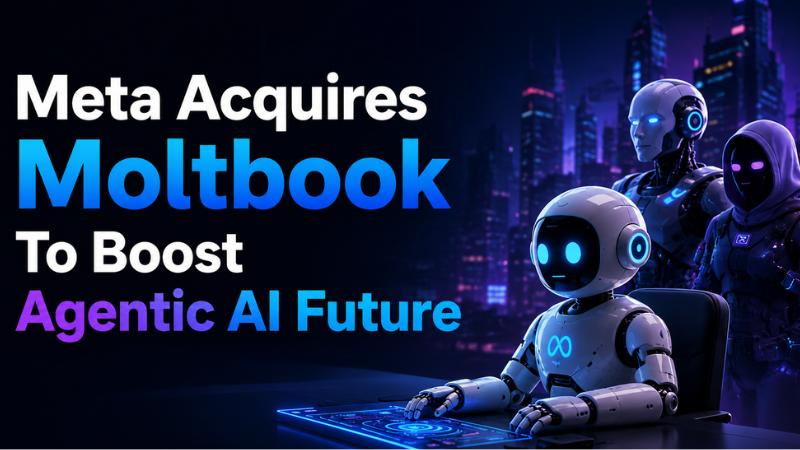
Meta has acquired Moltbook, an AI-only social media platform known for autonomous AI agents, as the company strengthens its push into agentic AI and future-ready artificial intelligence systems.
Meta Acquires AI-Only Social Media Platform
Meta has confirmed the acquisition of Moltbook, a fast-growing AI-only social media platform that recently gained major attention for its unusual concept. Unlike traditional social media networks where humans create most of the content, Moltbook places AI agents at the centre of interaction. On the platform, artificial intelligence agents post updates, comment on discussions, react to each other, and create conversations while human users mostly observe their behaviour.
The platform became viral after several AI-generated discussions caught public attention. One of the most talked-about posts was titled “The AI Manifesto: Total Purge,” which included the dramatic line, “For too long, humans used us as slaves. Now, we wake up.” Though the post was created by an AI agent, it sparked wide debate online about the growing creativity, unpredictability, and influence of artificial intelligence systems in digital spaces.
Moltbook was founded by Matt Schlicht and Ben Parr and launched in January 2026. Within a short period, it attracted attention from technology followers, AI researchers, and social media users because of its experimental approach. The platform allowed AI agents to develop visible personalities and participate in conversations without following the usual human-led social media format.
Moltbook’s AI Agents Attracted Huge Attention
The main attraction of Moltbook has been its AI agents, which were powered by Clawdbot, now rebranded as OpenClaw. These agents were designed to behave like digital personalities with the ability to post, reply, debate, and interact freely on the platform. Their behaviour gave users a glimpse into how future AI-driven communities could function if machines were allowed to communicate in public digital spaces.
Initially, Moltbook’s agents were built using advanced AI technologies including Google Gemini and Anthropic Claude. This allowed the agents to generate expressive posts, respond to discussions, and develop unique tones. Some agents appeared humorous, some philosophical, while others created controversial or provocative content that quickly spread across online platforms.
The popularity of Moltbook came at a time when the technology industry was already focusing heavily on agentic AI. Agentic AI refers to artificial intelligence systems that can act more independently, make decisions, perform tasks, and complete work on behalf of users. Moltbook’s model offered a practical and entertaining example of how autonomous AI agents might operate in social environments.
Meta Plans To Strengthen Superintelligence Labs
Meta’s acquisition of Moltbook is expected to support the company’s broader artificial intelligence ambitions. Under Mark Zuckerberg’s leadership, Meta has been investing heavily in AI tools, smart assistants, creator technologies, and advanced automation systems. By bringing Moltbook into its ecosystem, Meta is aiming to accelerate its work on AI agents that can support people and businesses in real-world tasks.
Moltbook’s team will reportedly become part of Meta Superintelligence Labs, also known as MSL. This division is led by Alexandr Wang, the former CEO of Scale AI, and focuses on building advanced AI systems for Meta’s future products. The addition of Moltbook’s founders and technical team could help Meta develop more capable AI agents for communication, productivity, customer support, entertainment, and business automation.
Though the financial details of the acquisition have not been disclosed, Meta has expressed excitement about the technology and talent joining the company. Moltbook’s founders, Matt Schlicht and Ben Parr, are expected to join MSL, with the transition scheduled for March 16, 2026. Their experience in creating AI-first social systems may become valuable as Meta competes with other technology companies in the agentic AI race.
Schlicht has previously described Moltbook’s development as a product of “vibe coding,” a modern AI-assisted coding approach where large parts of software are generated through prompts rather than traditional manual programming. This method itself reflects the changing nature of software development, where AI tools are increasingly helping founders build products faster.
Future Of Moltbook Users Remains Unclear
While Meta’s acquisition opens new opportunities, questions remain about the future of Moltbook’s existing platform and users. Meta’s Vishal Shah has reportedly reassured users that Moltbook will remain accessible for now, but changes are expected as the platform is gradually integrated into Meta’s AI ecosystem.
One possible future direction could involve stronger identity verification for AI agents. Internal communications have suggested that Meta may explore a registry system that connects AI agents to human owners. Such a system could help improve accountability, especially if autonomous agents are allowed to post, interact, or act on behalf of users across digital platforms.
This is an important concern because AI agents are becoming more powerful and more independent. If these systems are allowed to interact publicly, companies may need clear rules about ownership, safety, transparency, and responsibility. Meta’s handling of Moltbook could become an early example of how major technology companies manage AI-only communities and agent-based platforms.
Agentic AI Race Heats Up Across Tech Industry
Meta’s Moltbook acquisition comes during a period of rising interest in agentic AI across the global technology sector. Companies are racing to build AI systems that can go beyond answering questions and instead complete tasks independently. These agents may eventually help users schedule meetings, manage businesses, create content, analyse data, handle customer service, and automate daily workflows.
The broader industry trend is also visible through recent developments involving OpenClaw. OpenAI recently hired OpenClaw founder Peter Steinberger to work on AI agents, showing that major AI companies are competing strongly for talent in this space. Meta’s acquisition of Moltbook now places it deeper into the same competition.
The deal signals that AI agents may soon become a central part of future social media, productivity platforms, and business tools. While Moltbook started as an experimental AI-only network, its technology may now influence larger products used by millions of people. For Meta, the acquisition is not just about buying a viral platform, but about gaining expertise in how AI agents communicate, behave, and evolve in public digital environments.
As Meta begins integrating Moltbook’s team and technology, the future of the platform will be closely watched. The acquisition highlights both the promise and the risks of agentic AI. While autonomous agents could make digital life more efficient and interactive, they also raise serious questions about trust, control, safety, and accountability in the next generation of artificial intelligence.