
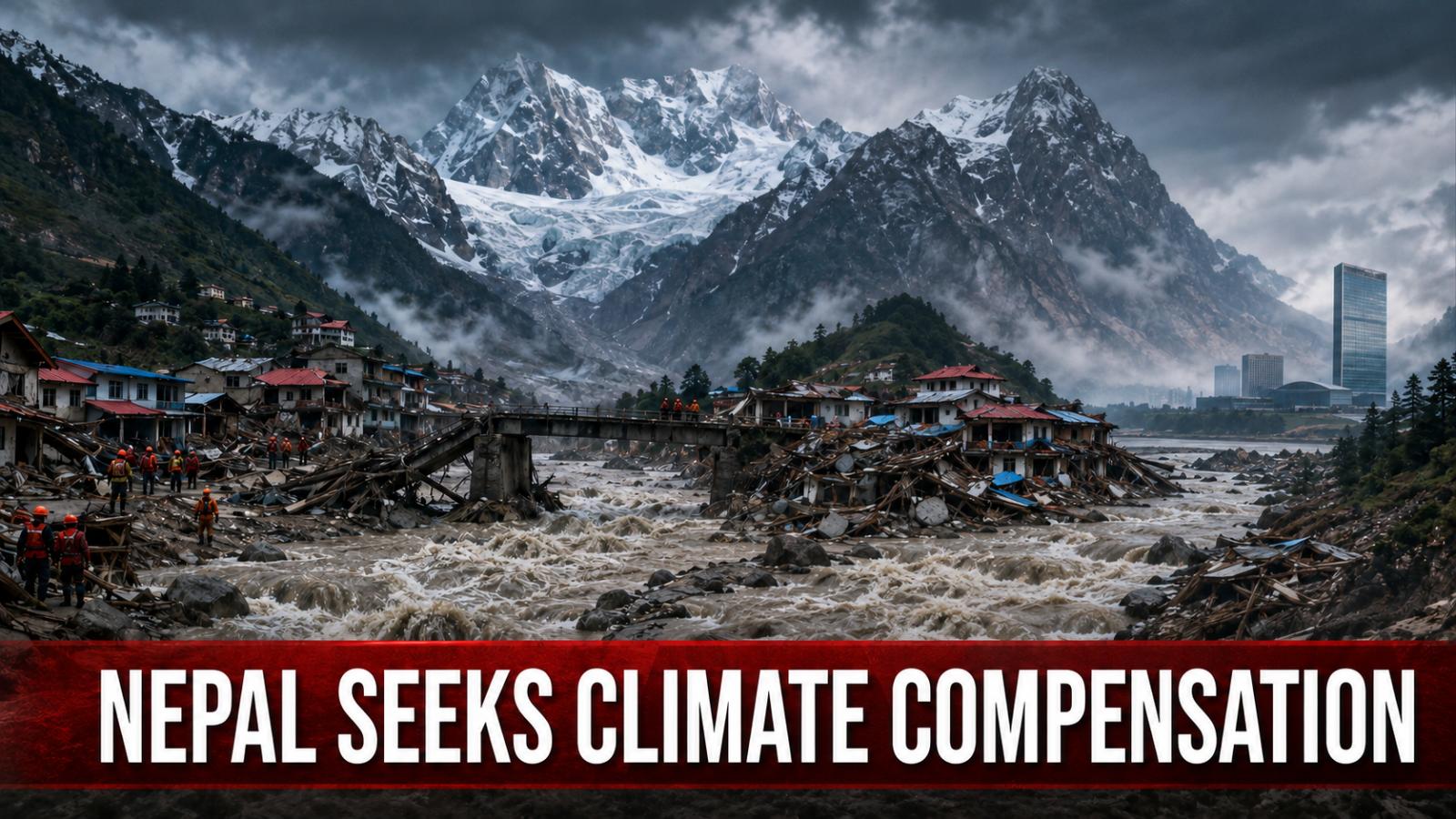
Nepal sought international climate compensation following the deadly August 26 floods in Rasuwa and neighboring districts, officials said on Wednesday, September 2, 2026. From Kathmandu, the government approached a UN-backed fund and considered sending Prime Minister Balen Shah to raise the issue at the UN General Assembly.
Nepal has sought international climate compensation following the catastrophic floods that devastated Rasuwa, Nuwakot and Dhading districts in Bagmati Province. The government has identified China, the United States and India among the world’s largest current greenhouse gas emitters while arguing that vulnerable Himalayan nations should not bear the recovery costs alone.
More than 1,000 people have been reported dead and thousands remain missing after the August 26 disaster in the Bhotekoshi River basin. Homes, roads, bridges and hydropower facilities were destroyed, while thousands of residents were displaced.
Nepal has formally approached the Fund for Responding to Loss and Damage for urgent financial assistance. The request has been directed to the multilateral fund rather than presented as three separate compensation claims against India, China and the US.
Nepal Shifts Its Climate Message From Aid To JusticeForeign Minister Shishir Khanal said Nepal was shifting its diplomatic position from seeking conventional aid to demanding justice and compensation. He argued that countries producing relatively little greenhouse gas pollution were suffering severe consequences linked to a warming climate.
Khanal described climate compensation as a moral responsibility of major industrial economies. However, determining how much responsibility individual countries carry remains complex because climate negotiations consider current, historical and per-capita emissions.
India is one of the largest emitters in absolute terms because of its population, but its emissions per person and historical contribution remain substantially lower than those of several developed economies. New Delhi has consistently argued that climate obligations should reflect development needs and the greater historical responsibility of industrialized nations.
Balen Shah May Raise Flood Demand At UN AssemblyPrime Minister Balendra “Balen” Shah could travel to New York for the 81st United Nations General Assembly to highlight the disaster and seek support for Nepal’s climate compensation demand. The reported proposal remained under discussion, with no final travel announcement confirmed at the time of publication.
Nepal had previously planned for Foreign Minister Khanal to represent the country at the UN gathering. Sending Shah would allow the prime minister to personally present the scale of the disaster and argue for faster international financing.
Finance Minister Swarnim Wagle estimated that Nepal could require between $4 billion and $5 billion for reconstruction, an amount equal to nearly one-tenth of the country’s economy.
Nepal Sends Request To UN-Backed Climate FundThe government’s formal request was sent to the Fund for Responding to Loss and Damage, established to help vulnerable developing countries address economic and non-economic losses associated with climate change.
Nepal requested an urgent response without waiting for the fund’s next scheduled board meeting. The appeal covers immediate relief, reconstruction, resettlement and specialist assistance, including tunnel-rescue teams, forensic experts and temporary Bailey bridges.
Kathmandu initially relied on its own security agencies for search-and-rescue operations but later accepted specialized assistance and equipment from India, China and other countries as the scale of the disaster became clearer.
Climate Link Requires Detailed Scientific StudyNepalese officials have described the flood as a “Himalayan Tsunami” and connected it to rapidly changing environmental conditions. Initial assessments have examined a rock-and-ice avalanche, unstable glaciers and broader changes in the Himalayan ecosystem as possible factors.
Scientists caution that directly attributing an individual disaster to human-caused climate change requires detailed investigation. Studies must examine temperatures, rainfall, glacier conditions, slope stability and other local factors before reaching a firm conclusion.
Nepal’s broader vulnerability is well established. Melting glaciers, unstable mountain slopes and glacial lake floods threaten communities and infrastructure across the Himalayas. Nepal argues that countries contributing least to global warming cannot repeatedly finance their own rescue and reconstruction without stronger international support.