
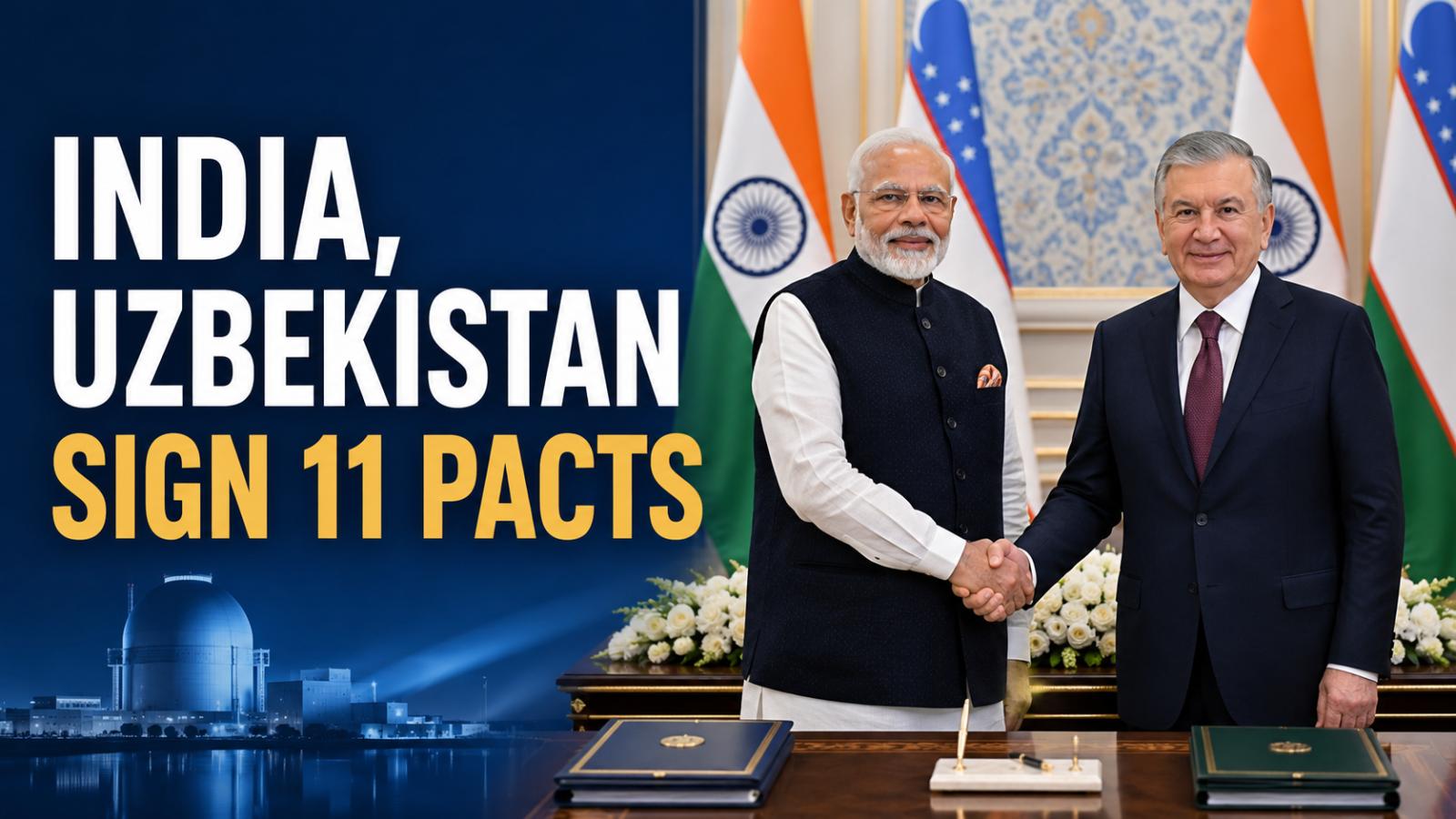
India and Uzbekistan signed 11 agreements, elevated diplomatic ties and advanced a long-term framework for supplying uranium to Indian nuclear plants.
India-Uzbekistan ties elevated during Tashkent talksIndia and Uzbekistan elevated their relationship to a Comprehensive Strategic Partnership following delegation-level talks between Prime Minister Narendra Modi and Uzbek President Shavkat Mirziyoyev at the Kuksaroy Presidential Palace in Tashkent.
The two leaders reviewed cooperation in trade, investment, digital public infrastructure, innovation, defence, healthcare, pharmaceuticals, agriculture, education, tourism, space and people-to-people exchanges.
Modi described Uzbekistan as central to India’s engagement with Central Asia and called for measurable goals under the upgraded partnership. The leaders agreed to create a Foreign Ministers-led coordination mechanism and elevate the bilateral Inter-Governmental Commission to the ministerial level.
Mirziyoyev conferred the Oliy Darajali Do‘stlik Order, Uzbekistan’s highest honour for foreign leaders, on Modi. The prime minister dedicated the honour to the longstanding friendship and civilisational relationship between the two countries.
India-Uzbekistan uranium framework gains momentumA major outcome of the discussions was progress toward a long-term arrangement for supplying uranium from Uzbekistan to India. The proposed framework would support fuel requirements for India’s civilian nuclear energy programme.
Modi welcomed the progress made on the uranium arrangement and emphasised the importance of expanding cooperation in critical minerals. Uzbekistan possesses significant mineral resources, making it an important potential partner as India diversifies its energy and raw-material supply chains.
The proposed arrangement concerns uranium supplies for peaceful civil-nuclear use and should not be confused with a nuclear weapons agreement. Final commercial terms, volumes and delivery schedules were not detailed in the official announcement.
The uranium discussions form part of a broader effort to strengthen energy security and critical-mineral cooperation between New Delhi and Tashkent.
India-Uzbekistan trade target raised to $5 billionIndia and Uzbekistan agreed to pursue bilateral trade worth $5 billion by 2030, significantly higher than the current level of approximately $1 billion. The two sides also proposed holding a business summit to deepen commercial and investment ties.
Digital payments emerged as another area of cooperation. A commercial agreement between NPCI International Payments Limited and Uzbekistan’s National Interbank Processing Centre is intended to enable Indian UPI applications to scan Uzbekistan’s UZQR system for merchant payments.
The two countries also discussed collaboration involving start-ups, pharmaceuticals, mining, agriculture and digital public infrastructure. These sectors could help both sides expand economic engagement beyond traditional trade.
Improved payment connectivity and institutional coordination may make it easier for businesses, tourists and investors to operate across both markets. However, reaching the new trade target will require stronger transport links, banking channels and private-sector participation.
PM Modi witnesses exchange of 11 agreementsThe two governments exchanged 11 agreements and memoranda covering culture, archives, Ayurveda, mining, tourism, diplomatic training, economic dialogue, environmental protection, higher education, scientific research and relations between Gujarat and Uzbekistan’s Samarkand region.
A Letter of Intent was concluded for restoring the Buddhist heritage sites of Fayaz Tepa and Kara Tepa. The two sides also finalised an ICCR Sanskrit Chair at the Tashkent State University of Oriental Studies.
India announced 100 Lal Bahadur Shastri scholarships for students of Hindi in Uzbekistan. Modi also announced a $1 million grant to support environmental rehabilitation and afforestation efforts in the Aral Sea region.
In their joint position on security, the two leaders condemned terrorism in all forms, including cross-border terrorism. They called for action against terrorist financing, safe havens and supporting networks while seeking stronger cooperation in intelligence sharing, law enforcement, cyber security and the fight against organised crime.