
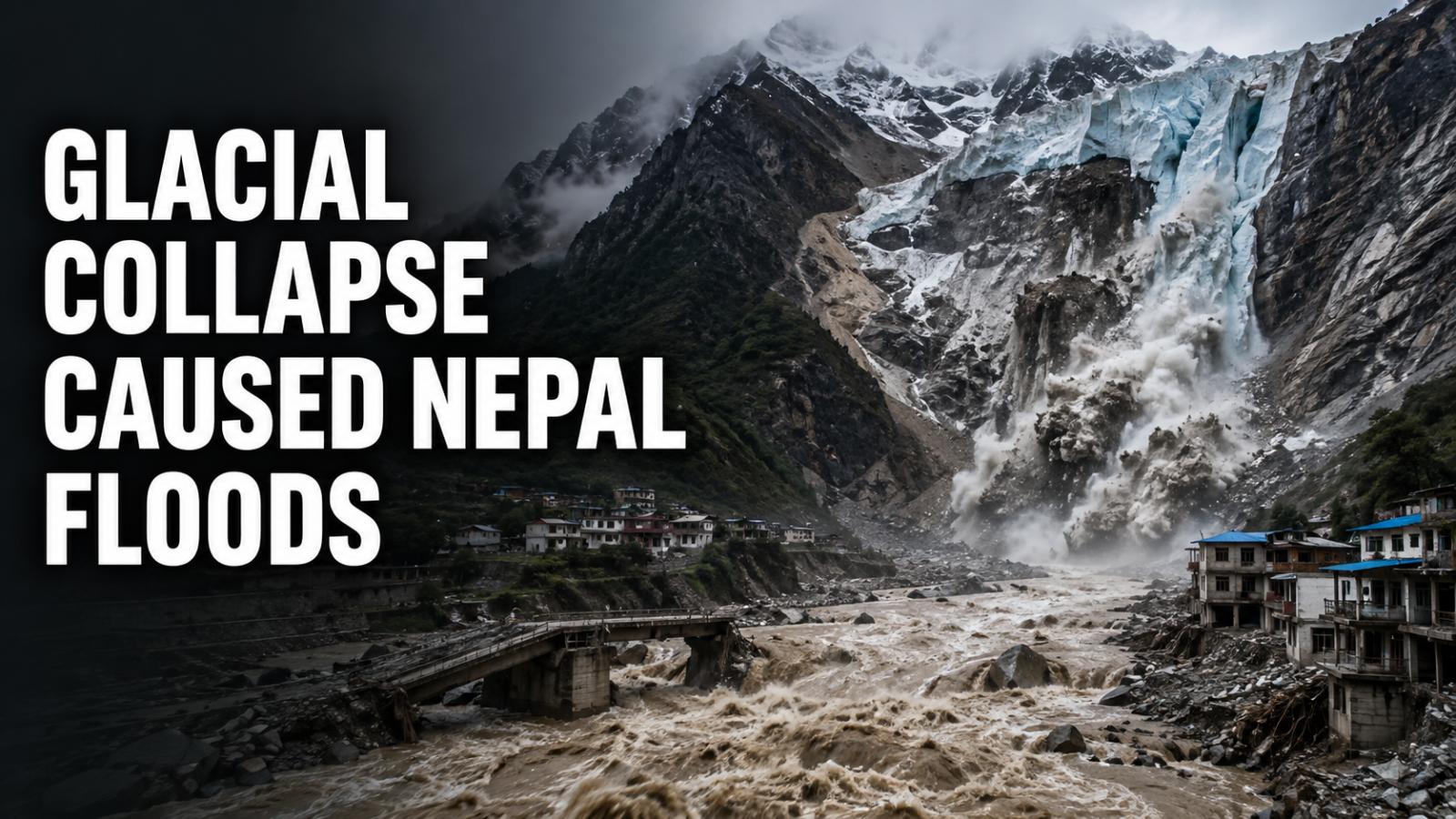
Thursday, August 27, 2026, 7:27 AM IST: USGS confirmed that a glacial collapse, rather than an earthquake, triggered the catastrophic Nepal floods. Kathmandu and Nepal-Tibet border: At least 160 people were killed, while hundreds remained missing across Nepal and Tibet.
Nepal Flash Floods Traced To Massive Glacial Collapse
KATHMANDU: The catastrophic flash floods that devastated communities along the Nepal-Tibet border were caused by a glacial collapse and debris flow, not an earthquake as initially reported, according to the United States Geological Survey.
The USGS said the disaster generated seismic signals resembling those of an earthquake before sending enormous quantities of ice, rocks, mud and water downstream. The resulting torrent struck settlements and infrastructure on both sides of the border on Wednesday, August 26.
At least 160 people were reported dead in Nepal and Tibet, while hundreds remained missing as rescue teams continued searching damaged villages, riverbanks and debris-covered areas. The casualty figures were expected to change as emergency personnel reached isolated locations and verified missing-person reports.
The flood swept through steep Himalayan valleys with extraordinary force, destroying homes, bridges, roads and other infrastructure. Several communities were cut off after transport and communication links were damaged.
USGS Rules Out Earthquake After Reviewing Seismic Data
The USGS recorded a magnitude 5.2 seismic event near the Nepal-China border at approximately 8:37 AM local time on August 26. Preliminary information had classified it as a magnitude 4.4 earthquake, leading to speculation that tremors may have triggered a landslide and subsequent flooding.
However, further examination of data from nearby seismic stations, long-period seismic waves and satellite imagery produced a different conclusion. The agency determined that the recorded activity came from a glacial collapse and fast-moving debris flow.
The USGS said no earthquake had occurred. Instead, the movement of an enormous mass of glacier ice, rock and debris created seismic energy strong enough to be detected and measured by monitoring stations.
The collapse then produced catastrophic effects downstream as the debris flow entered river channels and gathered speed through the mountainous terrain. The finding replaced the early earthquake theory and provided the clearest official explanation of the disaster’s initial trigger.
Earlier Theories Included Landslide And Glacial Lake Flood
In the hours after the flooding, officials and experts considered several possible causes. Nepal’s Foreign Minister Shishir Khanal initially said an earthquake may have triggered a landslide that blocked a river before the accumulated water broke through and rushed downstream.
Another theory involved a glacial lake outburst flood, which occurs when a natural barrier holding back glacier meltwater suddenly fails. Such barriers may be composed of loose rock, sediment or ice and can release large volumes of water with little warning.
Experts also considered an ice avalanche as a possible trigger. The latest USGS assessment established that a glacial collapse and debris flow caused the seismic activity and subsequent destruction, although further scientific investigation may be needed to reconstruct the complete sequence.
Aerial images from areas along the Bhote Koshi River showed extensive flood damage, including debris-covered land, damaged structures and swollen waterways. The destruction extended into districts located downstream from the Nepal-Tibet border.
Nepal Disaster Highlights Himalayan Glacier Risks
The disaster has renewed attention on the risks posed by unstable glaciers in the Himalayan region. Steep slopes can allow collapsing ice and rock to accelerate rapidly, producing debris flows capable of overwhelming river valleys and populated communities.
Glacier retreat, changing temperatures, unstable slopes and the formation or expansion of glacial lakes are among the hazards monitored across the Himalayas. However, authorities had not immediately established whether long-term climate conditions directly caused this particular collapse.
Search and rescue operations continued across the affected areas as emergency teams attempted to locate survivors and restore access to isolated settlements. Authorities also monitored upstream waterways for possible blockages that could produce additional flooding.
The confirmed death toll had reached at least 160 by Thursday, with hundreds still unaccounted for in Nepal and Tibet. Officials warned residents to avoid swollen rivers, damaged bridges and unstable slopes while scientific and disaster-response teams assessed the continuing danger.
The USGS finding clarified that the event was not an earthquake followed by flooding. Instead, the glacial collapse itself generated the earthquake-like signal before unleashing the deadly mass of ice, water, rocks and debris downstream.