
What the Proposed Talc Settlement Means
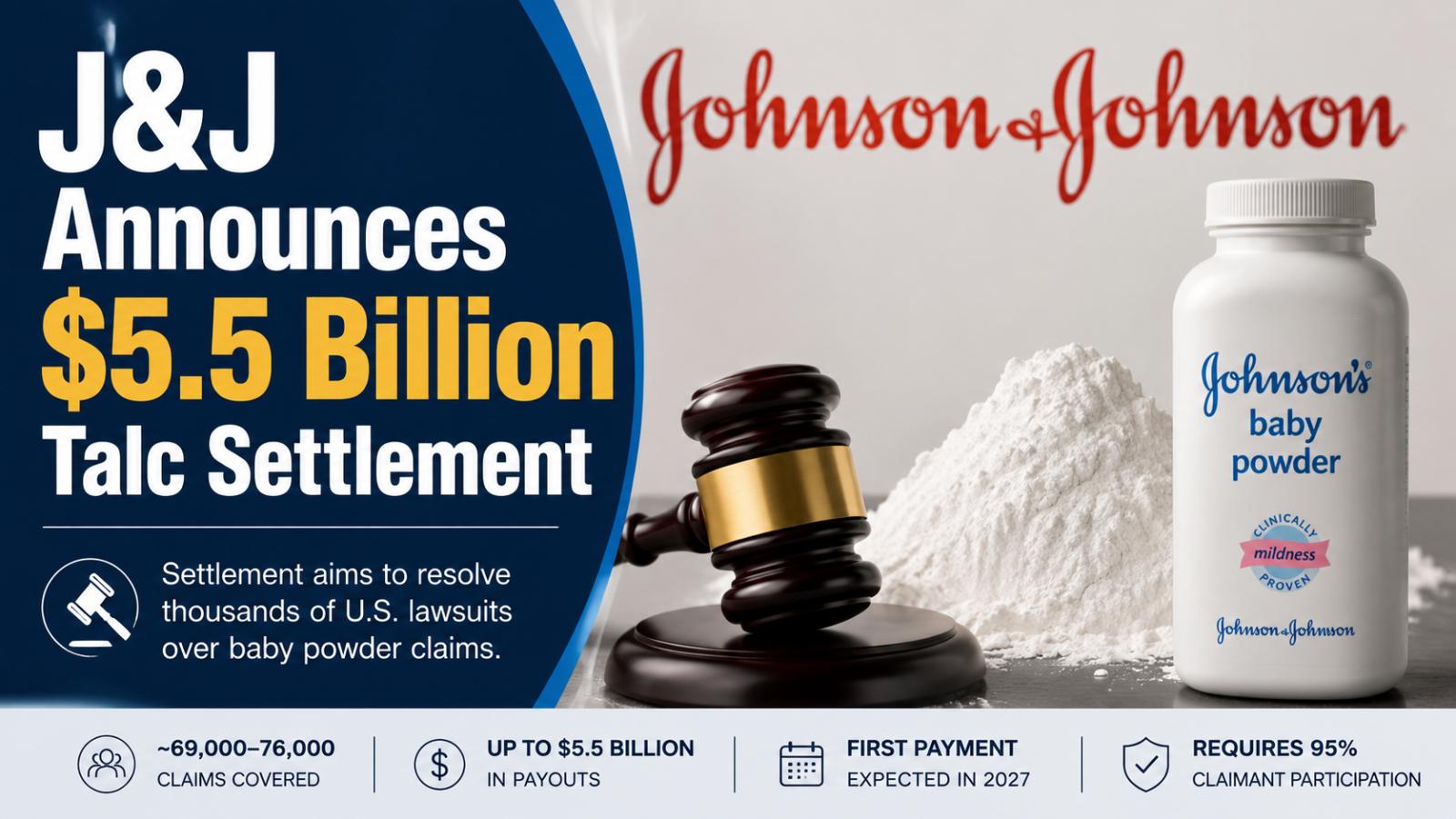
Johnson & Johnson has proposed a $5.5 billion resolution covering most remaining US ovarian cancer talc claims. The agreement requires participation from firms representing at least 95% of eligible claims before it can become final.
Johnson & Johnson Moves to Settle Talc Lawsuits for $5.5 Billion
The J&J talc settlement 2026 could resolve nearly all remaining US lawsuits alleging that Johnson & Johnson’s baby powder and other talc products caused ovarian cancer.
Johnson & Johnson announced on Monday, July 27, 2026, that it had committed an estimated $5.5 billion to the proposed resolution. The agreement follows approximately 15 years of litigation involving allegations about the safety of the company’s talc-based products.
The company continues to deny that its talc products caused cancer or contained asbestos. It says the settlement is intended to bring the long-running legal dispute to an efficient conclusion rather than acknowledge wrongdoing.
J&J Talc Settlement 2026 Covers Thousands of Claims
Reports differ slightly on the number of lawsuits affected by the proposed agreement. The original report said the settlement would cover about 69,000 cases.
Reuters subsequently reported that the agreement covers approximately 76,000 existing claims in federal and state courts, representing nearly all remaining ovarian cancer-related talc cases against Johnson & Johnson. The difference may reflect separate methods of counting pending cases, claimants or eligible claims.
The company’s official announcement does not provide a precise total. Instead, it states that the deal requires participation from the leading law firms in the litigation and must represent at least 95% of the remaining ovarian talc claims.
That participation requirement is important because the agreement will not automatically become final simply because Johnson & Johnson and several plaintiffs’ firms have supported it.
How Will the $5.5 Billion Be Paid?
Under the proposed settlement structure, Johnson & Johnson has committed $5.5 billion through payments made for qualifying claims.
The company expects its first payment to be no more than $3 billion in 2027. No additional payments would become due before 2028. The eventual amount could rise depending on the number of eligible people who participate because the settlement provides payments on a per-claim basis.
Reuters reported that one lawyer involved in the negotiations believes the total payout could eventually reach $7 billion or more. However, that figure is an estimate rather than the guaranteed value of the agreement.
The current proposal also applies only to existing claims. It does not automatically resolve lawsuits that may be filed in the future.
Why Did Johnson & Johnson Agree to Settle?
The deal follows several favourable legal developments for Johnson & Johnson.
On July 22, 2026, a US federal court questioned whether individual plaintiffs could provide reliable evidence proving that talc specifically caused their ovarian cancer. Johnson & Johnson said this strengthened its position that the claims lacked sufficient scientific support.
Despite saying it expected to prevail if the cases continued, the company said settling would provide closure and allow it to focus on its medicines and medical-device businesses.
Plaintiffs’ lawyers supporting the agreement described it as a fairer and faster route to compensation after years of court proceedings.
What Is the Background of the Baby Powder Lawsuits?
The litigation dates back more than a decade. Claimants have alleged that prolonged use of talc-based body powder contributed to ovarian cancer. Some other cases alleged that asbestos contamination in talc products caused mesothelioma.
Johnson & Johnson has consistently rejected those allegations. The company says its cosmetic talc was safe, asbestos-free and did not cause cancer.
The wider scientific discussion remains complex. The US Food and Drug Administration says studies have suggested a possible association between genital use of talc-containing powder and ovarian cancer, but those studies have not conclusively established a causal connection. The FDA also notes that talc deposits can occur near asbestos, making appropriate sourcing and testing important.
The International Agency for Research on Cancer classified talc as “probably carcinogenic to humans” in 2024, based on limited evidence in humans and stronger evidence from experimental and mechanistic studies. This classification evaluates whether an agent can cause cancer under some conditions; it does not determine the level of risk from a particular product or pattern of use.
Did Johnson & Johnson Stop Selling Talc Baby Powder?
Johnson & Johnson stopped selling talc-based baby powder in the United States in 2020 and later discontinued it worldwide. Its baby powder range was moved to a cornstarch-based formulation.
The company says the global withdrawal was a commercial portfolio decision rather than an admission that its talc products were unsafe. According to its latest statement, talc-based Johnson’s Baby Powder was discontinued globally in 2023.
What Happens Next?
The proposed settlement must secure the required level of claimant participation before it can take effect. If the 95% threshold and other conditions are met, the agreement could resolve one of the longest-running product-liability disputes involving a major healthcare company.
Until those conditions are completed, the $5.5 billion arrangement remains a proposed resolution rather than a fully finalised settlement.