
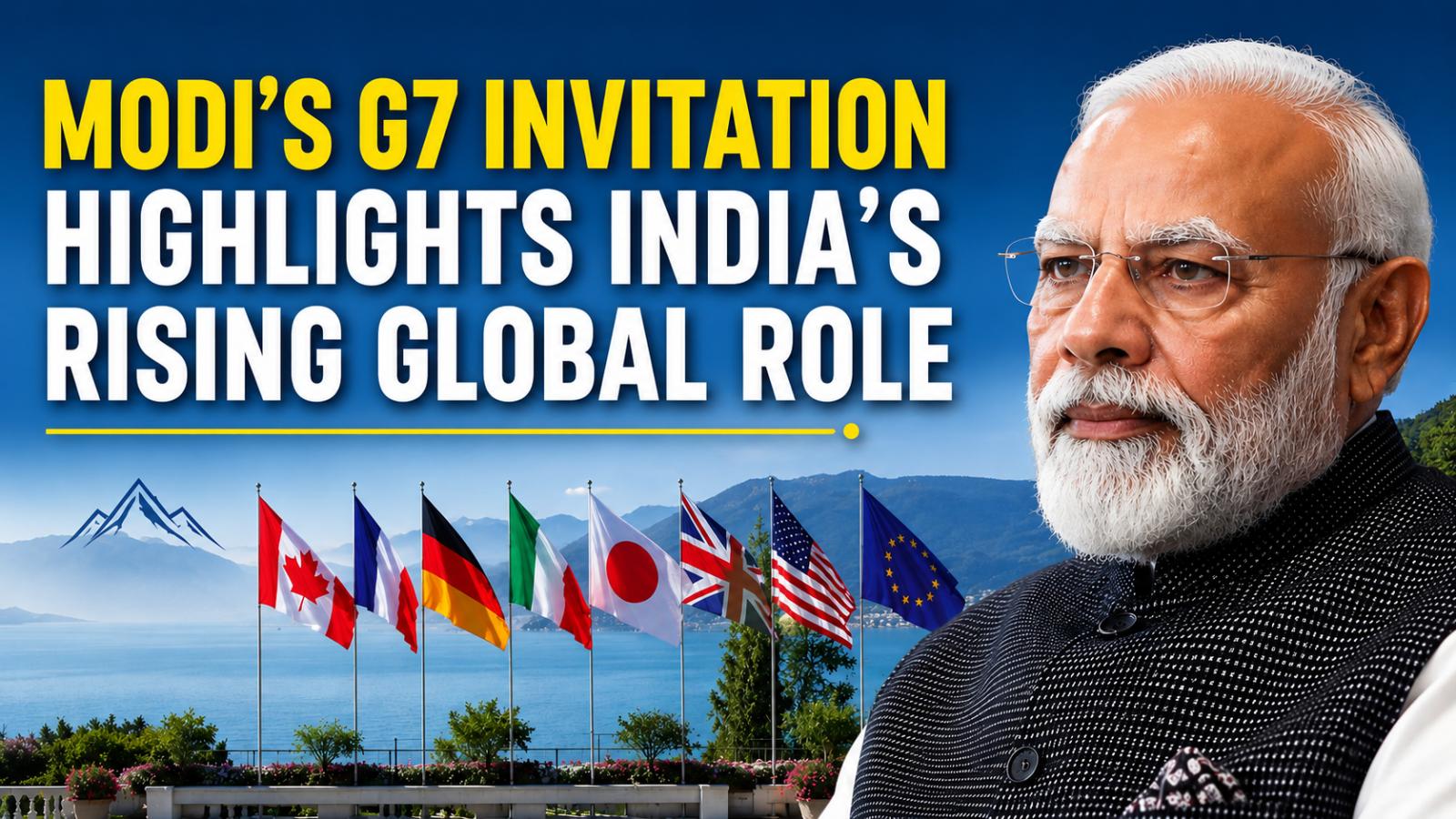
Prime Minister Narendra Modi’s expected participation at the G7 Summit in Évian-les-Bains, France, from June 15 to 17, 2026, has placed India’s expanding global influence back in focus. Invited by French President Emmanuel Macron, Modi will attend the summit as India continues to gain importance in discussions on trade, technology, energy security, supply chains and global development.
India is not a member of the G7, which includes Canada, France, Germany, Italy, Japan, the United Kingdom and the United States, with the European Union also taking part in discussions. However, New Delhi’s repeated presence at the forum shows that major global conversations can no longer be limited to traditional Western powers alone.
Why India matters to the G7
India’s growing importance comes from its position at the centre of several major global priorities. As the world’s most populous country and one of its largest economies, India is now closely linked to debates on manufacturing, critical minerals, digital technology, infrastructure, energy transition and defence cooperation.
For Western economies, India is also a key part of the China Plus One strategy. The approach encourages companies to reduce overdependence on China by building additional manufacturing and sourcing bases in other countries. India has gained attention from global firms looking for more resilient supply chains, though the country still faces challenges such as infrastructure gaps, complex regulations and the need for stronger manufacturing capacity.
India as a Global South voice
India has also positioned itself as a strong voice of the Global South. At international forums, New Delhi has raised issues such as climate finance, food security, debt stress, digital access and fair development funding. Its presence at the G7 gives developing countries a stronger channel into a forum traditionally led by advanced industrial economies.
For the G7, inviting India is not just a diplomatic gesture. The forum needs major developing economies to keep its agenda relevant. Without countries such as India, discussions on climate, trade, technology and financial stability risk appearing too narrow and disconnected from the wider global economy.
A strategic invite, not just symbolism
The 2026 G7 Summit is expected to focus on major global challenges, including economic imbalances, the Middle East, Ukraine, critical minerals, trade tensions and supply chain security. India’s participation gives New Delhi an opportunity to shape conversations in areas where global rules and partnerships are being built.
At the same time, India should not overread the invitation as a direct path to G7 membership. The real value lies in influence. Modi’s presence gives India access to high-level discussions where global economic priorities, strategic partnerships and development frameworks are shaped. That influence is now more important than symbolism, and it shows why India has become a necessary partner for the G7.