

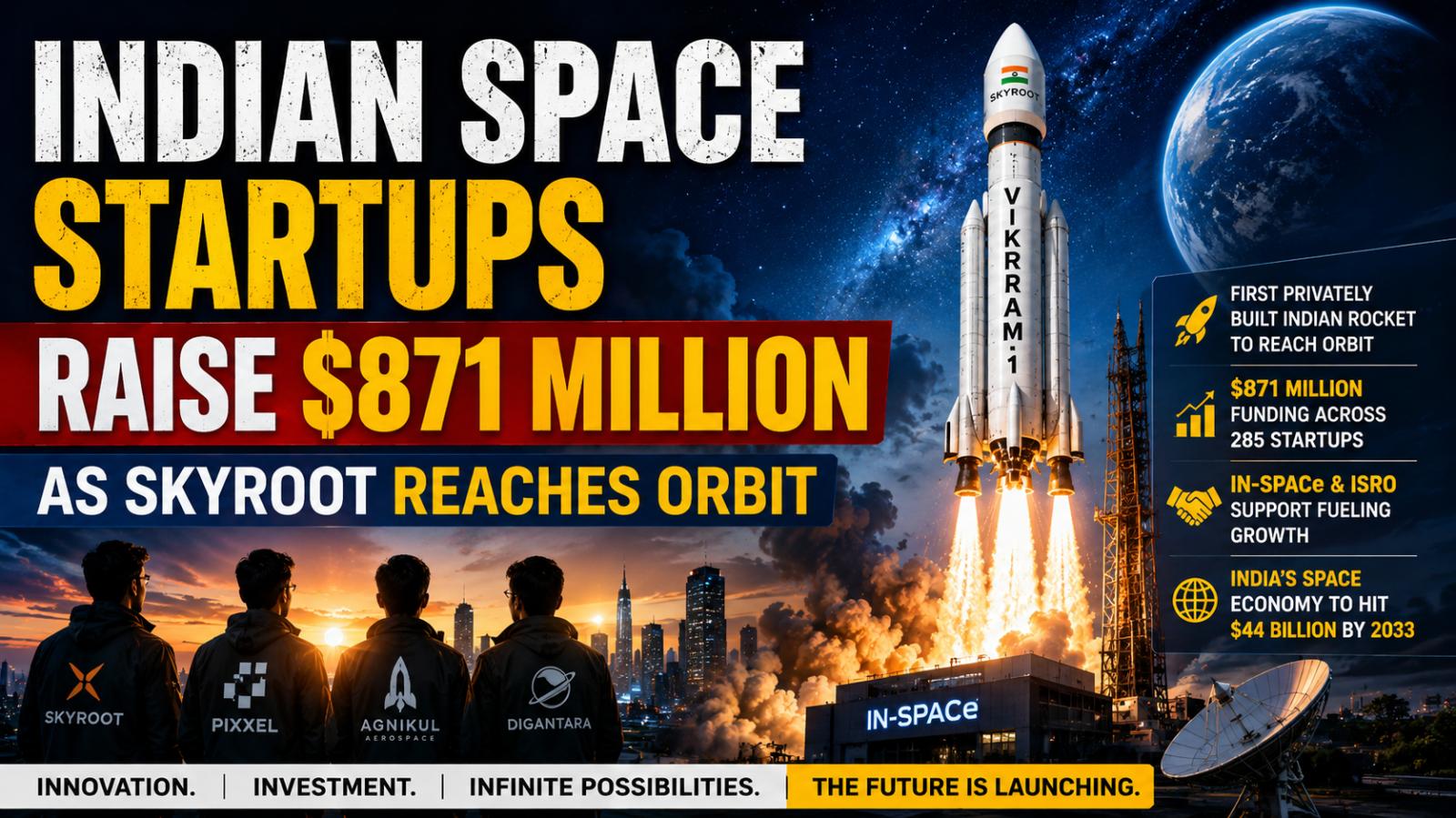
Indian spacetech startups have collectively raised $871 million across 285 companies, with Skyroot Aerospace leading the sector after Vikram-1 became the first privately built Indian rocket to reach orbit. The milestone signals growing investor confidence in India’s commercial space industry.
Skyroot’s Vikram-1 Marks a Turning Point
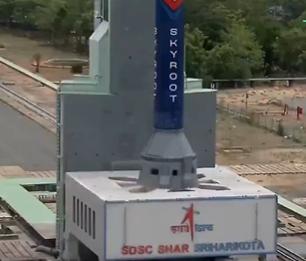
India’s private space sector reached a major milestone on July 18 when Skyroot Aerospace’s Vikram-1 rocket lifted off from Sriharikota. The seven-storey launch vehicle entered a 450-kilometre orbit and deployed four payloads, becoming the first privately built Indian rocket to successfully reach orbit.
The achievement went beyond technological success. It demonstrated that Indian spacetech startups can design, build and operate sophisticated space hardware rather than remaining limited to prototypes and business proposals. Skyroot’s success is expected to improve investor confidence in companies seeking larger funding rounds for infrastructure, manufacturing and commercial missions.
Watch: Vikram-1’s historic orbital launch from Sriharikota
Indian Space Startups Attract $871 Million
According to data from Tracxn, Indian spacetech startups have raised a combined $871 million across 285 companies. Skyroot leads the sector with approximately $150 million in funding, while Pixxel, Agnikul Aerospace and Digantara are among the other prominent companies attracting investor interest.
Funding in the sector has increased sharply over the past five years. Indian space startups raised about $43 million in 2021, while annual investment crossed $200 million in 2025. In 2026 alone, companies have reportedly secured $113 million across 24 funding rounds. The figures indicate that investors are gradually moving beyond early-stage experiments and supporting startups preparing to scale operations.
Government Reforms and ISRO Support Drive Growth
A major factor behind the sector’s expansion was the Union Government’s decision in 2020 to open India’s space industry to private participation. Through IN-SPACe, private companies can access ISRO’s launch pads, testing facilities, technical expertise and decades of research experience.
This public-private model has helped startups reduce development costs and avoid building every facility independently. India’s reputation for cost-efficient engineering has also strengthened the sector’s appeal. The country’s Mars Orbiter Mission reportedly cost around $74 million, significantly less than many comparable international missions. Similar financial discipline is now visible among private companies developing rockets, satellites and space-based services.
India’s Commercial Space Economy Expands
The commercial use of space is no longer limited to weather forecasting, navigation and earth observation. It now supports defence, telecommunications, data services, manufacturing, climate monitoring and digital infrastructure. This expanding demand is creating opportunities for startups across launch services, satellite manufacturing, geospatial intelligence and orbital monitoring.
India’s space economy is projected to grow from about $8 billion to $44 billion by 2033. However, the sector still faces a difficult transition from successful prototypes to commercially sustainable operations. Startups will need substantial capital, reliable launch schedules, international customers and strong manufacturing capacity to compete globally.
Skyroot’s Vikram-1 mission has provided evidence that Indian private companies can deliver working orbital technology. The next test will be whether the broader sector can convert technical success and rising investment into repeatable launches, stable revenues and long-term global competitiveness.