

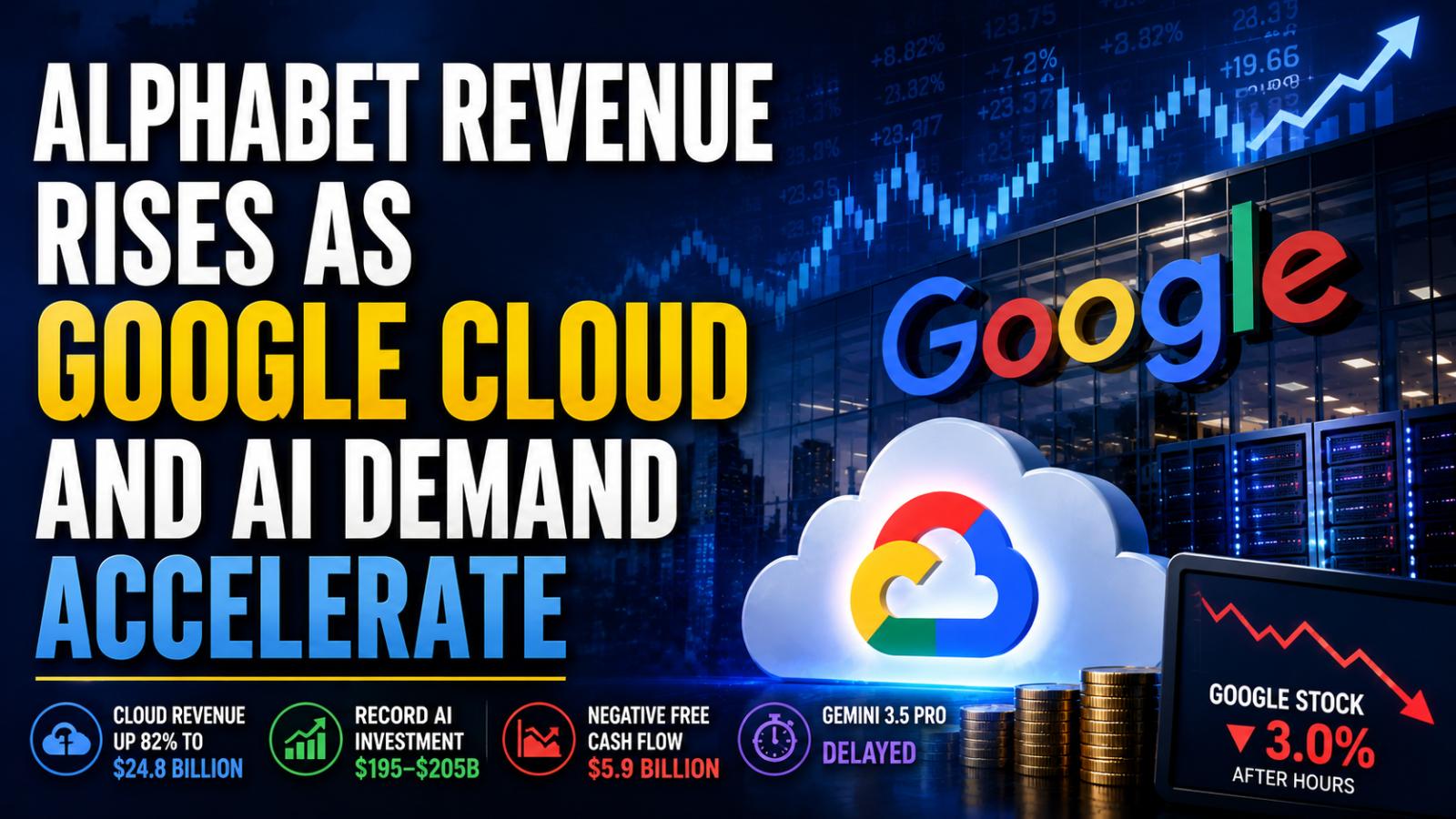
Alphabet reported a strong June-quarter performance as rapid Google Cloud revenue growth and resilient advertising demand lifted total sales above market expectations. The company generated $119.8 billion in quarterly revenue, compared with Wall Street estimates of around $116.9 billion. Google advertising revenue reached $81.6 billion, while adjusted earnings stood at $2.85 per share, slightly below the expected $2.89.
Google Cloud Revenue Leads Alphabet’s Growth
Google Cloud was the strongest part of Alphabet’s quarterly results, with revenue rising 82% from a year earlier to $24.8 billion. The increase reflected growing demand from companies using cloud platforms to train AI models, process data and deploy generative AI applications.
Alphabet said demand for computing power remained higher than the capacity it currently had available. This shortage has encouraged the company to accelerate the construction of data centres and expand its supply of servers, chips and networking equipment.
Google also began recording revenue from direct sales of its Tensor Processing Units. These specialised chips are designed for AI workloads and could help the company reduce its dependence on external suppliers while building a larger hardware business.
The strong performance also helped Google compete more aggressively with Amazon Web Services and Microsoft Azure. At the same time, Search, YouTube and other advertising services continued to generate solid revenue, showing that Google’s core advertising model remains resilient despite the rise of AI-powered search products.
AI Infrastructure Spending Raises Investor Concerns
Alphabet’s financial results were overshadowed by its rising investment in artificial intelligence. The company increased its 2026 capital expenditure forecast to between $195 billion and $205 billion, with spending expected to remain high as it expands AI infrastructure.
The company is directing funds toward data centres, AI servers, networking equipment and advanced chips needed to support Google Cloud, Gemini and other AI services. Management also indicated that capital spending could rise again in 2027 if customer demand continues to exceed supply.
These investments contributed to negative quarterly free cash flow of $5.9 billion. The figure worried investors because it showed how quickly Alphabet’s AI expansion is consuming cash, even as revenue continues to grow.
Alphabet shares fell around 3% in extended trading following the results. Wall Street is now looking for stronger evidence that the company’s record spending will produce higher profits, new revenue streams and a return to positive free cash flow.
Delays involving Gemini added to investor uncertainty. The release of Gemini 3.5 Pro was postponed while Google continued testing the model. The delay raised questions about the company’s progress in AI coding, reasoning and autonomous agent technology.
Chief Executive Sundar Pichai acknowledged that Google still needs to improve in coding and agentic AI. However, he said the company remained confident in its long-term AI strategy and confirmed that training had already started on Gemini 4.
Alphabet’s cloud and advertising businesses remain strong, but the company now faces pressure to prove that its massive AI investments can deliver sustainable returns. Future investor confidence will depend on faster product launches, continued Google Cloud growth and better cash flow performance.