
Vijay’s Rise Signals a Major Political Shift in Tamil Nadu
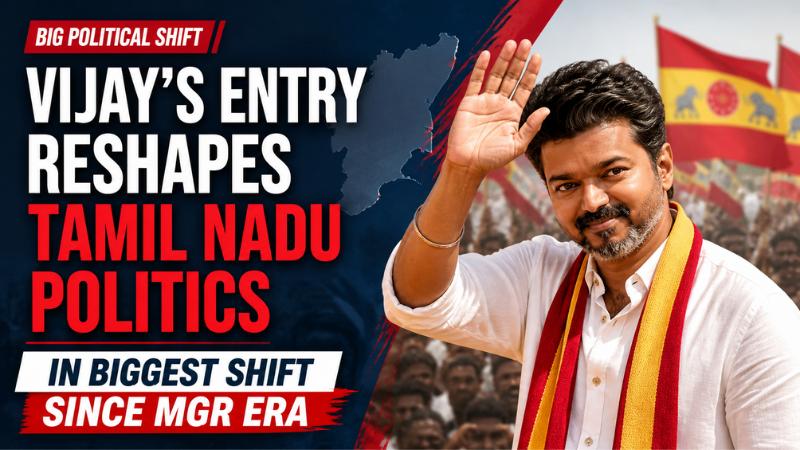
Tamil Nadu appears to be witnessing a rare political shift, with Vijay emerging as a disruptive force in a landscape long dominated by established Dravidian parties. For the first time in decades, the state is seeing the rise of a new political player that is not an offshoot of existing formations but a fresh challenge to the traditional order. His entry signals a break from the familiar two-party dominance that has defined Tamil Nadu politics for years.
The last major disruption of this scale was during the era of M. G. Ramachandran, who transformed cinematic popularity into political power. However, Vijay’s rise differs in key ways. Unlike earlier leaders who evolved within political ecosystems, he has entered directly, building a connection with voters without long-term political grooming. This direct engagement has helped him position himself as an outsider to the existing system.
This election cycle reflects a broader shift in voter sentiment. Rather than a typical anti-incumbency wave, there is a visible appetite for change and new leadership. Younger voters and urban populations, in particular, are showing increasing interest in alternatives beyond the dominance of the Dravida Munnetra Kazhagam and All India Anna Dravida Munnetra Kazhagam. Concerns around dynastic politics and governance have further contributed to this openness.
Vijay’s party, Tamilaga Vettri Kazhagam, has gained traction across regions, including key urban centres like Chennai. Early trends suggest that the party is not just participating but actively challenging established players in their strongholds. The support base appears to be driven largely by emotional connection, with women and younger voters forming a significant segment of this emerging backing.
While comparisons with past leaders are inevitable, Vijay’s rise represents a different kind of political phenomenon—less rooted in ideology and more in shifting public sentiment. As counting trends continue to evolve, the outcome remains uncertain. However, it is increasingly clear that Tamil Nadu’s political landscape is undergoing a transformation that could redefine its future trajectory.