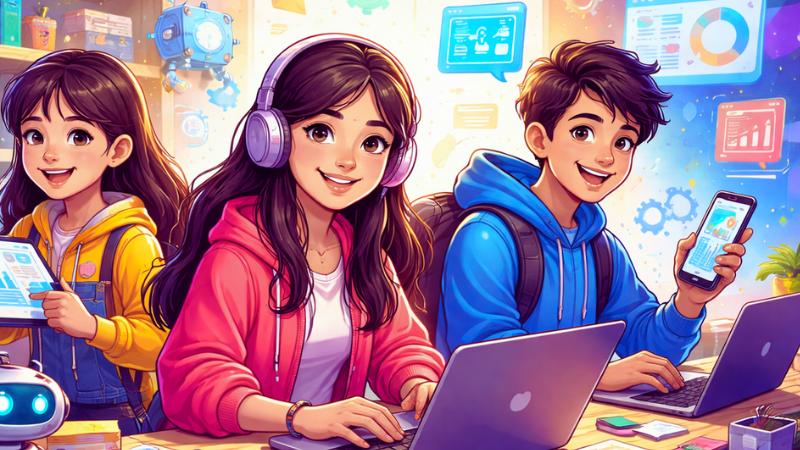

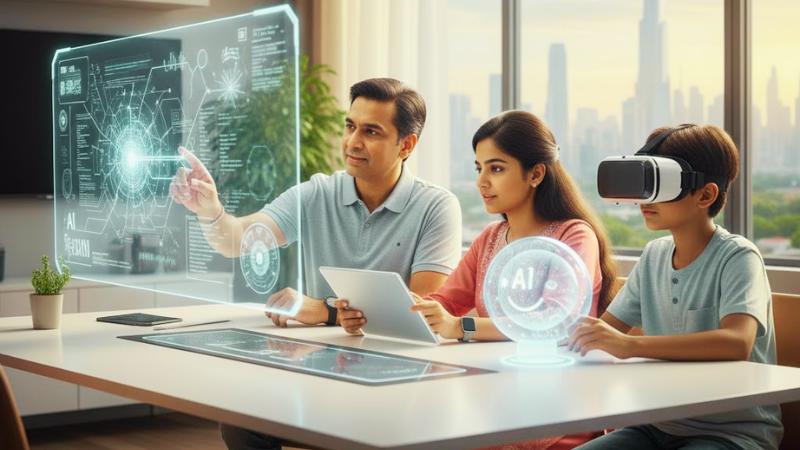
In today's digital world, artificial intelligence (AI) is transforming the way we live, work, and interact. As AI becomes an integral part of numerous industries, Indian parents are increasingly recognizing the importance of equipping their teenagers with AI skills. With the rapid rise of AI technologies, parents in India are actively guiding their teens to explore and learn AI, helping them to not only secure future job opportunities but also develop a mindset for innovation and problem-solving. Here’s a look at how Indian parents are supporting their children in navigating the world of AI.
1. Recognizing the Importance of AI Education
AI is rapidly becoming a dominant force in fields like healthcare, finance, robotics, education, and entertainment. Indian parents, who have always placed high value on education, are now acknowledging that AI literacy is crucial for their children’s future. Understanding the significance of AI in shaping the job market, parents are pushing for AI-related education as part of their teen's skill development.
Parents believe that AI skills can offer their children an edge in an increasingly competitive world. Whether it’s programming AI models, understanding machine learning, or mastering data analytics, these skills are no longer seen as optional but essential for career success in the 21st century.
2. Enrolling Teens in Online Courses and Workshops
With the growing availability of online learning platforms, Indian parents are taking advantage of affordable and accessible AI courses for their teenagers. Websites like Coursera, edX, Udemy, and Khan Academy offer specialized courses on AI, machine learning, and data science, which have become popular choices for teens looking to get started with AI.
Parents are encouraging their children to take part in workshops and online boot camps designed to teach teens AI programming and coding skills. These workshops are often interactive, offering a hands-on approach to learning and enabling students to build their own projects. Some of these workshops even focus on building AI applications, such as chatbots and recommendation systems, giving teens the opportunity to see their theoretical knowledge come to life.
3. Promoting Coding and STEM Education
Coding is the foundation of AI, and Indian parents are pushing their children to start learning programming languages early. Many teens in India are being introduced to coding through popular platforms like Code.org, Scratch, and Tynker, which offer beginner-friendly programming courses. Additionally, high school students are increasingly enrolling in coding classes focused on languages like Python, Java, and R, which are crucial for AI development.
Indian parents are also actively promoting STEM (Science, Technology, Engineering, and Mathematics) education by encouraging their children to take part in competitions and events like hackathons, robotics challenges, and coding Olympiads. These events provide teens with an opportunity to showcase their skills, collaborate with peers, and gain valuable real-world experience in AI and technology.
4. Encouraging Teenagers to Explore AI Careers
Indian parents are not just focused on academics; they are also guiding their teens toward potential career paths in AI. By introducing them to professionals and experts in the field, parents are opening up discussions about the wide range of career options available in AI, from data scientists and AI engineers to robotics developers and AI researchers.
Parents are also motivating their children to explore AI-driven industries that align with their interests. For example, if a teen has an interest in gaming, they may be encouraged to learn AI applications in game development. Similarly, teens interested in healthcare are being introduced to the applications of AI in medical diagnostics, personalized treatment, and drug discovery.
5. Supporting Hands-On Projects and AI Experiments
To further instill practical knowledge of AI, many parents in India are encouraging their teens to engage in hands-on projects and experiments. With access to affordable AI tools and platforms like TensorFlow, Keras, and OpenAI, teens can now create and test their own AI models. These tools are often beginner-friendly, offering step-by-step guides to help young learners build machine learning models, computer vision applications, or natural language processing systems.
Some parents are even helping their teens develop personal AI-driven projects like chatbots or smart home assistants. By encouraging these projects, parents ensure that their children are gaining practical skills while applying their knowledge in a real-world context. These projects are often a great addition to a teen’s portfolio, which can be beneficial when applying for internships or college programs in AI-related fields.
6. Fostering Creativity and Critical Thinking
Indian parents understand that learning AI goes beyond just technical skills. AI requires a strong foundation in critical thinking, problem-solving, and creativity. As such, many parents are encouraging their teens to approach AI from an interdisciplinary perspective, integrating concepts from mathematics, statistics, logic, and even ethics.
Parents are supporting their teens in exploring how AI can be used to solve real-world problems and foster innovation. For example, parents might encourage their children to use AI to address social issues such as climate change, healthcare access, or poverty. By fostering a creative mindset, parents ensure that their teens are not just learning AI for the sake of it, but are using it to make a positive impact on society.
7. Encouraging Ethical AI Awareness
With the rapid development of AI technology, the ethical implications of AI are becoming a major topic of discussion. Indian parents are guiding their teens to consider the ethical aspects of AI, including issues such as data privacy, algorithmic bias, and AI’s potential to disrupt industries and jobs. By encouraging teens to think critically about these ethical issues, parents are preparing the next generation of AI developers to create technology that is not only effective but also responsible and equitable.
8. The Future Outlook for AI Skills in India
As AI continues to evolve, the demand for skilled professionals will only increase. Indian parents are ensuring that their children are not left behind in this rapidly growing field. By providing access to AI resources, encouraging STEM education, and fostering a creative and ethical approach to technology, they are equipping their teens with the skills needed for the future.
In the long run, learning AI will empower Indian teens to take advantage of new job opportunities, become innovators, and play a key role in shaping the future of technology. By guiding their children to explore AI, Indian parents are not just preparing them for the future of work but also inspiring them to be leaders in the AI-driven world.
As AI becomes increasingly integral to the global economy, Indian parents are recognizing the importance of ensuring their teens are well-equipped with the skills to navigate this new landscape. Whether through online courses, hands-on projects, or discussions about ethical AI, parents are taking an active role in guiding their children to become proficient in AI. By doing so, they are empowering the next generation to thrive in an AI-driven world, ensuring that Indian teens are not just consumers of technology but creators, innovators, and problem-solvers in the field of artificial intelligence.