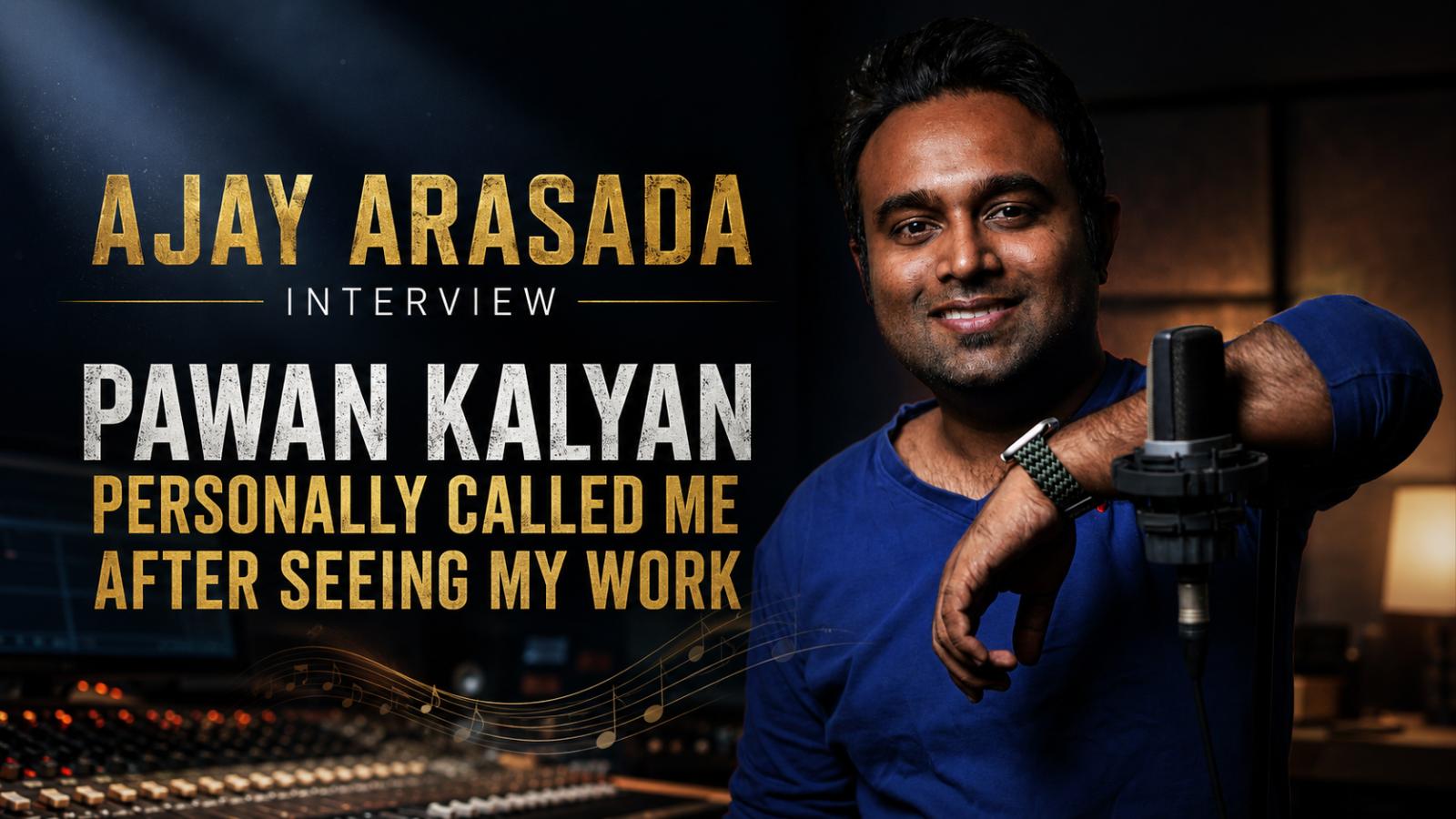
Could you tell us about your background and how your journey into music began?
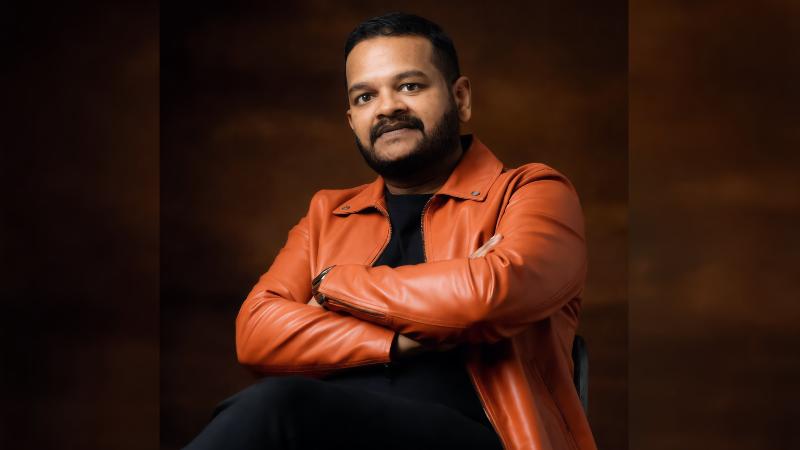
Ajay Arasada: Music and art have always been part of my family, so I grew up surrounded by them. I am originally from Vizag. Before entering the film industry full-time, I worked at TCS for nearly seven years. While I was still working there, I got opportunities to contribute to two films. Devi Sri Prasad has always been one of my biggest inspirations. My mother and my wife supported me strongly when I decided to pursue music professionally. Sricharan, who is also from Vizag, is a close friend of mine. He gave me an opportunity to work as a keyboard programmer for Goodachari, and that became an important step in my journey.
Did you face any major difficulties while working on smaller-budget films?
Ajay Arasada: I never really faced serious problems while working on smaller films. I was fortunate to work with good production houses, and payments were handled properly. Because of that, I did not experience many of the financial or professional difficulties that people often associate with small-budget cinema.
Are you consciously trying to create a unique musical identity?
Ajay Arasada: My main aim is to work across different genres and different kinds of stories. I want to do justice to the story rather than restrict myself to one particular musical style. If I am given a mass commercial film, I should be able to deliver strong mass music. If the story demands something subtle or experimental, I want to adapt accordingly.
Sometimes there is a perception that a composer from Tamil cinema will automatically bring something different, or that someone from Malayalam cinema will offer a fresh sound. I do not believe creativity should be judged that way. I want to explore different styles within my own work and continue evolving as a composer.
Does the budget of a film influence the kind of music you create?
Ajay Arasada: Different singers have different remuneration structures, but once I feel that a particular singer is perfect for my composition, I prefer to go ahead with that choice. At the end of the day, it is my song and I want it to remain memorable for years.
During the early phase of my career, I once requested a producer to bring in Anurag Kulkarni for a song, but he did not agree. Today, the situation has changed completely, and that same producer may not even be in a position to approach him easily. That is how the industry changes over time.
How different is composing music for theatrical films compared with OTT content?
Ajay Arasada: When we compose music and background scores, we usually design them with a theatrical experience in mind. The sound is created to have a certain impact inside a cinema hall. Eventually, when the same film moves to an OTT platform, some of that experience gets reduced.
For example, if Vikatakavi were experienced in a theatre, the sound and impact would feel very different. By the time it reaches OTT, I sometimes feel that nearly half of what we originally created in terms of sonic impact gets compromised.
What kind of impact do you think artificial intelligence will have on music?
Ajay Arasada: At this stage, I do not think AI has made a major creative impact on music. Even if you give AI several prompts, the generated output can often begin to sound similar. Some producers send us AI-generated tracks and ask us to create something along those lines. Sometimes we jokingly feel like asking them, “If that is the case, why not create the entire song using AI?”
AI can definitely be used as a tool by any technician. However, simply using AI does not automatically make someone a music director. Creativity, judgement, emotion and understanding of cinema still matter enormously.
You recently met Pawan Kalyan. How did that interaction happen?
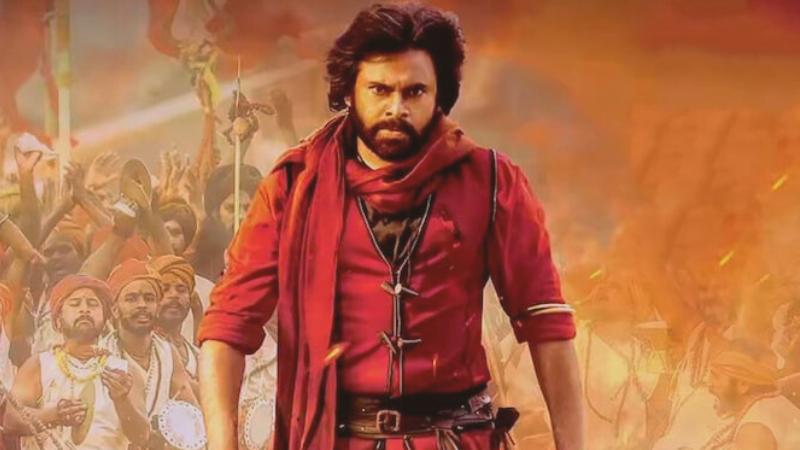
Ajay Arasada: I compose music for several Jana Sena programmes. Recently, when Pawan Kalyan garu met Prime Minister Narendra Modi, I created a special score connected to that occasion.
After seeing my work, Pawan Kalyan garu personally called me and spoke to me. He told me that we could potentially work together in the future, either for political programmes or for projects connected with the PK Creatives banner. For me, that was a very memorable and encouraging moment.
When did your association with Jana Sena begin?
Ajay Arasada: A friend of mine, Venkat Chikkala, works there as an editor. I received the opportunity through him. Bunny Vasu garu also gave me a lot of work and consistently supported me. That association eventually helped me get the opportunity to work on Aay as well.
Why are you rarely seen at public events or promotional gatherings?
Ajay Arasada: I am naturally an introvert. I do not enjoy going out and speaking extensively about my own work. I rarely attend events and I am not very comfortable promoting myself. I prefer to allow my music to speak for me, although I understand that self-promotion has become an important part of the industry today.
What went through your mind when you learned that Pawan Kalyan wanted to meet you personally?
Ajay Arasada: Initially, I was surprised and wondered why he specifically wanted to speak to me. Later, I received another call confirming the meeting. I assumed it would be a brief five- or ten-minute interaction where I would meet him, take a photograph and leave.
But when I reached there, he was alone and we ended up speaking for almost half an hour. We discussed several topics, including possible projects we could work on together. The meeting was much more personal and detailed than I had expected.
We heard there was also a funny moment involving your speaker. What happened?
Ajay Arasada: I carry a Bose speaker that looks similar to a coffee mug. Pawan Kalyan garu noticed it and asked me what it was. He picked it up, examined it playfully and laughed. He joked that it looked like a coffee cup and even asked whether I had brought coffee. Inside, I was thinking, “He is actually joking with me!” It was a small moment, but I was genuinely thrilled.
How do you find working with the current generation of filmmakers?
Ajay Arasada: Earlier, directors would usually explain a situation or concept clearly and then ask for a tune that suited it. With some newer directors, I occasionally notice that while they can describe the scene, they may struggle to communicate exactly what the scene is trying to convey, what the emotional core is, or what kind of song they actually need.
Sometimes even the overall concept of the film is not explained with enough clarity. For a song to work, the idea must first be clear. Unless the director communicates the concept properly, the lyricist cannot write effectively and the composer cannot create the right tune. Clear communication is extremely important.
What is your view on composers not receiving proper credit for their work?
Ajay Arasada: I have personally faced situations where credits were either missed or incorrectly attributed. During Aay, Ram Miriyala garu contributed two songs, while I worked on the remaining music. However, in some places, only his name appeared, and parts of the media reported it incorrectly.
Bunny Vasu garu made it a point to mention my name at various events and tried to correct the misinformation. Something similar happened during Save the Tigers, where another person's name appeared instead of mine. I strongly believe in giving proper credit. I always ensure that everyone who works with me receives recognition for their contribution.
Looking back at your decade-long journey, are you satisfied with your progress?
Ajay Arasada: Technically, it has been around ten years, but a significant portion of that period was affected by COVID, so the journey has not been completely continuous. Still, these years have given me confidence in my abilities. Today, I genuinely believe I can compose music for any kind of film. I am confident that if I get the opportunity to work on a large-scale commercial project, I can deliver exceptional music for it as well. That confidence is something I have earned through experience. Now, I am waiting for the right opportunity to take the next big step in my career.