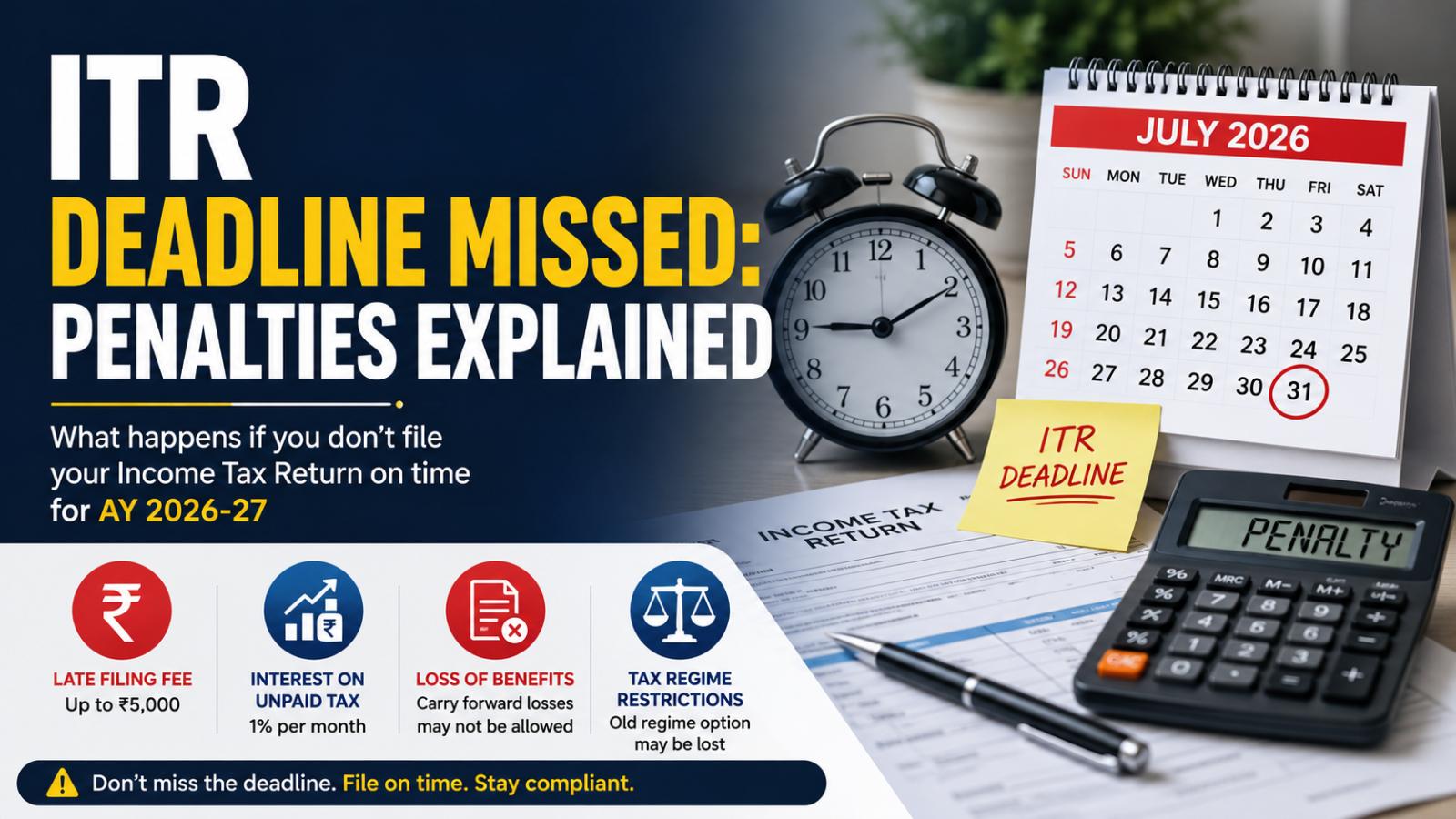
ITR Deadline Missed? Know the Penalties and Tax Consequences
Missing the applicable ITR due date for AY 2026-27 does not end your chance to file, but it may trigger a late fee, interest, and restrictions on carrying forward certain losses or choosing the old tax regime. Here is what taxpayers should know.ITR Late Filing Penalty AY 2026-27: What Taxpayers Could Lose
New Delhi, July 27, 2026: The ITR late filing penalty AY 2026-27 could make delayed tax compliance more expensive for taxpayers who fail to submit their income tax returns by the due date applicable to them.
While many individual taxpayers have received reminders mentioning July 31, 2026, the Income Tax Department’s transition guidance also refers to August 31 for certain non-audit cases. Taxpayers should therefore confirm the deadline applicable to their return form and income category instead of assuming that one date applies to everyone.
ITR Late Filing Penalty AY 2026-27 Explained
Missing the applicable deadline does not permanently prevent a taxpayer from filing an income tax return. A belated return for Assessment Year 2026-27 can ordinarily be filed on or before December 31, 2026, or before completion of the assessment, whichever is earlier.
However, delayed filing may attract a fee under Section 234F of the Income Tax Act, 1961. The fee is ₹1,000 when the total income does not exceed ₹5 lakh and ₹5,000 in other eligible cases.
The return for income earned during Financial Year 2025-26 is to be filed under Assessment Year 2026-27. Although the new Income Tax Act came into effect from April 1, 2026, returns relating to FY 2025-26 continue to be governed by the provisions of the Income Tax Act, 1961.
Interest May Apply When Tax Remains Unpaid
The late filing fee may not be the only additional cost. When tax remains payable after the applicable due date, interest under Section 234A may be charged at one per cent for every month or part of a month of delay.
The interest is calculated on the outstanding tax after adjusting for eligible advance tax, tax deducted at source, and other available credits. Taxpayers who have already paid their entire liability may therefore face different consequences from those who still have unpaid tax.
Certain Losses May Not Be Carried Forward
Delayed filing can also affect the ability to carry forward certain financial losses.
Capital losses and eligible business losses generally need to be reported through a return filed within the prescribed due date to remain available for adjustment against qualifying income in future years. A belated return could therefore increase a taxpayer’s future tax burden even when the immediate late filing fee appears manageable.
The precise treatment can differ depending on the nature of the loss. Taxpayers with share-market losses, business losses, or other complex income should verify their position before filing late.
Old Tax Regime Option Could Be Affected
The new tax regime is the default regime for eligible individual taxpayers. In non-business cases, taxpayers seeking the old tax regime generally need to exercise the option through an ITR filed on or before the due date under Section 139(1).
Eligible taxpayers earning income from a business or profession may also need to submit Form 10-IEA within the prescribed deadline. Missing the deadline could therefore restrict the ability to select the old tax regime for that assessment year.
Check AIS, Form 26AS, and Bank Details
Taxpayers should avoid filing an incomplete return merely to beat the deadline. Before submission, they should compare income and tax details appearing in the Annual Information Statement and Form 26AS with Form 16, interest certificates, bank records and other relevant documents.
PAN details, bank account information, deductions, tax payments, and the selected tax regime should also be checked carefully. The Income Tax Department advises taxpayers to reconcile discrepancies with their employer, bank, or tax deductor before completing the return.
Filing alone does not complete the process. An electronically filed return must also be verified through an available method such as Aadhaar OTP, net banking, a bank-account EVC, or a digital signature. The standard e-verification timeline is 30 days from the date of filing.
What Taxpayers Should Do Now
Taxpayers whose applicable deadline is approaching should collect their documents, choose the correct ITR form, and complete the filing without unnecessary delay.
A belated return remains available after the original due date, but late fees, interest, restrictions on carrying forward losses, and loss of tax-regime flexibility can make delayed filing significantly more costly.