

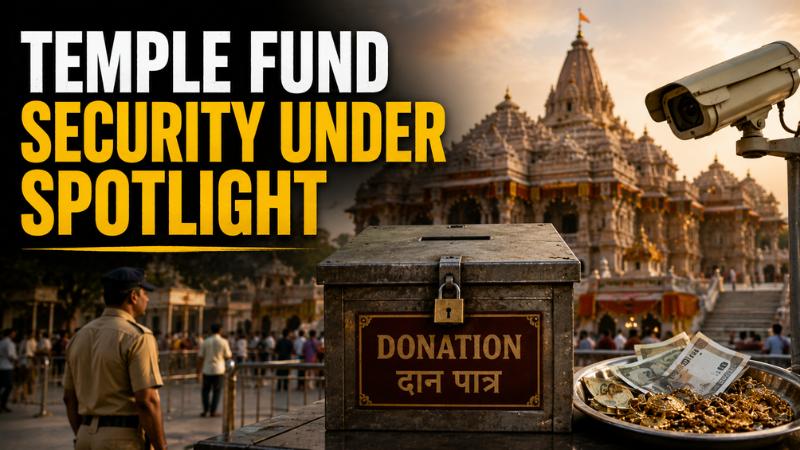
Ayodhya Donation Row Puts Temple Fund Security Under Spotlight
The Ayodhya Ram temple donation row has put the spotlight on how India’s major temples protect cash, gold, silver, and other offerings made by devotees. The issue has raised fresh questions about transparency, security, and accountability in temple donation management.
The row gained attention after reports claimed that investigators found lapses in the handling of offerings, CCTV monitoring, staff verification, and the movement of donations from the temple premises. While the probe continues, the larger debate has now moved beyond Ayodhya to how revered temples across India safeguard public faith and temple wealth.
Why Temple Donation Security Matters
Temples across India receive large volumes of donations every day through hundis, donation boxes, digital payments, and direct contributions. In major shrines, offerings often include cash, coins, gold, silver, and other valuables.
For devotees, these donations are not just financial contributions. They are expressions of faith. That is why any allegation of misuse or weak security can affect public trust deeply.
The Ayodhya Ram temple donation row has now brought renewed attention to the systems followed by major temples such as Tirumala, Shirdi, Siddhivinayak and Sabarimala.
Tirumala Follows Strict Hundi Counting Rules
Tirumala Tirupati Devasthanams is one of the most closely monitored temple administrations in India because of the huge volume of offerings it receives.
Donations collected through the hundi are moved to a dedicated counting facility. The process is carried out under supervision, with staff and volunteers following strict rules. Personal belongings, mobile phones, and unnecessary items are usually restricted in sensitive counting areas.
Security checks, CCTV surveillance, and monitored movement of offerings help reduce the risk of theft or diversion. The system is designed to ensure that offerings are counted, recorded, and deposited safely.
Tamil Nadu Temples Use Recorded Counting Systems
Many temples under the Tamil Nadu Hindu Religious and Charitable Endowments department follow structured donation-counting procedures.
In several major temples, donation boxes are opened in the presence of officials, temple staff, and verified volunteers. The counting process is monitored and documented. At some temples, video recording or live-streaming is used to improve transparency.
This helps temple authorities reassure devotees that offerings are handled in a controlled and accountable manner.
Shirdi And Siddhivinayak Depend On CCTV Monitoring
Major temples in Maharashtra, including Shirdi Sai Baba Sansthan and Siddhivinayak Temple, have long-established systems for handling donations.
Donation boxes are opened on fixed schedules, and counting is carried out under CCTV surveillance. Bank officials, temple representatives, and authorised staff are usually involved in the process.
Some counting areas also follow additional safeguards such as restricted clothing, entry checks, and exit checks to prevent the concealment of cash or valuables.
Sabarimala Shows Need For Regular Review
Sabarimala receives a large volume of donations, especially during the annual pilgrimage season. Offerings are moved to counting centres and handled under official supervision.
However, controversies linked to temple valuables in recent years have shown that even established systems need regular review. Stronger audits, better documentation, and independent monitoring are necessary to maintain public confidence.
The lesson is clear: temple security systems must keep improving as donations increase and public scrutiny grows.
Transparency Is Key To Devotee Trust
The Ayodhya Ram temple donation row has shown that temple administrations cannot depend only on traditional systems. They need clear records, strong CCTV coverage, staff verification, bank-level supervision, and regular audits.
Live-streaming, video documentation, and public-facing transparency measures can also help strengthen trust.
For major temples, the responsibility is not only to protect money and valuables. It is also to protect the faith of devotees who make offerings with belief and devotion.
As the Ayodhya investigation continues, the larger question remains: how can India’s major temples build stronger, more transparent systems to ensure that every offering is safely recorded and used for its intended purpose?