

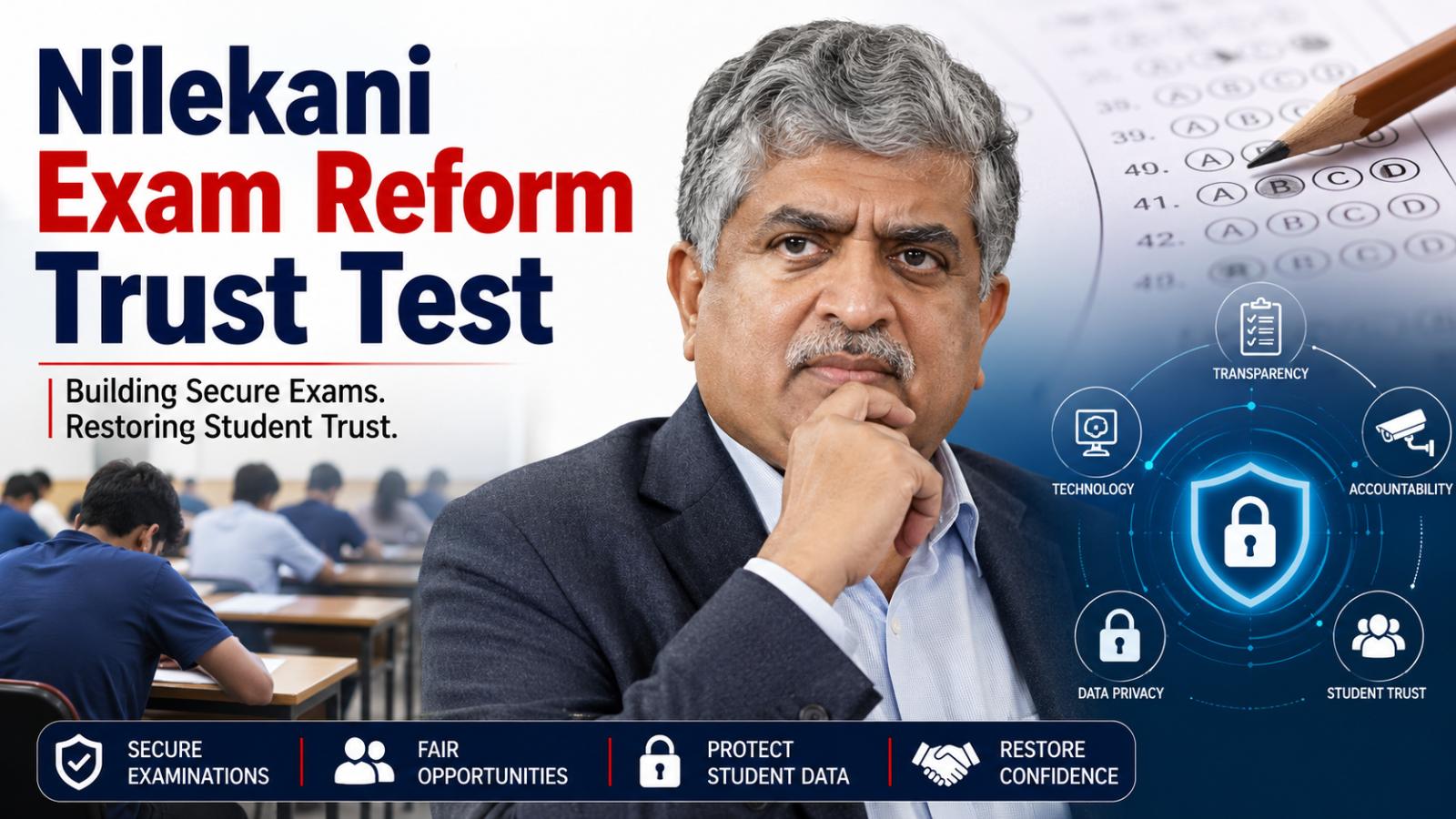
Nilekani-Led Exam Reform Panel Faces Trust and Privacy Test
PM Modi’s Nandan Nilekani-led examination reform task force will examine technology, security and structural changes for the NTA. The APAAR consent dispute shows that privacy, voluntary participation, and accountability will be vital to restoring student trust.
Nandan Nilekani Exam Reform Task Force Faces APAAR Trust Test
The Nandan Nilekani exam reform task force will examine how India can make its public examination system more secure, transparent, and trustworthy. However, the recent controversy surrounding consent for APAAR student IDs shows that the panel’s biggest challenge may not be developing new technology—it may be persuading students and parents to trust how that technology is used.
Prime Minister Narendra Modi announced on Sunday, July 26, 2026, that a high-powered task force on examination reforms had been constituted under Nilekani’s leadership. The Prime Minister emphasised the need for a reliable and transparent examination system that makes greater use of technology.
PM Modi Announces Nandan Nilekani Exam Reform Task Force
The panel has been established amid growing pressure to strengthen the integrity of national entrance examinations following the NEET controversy and allegations of question-paper leaks.
The multidisciplinary task force includes Nandan Nilekani, former ISRO chairman S Somanath, former Intelligence Bureau director Tapan Deka, IIT Madras director V Kamakoti, former school education secretary Anita Karwal and logistics expert Amrit Lal Meena.
The panel is expected to examine structural weaknesses in the National Testing Agency and recommend technological, administrative, and logistical reforms. Its work could cover secure question-paper distribution, examination-centre monitoring, candidate verification, cybersecurity, and accountability at different stages of the testing process.
The announcement followed sustained protests over examination irregularities. The government’s decision is therefore likely to be judged not only by the sophistication of its recommendations but also by whether those changes restore confidence among students.
APAAR Consent Ruling Provides a Critical Lesson
The Automated Permanent Academic Account Registry, commonly known as APAAR, was designed as a lifelong digital academic identity for students.
The official APAAR portal describes it as a permanent 12-digit identification number that can consolidate degrees, scholarships, awards, credits, and other academic achievements. The registration process requires parental consent when the student is a minor.
Despite those stated safeguards, concerns emerged after parents alleged that some schools were presenting APAAR enrolment as mandatory. Questions were also raised about Aadhaar authentication, long-term storage of children’s academic information and the ability of parents to refuse participation.
On July 20, 2026, the Supreme Court said parents could not be compelled to create APAAR IDs for their children. The court supported the inclusion of a clear opt-out mechanism and indicated that students should not face educational disadvantages when their parents decline enrolment.
Nilekani did not design or lead the APAAR programme. However, the dispute offers an important lesson for the examination reform panel: technology may provide convenience and efficiency, but weak consent procedures or unclear data safeguards can quickly undermine public confidence.
Technology Alone Cannot Prevent Examination Failures
The examination crisis cannot be treated exclusively as a software problem.
Digital tracking may help authorities monitor when a question paper is created, accessed, or transferred. Biometric verification may reduce impersonation, while CCTV systems may improve oversight at examination centres. Nevertheless, these measures cannot independently prevent collusion, administrative negligence, or failures involving officials, vendors, and local examination centres.
The task force will therefore need to consider both technological security and institutional responsibility. Every agency and contractor involved in conducting an examination should have clearly defined duties, audit trails, and consequences for lapses.
Student Data Privacy Must Be Part of Exam Reforms
Future examination systems could process large quantities of sensitive information, including identity details, biometric records, academic performance, and examination-centre data.
The panel must clearly define what information is collected, why it is needed, how long it is retained, and who can access it. Students and parents should also receive straightforward information about grievance procedures and options for correcting inaccurate records.
The APAAR experience demonstrates that consent cannot be reduced to a formality. It must be informed, voluntary, and supported by an accessible refusal or withdrawal process.
Restoring Trust Will Be the Real Test
Nandan Nilekani brings extensive experience in developing digital systems at a national scale. His background as an Infosys co-founder and the founding chairman of the Unique Identification Authority of India makes him a significant choice to lead the examination overhaul.
However, the success of the Nandan Nilekani exam reform task force will depend on more than creating a technically advanced testing platform.
Students need confidence that examinations are fair. Parents need assurance that personal information is protected. Examination authorities need clear accountability, and the government must communicate openly when failures occur.
The panel’s ultimate challenge is therefore twofold: preventing examination malpractice and rebuilding the trust damaged by repeated controversies. Technology can support that mission, but transparency, privacy, and accountable governance will determine whether the reforms succeed.