
DK Shivakumar Urges PM Modi to Send Central Team as Karnataka Drought Risk Deepens
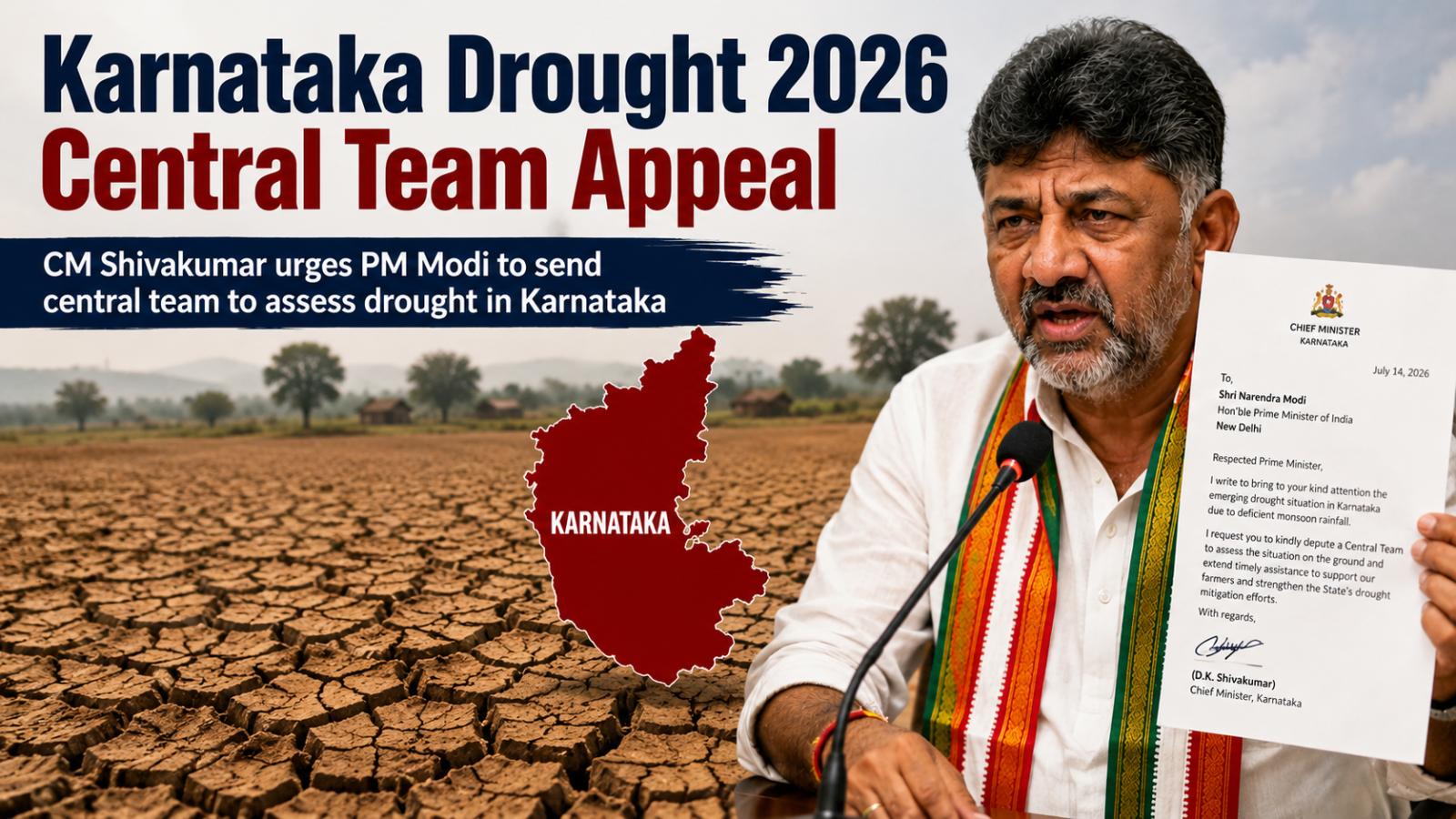
Bengaluru, July 15, 2026: Karnataka Chief Minister DK Shivakumar has written to Prime Minister Narendra Modi seeking the immediate deployment of a central team to examine the emerging drought conditions in the state. The request follows a reported 30% rainfall deficit, delayed kharif sowing, and low storage across Karnataka’s major reservoirs. Shivakumar said an early assessment could help the state secure timely assistance for farmers, drinking-water management, and drought mitigation.
Shivakumar, who took oath as Karnataka Chief Minister on June 3, said the state government had already initiated contingency measures but required support from the Centre as agricultural and water-related stress increased. The Prime Minister’s Office had earlier said the Centre would work closely with the new Karnataka government for the welfare of the state’s people.
Shivakumar Seeks Central Drought Assessment
In his communication to the Prime Minister, Shivakumar requested an on-ground assessment by central officials. He argued that such a visit would help determine the severity of the Karnataka drought 2026 situation and provide confidence to farming communities facing uncertainty over rainfall and crop cultivation.
According to the Chief Minister, deficient monsoon rainfall has begun placing pressure on agriculture, drinking-water supplies, and rural livelihoods. The state has consequently requested timely central assistance to strengthen its ongoing drought-preparedness measures.
However, the appeal concerns an emerging drought risk. It does not by itself amount to a formal drought declaration or confirmation that a central team has already been appointed. The Centre’s response to the request was awaited when the letter was received.
Karnataka Records 30% Rainfall Deficit
As of July 11, Karnataka had reportedly received 203 mm of rainfall against the normal level of 292 mm, resulting in a 30% seasonal deficit. The figures placed the state within the deficient-rainfall category.
The monsoon entered Karnataka on June 5 but reportedly required 17 days to cover the state fully, reaching all areas only by June 22. A prolonged break in monsoon activity was cited as one of the reasons for the slow progress.
The rainfall shortage has also been geographically widespread. Of Karnataka’s 31 districts, 18 had recorded deficit-to-large-deficit rainfall by July 11. At the taluk level, 141 of the state’s 240 taluks were reported to be experiencing deficient or severely deficient rainfall.
IMD’s Karnataka bulletin for the period ending July 8 had also classified the state’s overall seasonal rainfall as deficient, despite a week of above-normal rainfall in several areas. This shows that short spells of heavy rain had not fully erased the accumulated monsoon shortage.
Malnad Region Faces Highest Rainfall Shortage
Among Karnataka’s four meteorological regions, Malnad reportedly recorded the largest rainfall deficit at 34%. Coastal Karnataka followed with a 30% deficit, while North Interior Karnataka and South Interior Karnataka recorded shortages of 24% and 18%, respectively.
The Malnad rainfall deficit in 2026 is particularly concerning because the region contains important upper catchments that feed major river systems, including the Cauvery, Tungabhadra, and Bhadra.
Reduced rainfall in these catchments can limit reservoir inflows even when isolated districts receive intense showers. Continued shortages could therefore affect irrigation releases, drinking-water supplies, and hydropower production during the coming months.
Kharif Sowing Reaches Only 34% of Target
The agricultural impact is already visible in the progress of kharif cultivation. By the first week of July, sowing had covered approximately 28.36 lakh hectares, or around 34% of Karnataka’s seasonal target of 84.10 lakh hectares.
The kharif sowing delay in Karnataka has been linked to insufficient soil moisture and uncertainty over future rainfall. Many farmers may hesitate to invest in seeds, fertilisers, and labour when there is no assurance of adequate rain during critical crop-development stages.
Karnataka is particularly vulnerable because a large part of its agricultural land depends on rainfall rather than assured irrigation. The state’s letter said nearly 77% of its geographical area falls within dry or semi-arid zones, while approximately 84.79 lakh hectares are under rainfed farming.
Reservoir Storage Raises Water-Security Concerns
The state has also highlighted low storage in its major reservoirs. As of July 10, Karnataka’s 14 major reservoirs reportedly contained a combined 303 thousand million cubic feet, or TMC, of water.
This represented around 34% of their total gross storage capacity of 895.65 TMC. Reduced inflows into these reservoirs could affect irrigation, urban and rural drinking-water supplies, power generation, and water availability later in the agricultural season.
The state government has consequently decided to give the highest priority to conserving available reservoir water for drinking purposes. This policy could restrict the amount available for irrigation unless rainfall and reservoir inflows improve.
The water-allocation decision has also generated concern among some farmers. Demonstrations were reported in Mandya over demands for irrigation releases from the Krishnaraja Sagar reservoir, particularly for standing crops such as sugarcane.
Possible Impact on Pulses and Food Prices
Shivakumar warned that the consequences of a prolonged drought may extend beyond Karnataka. The state is an important producer of pulses, including tur dal, and a significant reduction in cultivation could affect supplies and prices at the national level.
Delayed sowing, inadequate soil moisture, and uncertainty over rainfall could encourage farmers to reduce cultivated acreage or shift to short-duration, lower-water crops. A wider monsoon slowdown across western and southern India has similarly raised concerns over agricultural sowing in several rain-dependent states.
Karnataka Begins Contingency Measures
The Karnataka government said it had issued crop advisories and prepared district-level contingency plans with agricultural experts. Departments have also been directed to introduce suitable drought-mitigation measures depending on local rainfall, crop, and water conditions.
These measures are expected to focus on water conservation, alternative crops, fodder availability, drinking-water preparedness, and support for farmers in severely affected areas.
Shivakumar said a central assessment would complement these state-level actions by providing an independent understanding of the rainfall shortage and its effects. An official visit could also form the basis for deciding whether additional financial, agricultural, or drought-relief assistance is required.
For now, the Karnataka government is awaiting the Centre’s response while monitoring rainfall, sowing progress and reservoir storage. The final severity of the Karnataka monsoon deficit in 2026 will depend heavily on rainfall during the remaining weeks of July and August.